WebSafe 3.7en.planet.wikimedia.org
|
|
🏠
A meeting at Wikimania 2026 pre-conference in Nairobi
A meeting at Wikimania 2026 pre-conference in Nairobi, Kenya

The Language Diversity Hub (LDH) is pleased to invite you to its first General Assembly (GA) a community-wide consultation and engagement space for everyone working on language diversity projects within and beyond the Wikimedia ecosystem.

The Language Diversity Hub is a proposed Wikimedia hub for affiliates and volunteers who are working on new language versions of Wikipedia or other Wikimedia projects. These will typically include indigenous, minority, marginalized and under-resourced language communities.

We warmly welcome both new and experienced volunteers to join us, with a special invitation to contributors working on smaller-language Wikipedia projects. Whether you are just beginning your journey or have been supporting your language community for years, this is an opportunity to connect, collaborate, and strengthen collective efforts around language equity.

We especially encourage those interested in learning more about the Language Diversity Hub, its mission, current initiatives, and pathways for engagement to take part. Participants will gain insight into how the Hub supports underrepresented language communities and explore meaningful ways to contribute, collaborate, and shape its ongoing work.

Date: Saturday, 18 April 2026
Time: 13:00 UTC
Format: Virtual (online)
Open to: All interested community members, affiliates, organizations, and individuals

The General Assembly is designed to:

  • Share updates on LDH programs, partnerships, and strategic direction
  • Consult communities on priorities, challenges, and opportunities related to language diversity
  • Create pathways for participation (e.g. volunteers, language ambassadors, working groups)
  • Strengthen transparency and accountability to the wider language community

Please note:
The General Assembly is not a governance or decision-making body and does not replace the LDH Steering Committee.

🔗 Registration: https://forms.gle/JMDTz2R5sqJ8JwrV7


Register to participate and spread the word within your networks.

Wikipedia turning 25 on January 15, 2026, is a moment in the history of free knowledge and the global Wikimedia Community. Most of us learnt that it was an effort that began as an ambitious experiment, which has grown into one of the world’s most widely used reference sources, sustained entirely by volunteers across languages, cultures, and continents. While to some, they were part of the cohort that ran the first pilot. Whichever category, we are all Wikipedians – and so are members of the Igbo Wikimedians Community.

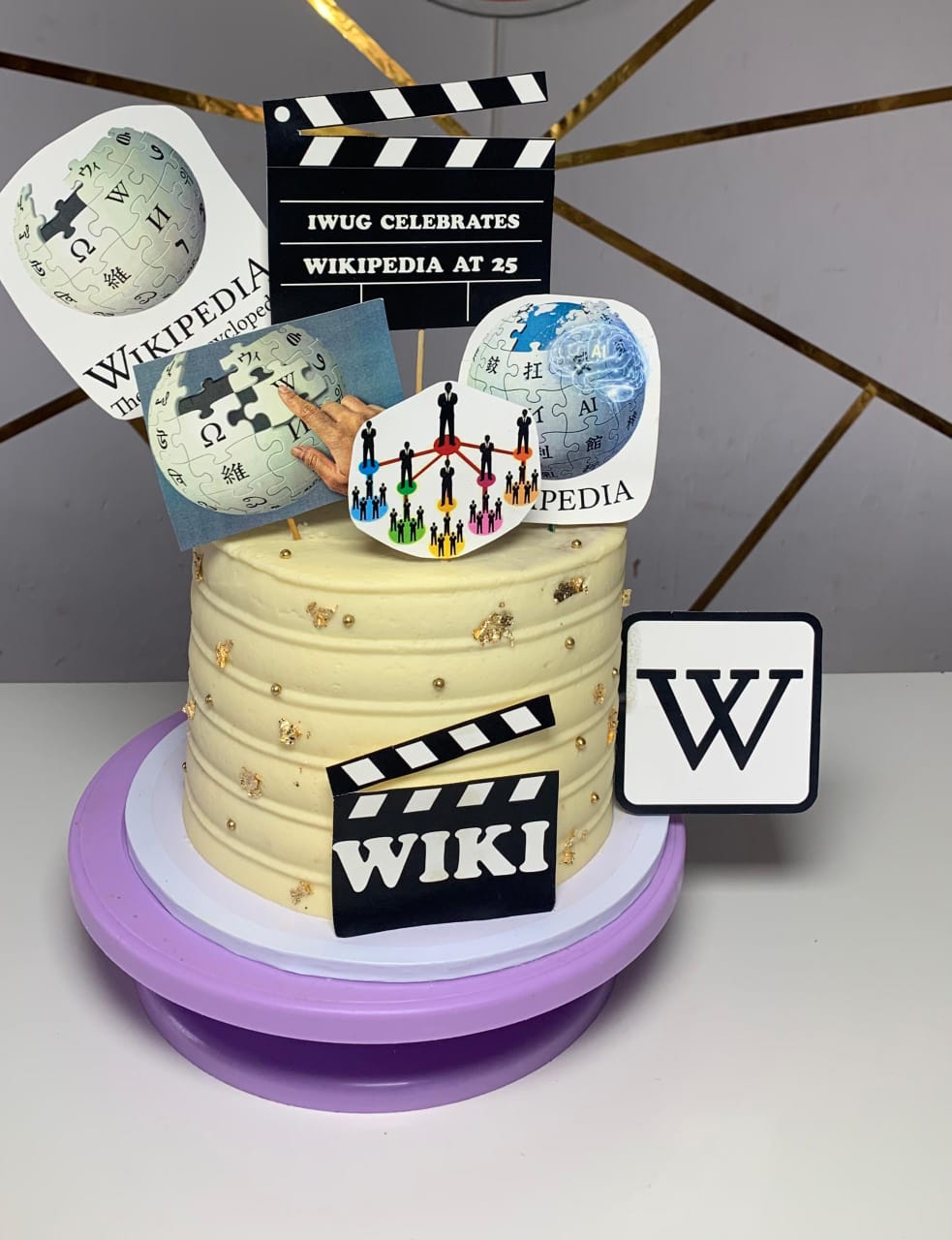
For the Igbo Wikimedians User Group, this anniversary was an opportunity not only to celebrate Wikipedia’s ever-present presence but also to reflect on the community’s own journey within the Wikimedia movement. Since its inception, Igbo Wikimedians have consistently marked Wikipedia Birthday celebration through virtual gatherings, however, for the first time, we celebrated Wikipedia’s 25th birthday hybrid – onsite (Abuja and Owerri) and online (the global celebration) with a high degree of community participation and intentionality towards expanding the scope of the celebration, combining the physical celebration with fun and interactive activities and joining the global virtual event in the spirit of unity to amplify impact, strengthen bonds among members, recognise volunteer contributions, and introduce new people to the Wikipedia project.

Event Highlights

The celebration took place in two different Igbo Wikimedians Communities but on the same day – January 10, 2026, featuring interactive engagements conducted in Igbo and English, ensuring accessibility and inclusivity for participants with different language preferences. The programme highlights included community conversations, interactive games, quizzes, birthday shoutouts from members, toasting to Wikipedia’s continuity, a happy birthday Wikipedia rendition, hearty cheers, cutting of cakes, and onboarding activities for new contributors. Each session was designed to be participatory, reflective, and celebratory, reinforcing the sense of shared ownership within the community.

Physical Celebrations: Abuja and Owerri

Abuja Meetup

The Abuja physical celebration was held on January 10, 2026, at the Enspire Hub, Merit House, Maitama. Community members gathered to commemorate Wikipedia at 25 in a relaxed but purposeful atmosphere. The session opened with reflections on Wikipedia’s global impact and on the specific role Igbo Wikimedians play in expanding free knowledge in Igbo. Participants engaged in interactive games and a Wikipedia-themed quiz that tested knowledge of Wikipedia history, policies, and fun facts about its evolution. These activities encouraged participation from both experienced editors and newcomers, sparking conversations and shared laughter. The meetup concluded with informal networking, discussions around contribution pathways, and a collective birthday moment – toasting and cutting of birthday cake – that reinforced the sense of belonging within the Abuja Igbo Wikimedia community.

Owerri Meetup

The Owerri celebration also took place on January 10, 2026, at Pinewood Hotel, Amakohia. Similar in spirit but distinct in its local flavour, the Owerri meetup brought together members of the Igbo Wiki Fan Club, Alvan and Igbo Wiki Fan Club, Imo State University, respectively, to celebrate, learn, and connect. Activities included storytelling and conversations about how Wikipedia has supported learning, research, and cultural documentation within the region. Participants took part in games and quizzes tailored to Wikipedia projects and Igbo knowledge, making the session both educational and engaging. New contributors were introduced to the Wikipedia project, with experienced members offering guidance on how to get started and remain active and was concluded with a photo session and cutting of the Wikipedia birthday cake.

Virtual Celebration, Community Shoutouts, and Wikipedia @25 Birthday Cakes Spotlight

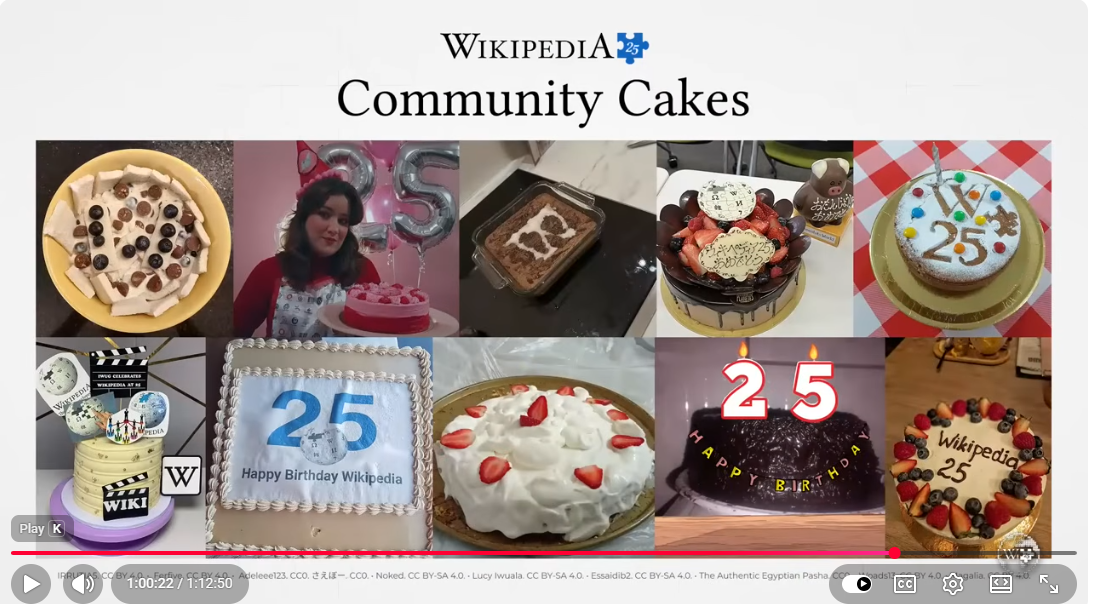
Screenshot Photos of the Wikipedia 25 birthday cakes, as spotlighted during the global celebration

The virtual celebration, held on January 15, 2026, provided an opportunity for broader participation beyond physical locations. Igbo Wikimedians Community members joined the global Wikimedia community online to reflect on Wikipedia’s 25-year journey, share experiences, and celebrate together despite geographical boundaries. A key highlight of the virtual event was the compilation and sharing of birthday shoutout messages submitted by community members in different languages – Igbo Wikimedians User Group community members also shared their birthday shoutouts in the Igbo Community. These messages captured diverse perspectives, from gratitude for Wikipedia as a learning tool, to pride in contributing in their local languages, and optimism about the future of the Wikimedia movement. The virtual session also reinforced continuity within the community, connecting long-time contributors with newer members and reaffirming shared goals for growth, sustainability, and collaboration. A special moment during the celebration was the spotlight on the Wikipedia @25 birthday cakes from different part of the world – Igbo Wikimedians cake inclusive. These cakes symbolised the joy and collective effort behind the anniversary, a reminder that local celebrations are an integral part of the global movement, and that every community, regardless of size, adds colour and meaning to Wikipedia’s shared milestones.

Organising Team and Community Effort

The success of the Wikipedia @25 Birthday celebration in the Igbo Wikimedians User Group was made possible through the collaboration of the organising team, @macocobovi, @king-christlike, @iwuala-lucy, @ogalihillary, @Chiziqa and @Chinemerem Prince. Their efforts in planning, coordination, facilitation, and documentation ensured that the celebration was inclusive, engaging, and well-executed. Beyond the organisers, the event was powered by community members whose participation, enthusiasm, birthday shoutouts, and contributions brought the celebration to life.

Looking Ahead

As Wikipedia moves beyond its 25th year, the Igbo Wikimedians User Group remains committed to strengthening its community, supporting contributors, and expanding Igbo-language content across Wikipedia project. The anniversary celebration was not just a look back at how far Wikipedia has come, but a reaffirmation of the community’s role in shaping its future.

Happy 25th Birthday, Wikipedia!

Here’s to many more years of free knowledge, collaboration, and community-driven impact.

On 11 February 2026, at the Autonomous University of Madrid (UAM), Wikimedia Spain, together with the madri+d Foundation, Rey Juan Carlos University (URJC) and Complutense University (UCM), held the conference ‘11F: Making the invisible visible: women, science and equality’ to mark International Day of Women and Girls in Science

The meeting brought together institutional leaders, experts in equality and representatives from the scientific field to  reflect  on the gender gap in science, the role of role models and the importance of free knowledge as a tool for reducing  inequalities. 

Science exists, but it is not always visible: the power of visibility  

Fátima Anllo,cultural researcher and member of Wikimedia Spain, opened the conference with a clear and powerful message: women are present in science, but for many reasons they remain ‘invisible’ in many fields. Anllo also recalled that the UAM  was the university where she began her scientific career, and that this meeting consolidates a collaborative relationship between  Wikimedia Spain, madri+d and the universities of Madrid.  

‘At Wikimedia Spain, we start from a very clear conviction: knowledge has enormous power to reduce inequalities.’ 

In her speech, Anllo stressed that accessible knowledge allows us to understand the world, make informed decisions and develop critical thinking, but that its transformative potential is activated when it is open, shared and reflects diverse perspectives.  

“A contribution cannot remain invisible.”  

Furthermore, 2026 is a special year for Wikimedia Spain because it marks the 25th anniversary of Wikipedia, a project that  demonstrates that collaborative knowledge can become a common good of enormous value. 

Spanish Wikipedia: a mission of its own, beyond translation  

Federico Morán, director of the madri+d Foundation, highlighted the strategic importance of Spanish Wikipedia.  

‘Correcting and increasing the number of entries and the presence of Spanish terms in Wikipedia… is not so much about translating entries, but rather about entries that are uniquely interesting to the Spanish-speaking world.’ 

Morán argued that Spanish Wikipedia should have its own identity and a mission beyond being a translated version of English Wikipedia. 

The gender gap begins at school: the challenge of role models  

Amaya Mendikoetxea, rector of the UAM, stressed that the lack of representation of women in scientific disciplines is a loss  for society. According to studies, girls’ lack of interest in science begins at school and is due to educational, social and cultural  factors: gender stereotypes, expectations and the absence of role models.  

‘That is why I have always argued that on 11 February it is so important to highlight the minority status of female engineers, as well as that of male teachers and nurses.’ 

Mendikoetxea insisted that inequality is not limited to STEM: it is also reflected in the over-representation of women in disciplines associated with care, the humanities and some social sciences. 

Equality at university: plans, responsibilities and results  

María Pilar Charro Baena, director of the URJC Equality Unit, defended the importance of linking equality with institutional  responsibility.  

‘We have prudent regulations, and all universities have equality plans.’ 

She also drew attention to the need not to associate a country’s lower level of development with the situation of women, citing a 2019 United Nations report that showed similar realities in many countries. 

From policies to results: the challenge of measuring impact  

Marta Evelia Aparicio García, director of the University Institute for Feminist Research (UCM), emphasised that the challenge  is not only to design policies, but also to evaluate their real impact.  

‘The challenge is not just to have policies, but also to see how they impact. To reflect on what we are doing.’ 

Aparicio García highlighted the importance of dismantling messages such as ‘this is not for you’, which limit women’s career  choices from childhood onwards. She also defended the role of universities in supporting families, offering resources and showcasing real and diverse role models. 

Awareness and alliances: feminism as global action  

Itziar Ruiz-Giménez, director of the Gender Equality Unit at the UAM, insisted on the need to raise awareness and change the  social structures that reproduce inequalities.  

“The good thing is these interconnections, these global alliances between feminist movements… The history of feminism shows that this is a global action.” 

Ruiz-Giménez also argued that it is necessary to offer tools for everyday resistance: care, alliances, self-support and solidarity. 

In addition, she pointed out that it is essential to introduce training with a gender and intersectionality perspective into  teacher training, to prevent teachers from reproducing biases in the classroom. 

General reflections: gender equality is also a question of structure  

In closing, moderator Laura Chaparro from the Spanish Foundation for Science and Technology summarised some of the ideas  that ran through the entire debate: raising awareness is essential, but it is not enough. 

Inequality in science remains structural and, in many cases, invisible.  

In certain fields, such as theoretical physics and philosophy, men continue to bein the majority. Science is not neutral: the questions that are researched, the priorities and the approaches also respond to historical inertia. Asking ourselves why we research what we research is part of the change.  

It was emphasised that 11 February is indeed necessary. The pay gap persists, even at the same professional level, and there is  still resistance to changing it.  

Equality does not only mean more women in STEM, but also more men in disciplines related to care and the humanities.  It implies shared responsibility and a review of anacademic model based on permanent availability, prolonged stays abroad and a 24/7 logic that is difficult to reconcile with personal life. 

Less visible but decisive dynamics were also pointed out:  

  • Scientific evaluation systems continue to penalise non-linear career paths.  
  • Microdynamics persist in meetings and classrooms that reproduce inequalities.  
  • Discrimination is often subtle, cumulative and everyday.  
  • Equality plans exist, but the challenge lies in implementing them and measuring their impact.  

The transformation must begin before university: supporting scholarship programmes, analysing why the presence of women in master’s and doctoral programmes is declining, training teachers with a gender perspective, and working with families and educational centres to dismantle stereotypes. 

Because talking about gender is not just about women. It is about reviewing structures. It is about ensuring spaces free from violence and harassment. It is about ensuring that women are present in all areas, not as an exception, but as the norm. 

Editatona: writing the missing history  

The day ended with an editatona on Wikipedia, led by Rubén Ojeda from Wikimedia Spain, focusing on women scientists, with the aim of increasing the visibility of biographies that remain invisible in the encyclopaedia.  

Because, as Fátima Anllo reminded us, a contribution cannot remain invisible. And the construction of free and diverse knowledge is a direct way to combat inequality.  

Wikimedia Spain, the madri+d Foundation and Madrid’s public universities reaffirm with this conference our common commitment to a more equitable, diverse and open science.  

Making women in science visible is not only a matter of recognition, but also of justice, academic quality and institutional responsibility.  

We will continue to work together to ensure that knowledge, in classrooms, in research and on Wikipedia, reflects all the diversity that already exists in our society. 


WikiCon Australia pre-conference event
, Ali Smith.

Join us in Canberra for a special panel session with Dr Terri Janke, who will present an overview of the Indigenous Cultural and Intellectual Property (ICIP) and Indigenous Data Sovereignty (IDSov) project she is leading for Wikimedia Australia.

This event is part of WikiCon Australia 2026 Canberra, the National conference for the Australian Wikimedia community.

Please register via Humanitix.

Open platforms, open minds, respectful practices: ICIP & IDSov Guide for Wikimedia Australia
AEST
Dr Terri Janke will present an overview of the ICIP and Indigenous Data Sovereignty project she is leading for Wikimedia Australia, followed by a panel discussion.

This one hour session will explore how galleries, libraries, archives and museums (GLAM) engage with ICIP and IDSov protocols, and how those intersect with open knowledge platforms such as Wikipedia, Wikidata and Wikimedia Commons. Dr Janke will share insights from the project to date and invite discussion on respectful, ethical and culturally appropriate approaches to managing and sharing Indigenous knowledge.

Following the panel we warmly invite members of the local GLAM community, along with Wikimedia contributors and supporters, to stay and continue the conversation over one hour of drinks and nibbles.

Please register via Humanitix.

Region: ACT
Location: Mabo Room, AIATSIS, Maraga Building

Share link: https://events.humanitix.com/open-platforms-open-minds-respectful-practices – or download calendar item (.ics)

Keywords: ICIP · IDSov · GLAM · WikiCon Australia


ACT

The Africa Wiki Women Leadership and Mentorship Fellowship Programme is back for its third cohort, empowering women across Africa to lead and contribute to Wikimedia projects. Running from January to June 2026, this six-month fellowship will give participants the skills, mentorship, and experience to make a real impact in open knowledge and leadership.

These are Africa Wiki Women Fellows, selected for the Leadership and Mentorship Fellowship Program 2026 (Cohort 3)

The African Wiki Women Leadership and Mentorship Fellowship (LMF) Program is dedicated to providing African women with tools to support and take on leadership roles within the Wikimedia Movement. 

The mission remains clear: to bridge the gender gap in leadership across Wikimedia communities in Africa, while supporting fellows to lead initiatives that promote equity, visibility, and diversity across Wikimedia platforms. The 2026 cohort will work closely with mentors and the broader Africa Wiki Women community to create a collaborative space where ideas and talents can thrive. Together, they will contribute to Wikimedia projects while strengthening their confidence and capacity for leadership. This year, we received 188 applications and selected 10 outstanding Fellows across Africa for the 2026 Africa Wiki Women Leadership and Mentorship Fellowship (Cohort 3).

Meet the 2026 Fellows

Salah Mel-Catherine Atuma (Cameroon) is a Wikimedian, researcher, and tech-driven community contributor passionate about digital inclusion and African representation online. She joined the Africa Wiki Women (AWW) Fellowship Program to engage in structured learning, community collaboration, and impact-driven contributions, bringing curiosity and discipline to her Wikimedia journey.

Since joining AWW, Salah has steadily built her confidence on-wiki, learning how Wikimedia systems operate and contributing with intention. She focuses on improving content quality, strengthening documentation, and ensuring African stories are told accurately and sustainably. She approaches her work like building a system: identifying gaps, conducting research, and making edits that enhance visibility of underrepresented knowledge.

“The Africa Wiki Women Fellowship Program feels like more than training; it’s a community that genuinely builds people. I’m inspired by how organized and supportive the AWW team is, and how they make learning feel possible for everyone, no matter where they’re starting from. Being part of AWW has pushed me to contribute more confidently and intentionally, and I’m excited to keep growing and giving back to the community.”
— Mel-Catherine

Lois Owusu-Afram (Ghana) is an entrepreneur, Social Media Manager for an NGO, and photography enthusiast with a growing interest in digital storytelling, open knowledge, and community engagement.

“I joined Africa Wiki Women to gain practical Wikimedia skills through mentorship and to strengthen my communication abilities. I am passionate about learning and connecting with diverse African women whose work creates meaningful impact. Through this fellowship, I look forward to growing as a contributor and making significant, sustained contributions to the Wikipedia ecosystem.”
— Lois

Emilia Modestus Nzilano (Tanzania) is a Wikimedian, IT technician, ICT literacy trainer, graphics designer, and NGO volunteer. She is committed to digital inclusion, community empowerment, and equitable access to information. Emilia believes knowledge should be open, accessible, and reflective of diverse African experiences, particularly those often left out of mainstream digital spaces.

Since joining AWW, she has been building her Wikimedia skills intentionally, contributing to improve content quality and documentation while ensuring African women’s voices are preserved online.

“AWW is a community that empowers growth. The support has boosted my confidence and helped me contribute more intentionally. I am grateful and excited to learn, collaborate, and network with people across Africa to bridge the gap between men and women in digital spaces.”
— Emilia

Keatlaretse Katrinah Moeng (Botswana) is a Wikimedian, Business Administrator for tech, and YALI RLC fellow. She is passionate about indigenous languages, women’s economic empowerment, and poverty eradication.

She joined AWW to work on bridging the gender gap while developing new skills in communication and community engagement. Keatlaretse believes in the power of open knowledge to advance African women’s empowerment. — Keatlarestse

Ntlafatso Veronicah Gaowele (Botswana) is an environmental scientist, grant writer, and Wikimedia volunteer contributing to English and Setswana Wikipedia, Wikiquote, Wiki Commons, and Wikidata. She focuses on women’s representation, climate action, and indigenous knowledge, co-leading campaigns like Art+Feminism and Wiki Loves Monuments, mentoring emerging editors, and promoting visual storytelling.

“I joined Africa Wiki Women, particularly the Mentorship and Leadership program, to enhance my skills while empowering women across Africa to share their voices on Wikimedia platforms. Through this fellowship, I aim to expand community impact projects connecting environmental sustainability, open knowledge, and women’s visibility online.”
— Ntlafatso

Ann Veronicah Wambui (Kenya) is a multimedia journalist and law student, working as a freelance journalist and communications consultant. She co-founded Getting BETA Together, an NGO empowering young women and children through peer-to-peer mentorship in health, finance, career development, and wellness.

Ann joined AWW, specifically the Podcast and Skill-Up departments, to strengthen her skills in online community engagement and leadership. She aims to create more inclusive digital spaces where women can engage in open, impactful conversations accessible from home. — Veronica

Ingrid Ngueumeni (Cameroon) is a computer science engineer and Customer Service officer passionate about STEM and finance. She is a member of the Wikimedians of Cameroon User Group and serves as program coordinator for the Central Région chapter. Ingrid contributes to French Wikipedia, Wikidata, WikiCommons, WikiQuote, and Vikidia.

“I joined the AWW fellowship to grow my knowledge, reduce the gap of women on Wiki, and improve projects that help women be more impactful and visible worldwide.”
— Ingrid

Mwale Mubanga (Zambia) is an early-career agriculturist with a background in Animal Science and a growing interest in climate-smart agriculture, open knowledge, and community development. Her work focuses on empowering women and youth in agriculture through storytelling, capacity building, and digital platforms.

“I joined Africa Wiki Women to learn, grow, and contribute meaningfully to the Wikimedia movement, particularly by supporting African women to tell their own stories and increase their visibility online. I hope to strengthen my Wikimedia skills, contribute to projects like the Skill Up Workshop and Africa Wiki Women Podcast, and become a community ambassador mentoring other young women and youth in Zambia.”
— Mwale

Adur Margaret (Uganda) is an educationist and social impact practitioner with a background in Business Studies with Education. She joined AWW to strengthen her skills in open knowledge advocacy, storytelling, and leadership, amplifying the voices of African women on Wikimedia.

“Through the Africa Wiki Women fellowship, I hope to grow as a mentor, support more women and girls to become confident contributors, and lead projects that increase the visibility of women in education, social impact, and grassroots community development across Africa.”
— Margaret

Dorcas Awinsongya Baba is a youth leader, climate change activist, social scientist, and SRHR advocate from Ghana. She is a Wikimedia volunteer who contributes to the English and Dagbani Wikipedia, Wikidata, and Wikimedia Commons, with a focus on climate action, women’s representation, and the promotion of local content. She is an active member of the Tamale WikiHub, where she supports trainings and moderates online activities.

Dorcas joined the African Wiki Women Fellowship to gain practical skills and knowledge to strengthen her contributions across Wikimedia projects, particularly in addressing the underrepresentation of women. She also seeks mentorship and opportunities to network with like-minded individuals to support her current and future contributions. Through the fellowship, she hopes to gain relevant knowledge on how to translate her passions—women’s empowerment, youth leadership, climate change, SRHR, and community development—into valuable, accessible information for public use.
— Dorcas

Conclusion

These 10 remarkable women bring diverse expertise, creativity, and commitment to open knowledge. Over the next six months, they will engage in mentorship, training, and community projects, contributing to Wikimedia while strengthening their leadership and advocacy skills.

Congratulations to the 2026 Africa Wiki Women Fellows (Cohort 3)! We can’t wait to see the impact they will make in open knowledge and across the continent.

Yak Shaving, part 3: Pari, Zelah, and Wikipedia

Wednesday, 18 February 2026 05:17 UTC

There’s a story behind every Wikipedia edit. This here is just one out of many millions. It starts from an award for LGBT reality TV stars and ends with Biblical Hebrew vowels and a village in Cornwall.

Apparently, there’s a thing called “Queerties”, an award given out by the Queerty magazine to LGBT media personalities, and one of the categories is “Reality TV star”.

A screenshot from Instagram: "QUEERTIES Reality TV star nominees". Photographs of Chrishell Stause (woman, Selling Sunset), Emira D'Spain (woman, Next Gen: NYC), Ezra Sosa (man, Dancing With the Stars), Fraser Olender (man, Below Deck), Gabby Windey (woman, The Traitors), Michols Peña (man, Southern Hospitality), Nany González (woman, The Challenge), Pari Kim (woman, Love on the Spectrum), Tiffany "New York" Pollard (woman, House of Villains), Zelah Glasson (man, Big Brother: UK).
I don’t know who any of these people are—except Pari Kim

I don’t follow the LGBT culture very deeply, so I wasn’t familiar with the Queerties before today, but I did watch all the episodes of Love on the Spectrum, and I do follow some of its participants on social media. And one of them, Pari Kim, is a nominee.

A screenshot from Instagram. A photo of Pari Kim, a young woman smiling and wearing eyeglasses and a purple T-shirt with an MBTA Commuter Rail locomotive.
I wish I could tell you the model name of the locomotive on Pari’s T-shirt, but I’m not nearly as big an expert in MBTA rolling stock as Pari is. Perhaps it’s EMD F40PH, but I’m not certain. I should probably buy me one of those T-shirts.

Pari is awesome for a lot of reasons, and the main ones are that like me, she lives in New England, and like me, she loves trains. Especially the MBTA Subway and the MBTA Commuter Rail, colloquially known in this area as “the T”.

I found out about this because I follow Pari on Instagram, but another name in the nominees list caught my eye: “Zelah”. It sounded Hebrew. It is quite common in the United States and some other traditionally Christian countries to give children obscure Biblical names. I got curious and found that in the Bible, it’s not a name of a person, but of a place. The English Wikipedia has an article about it: Zelah, Judea. Wikipedia articles usually have the native spelling of foreign names, but surprisingly, this English Wikipedia article didn’t have a Hebrew spelling.

I looked it up in the Hebrew Bible, and added the spelling to the English Wikipedia: צֵלַע. It perplexed me a bit that it’s spelled with -h in the end, even though the original name doesn’t end with ח or ה, which are usually transliterated as h, but with ע, which is usually not transliterated in the end of the word, as in Joshua, Bathsheba, and Elisha. I should explore why is it like that.

Anyway, I added the Hebrew spelling to the English Wikipedia article. But I wanted to be more thorough, and I checked in which other language there’s an article about this Biblical place. The only such language was Russian.

The Russian article was more curious. It did have Hebrew spelling in the beginning, but it was written backwards! The article’s author probably didn’t really know Hebrew and tried to write it correctly from right to left, but got doubly confused. I fixed it, but then I noticed that the name appears in the article again, also written backwards and making an incorrect claim: that a variant of this name “Zelah Eleph” is written in one word in Hebrew. It may be written as one word in some ancient translations, but not in Hebrew—it’s definitely two words in the Hebrew text. So I fixed that, too.

As I was writing this blog post, I double-checked the Hebrew spelling of that name in the Bible and realized that I actually wrote the vowel signs incorrectly: it’s not צֵלַע, but צֵלָע. So I fixed them yet again.

As a little follow-up, I checked for other people and things named “Zelah” in Wikipedia. I didn’t find much, but there’s a village with that name in Cornwall. Wikipedia says that the origin of this name is uncertain, and the Biblical place is one possibility. I didn’t have much to add to that, but I did notice that the articles mentions Akademi Kernewek, the organization for the Cornish language, and there was no link from the article about the village to the article about the organization. So I added it. It’s a tiny thing, but it will make finding the article about the organization a little bit easier.

And that’s really the point. People sometimes wonder why on Earth do we invest our free time in writing about obscure things on Wikipedia. Here’s my motivation: I learned about a Hebrew name that I didn’t know, and I had to dig through Biblical verses, concordances, and dictionaries to find its correct spelling. Now that I added the Hebrew names to the Wikipedia articles, it will be a bit easier to learn for the next person who is curious about it. Making it easier for other people to learn things that interested me is my motivation.


In case you haven’t figured it out yet, there’s another thing in which Pari Kim is like me—we’re both autistic. I figured it out myself only very recently. The next post on this blog will probably be about that.


Previous “Yak Shaving” posts:

Wikimedia Foundation Bulletin 2026 Issue 3

Tuesday, 17 February 2026 23:33 UTC

Here is a quick overview of highlights from the Wikimedia Foundation since our last issue on January 30. Previous editions of this bulletin are on Meta. Let askcac@wikimedia.org know if you have any feedback or suggestions for improvement!

Highlights

  • Wikipedia LibraryWikipedia Library gained new content partnerships, restored access to the British Newspaper Archive, and added an Arabic language academic resource with more than 7 million records.
  • Gender gap: The Celebrate Women 2026 campaign will run from March 1–31 to advance the achievements of the women’s rights and gender equity movement globally.
  • Annual Planning: The Annual Plan is the Wikimedia Foundation’s description of what we hope to achieve in the coming year. We invite you to shape this plan together with us. Between now and the end of June 2026, we will have continuous conversations about how global trends may shape our future, how we can experiment, adapt and respond together.

Annual Goals Progress on Infrastructure

See also newsletters: Wikimedia Apps · Growth · Product Safety and Integrity · Readers · Research · Wikifunctions & Abstract Wikipedia · Tech News · Language and Internationalization · other newsletters on MediaWiki.org

  • Patrolling improvements: A new feature available on Special:Contributions shows temporary accounts that are likely operated by the same person, and so makes patrolling less time-consuming.
  • WikifunctionsHow Abstract Wikipedia articles can be integrated into Wikipedia language editions to enable Wikipedians to write an abstract article once and have it available in many languages.
  • Suggestion Mode: A new Beta Feature for the VisualEditor, Suggestion Mode, is now available on English Wikipedia for experienced editors. This features proactively suggests actions that people can consider taking to improve Wikipedia articles, such as “add citation”, “improve tone”, or “fix an ambiguous link”.
  • WDQS Blazegraph Migration: As part of the migration away from Blazegraph (the current backend of the Wikidata Query Service), an initial evaluation of open-source triple store candidates has been completed. Using the published evaluation methodology, performance, stability, and compatibility was assessed.
  • Tech News: Latest updates from Tech News week 06 and 07 include the new Watchlist labels feature that allows logged-in contributors to organise and filter watched pages in ways that improve their workflows. They also link to the 44 community submitted tasks that were resolved over the last two weeks.

Annual Goals Progress on Volunteer Support

See also blogs: Global Advocacy blog · Global Advocacy Newsletter · Policy blog · WikiLearn News · The Wikipedia Library · list of movement events

Annual Goals Progress on Effectiveness

See also: Progress on the annual plan

Wikimedia Futures LabReflections from a Wikimedian who attended the Wikimedia Futures Lab.

Other Movement curated newsletters & news

See also: Diff blog · Goings-on · Planet Wikimedia · Signpost (en) · Kurier (de) · Actualités du Wiktionnaire (fr) · Regards sur l’actualité de la Wikimedia (fr) · Wikimag (fr) · Education · GLAM · Milestones · Wikidata · Central and Eastern Europe · other newsletters

Subscribe or unsubscribe to the Bulletin

Picture a parasite. The animal you picture probably isn’t the same as what someone else does, it probably fits E.O. Wilson’s description: “predators that eat prey in units of less than one”. 

But the hoverfly Microdon mutabilis is a different kind of parasite. Adult flies linger close to ant colonies, and their larvae feed on their eggs and larvae. Rather than being a parasite in the typical form, they are social parasites — in essence, very bad houseguests who exploit the social bonds of an ant colony. 

When Saty Paynter-Tavares had to pick a Wikipedia article to improve as part of her Insect Diversity and Evolution course, Wikipedia’s short article on Microdon mutabilis seemed like an obvious choice.

Paynter-Tavares is a senior and entomology major at Cornell University. In the semester before she did the Wikipedia assignment, she worked on a curation project working on flies in the genus Microdon and found their biology and life history to be fascinating.

Female Microdon mutabilis flies use chemicals produced by the ants to locate a suitable nest for laying their eggs. Their small, slug-like larvae fly under the radar while wreaking havoc on ant eggs and larvae since their hosts apparently can’t recognize them as invaders.

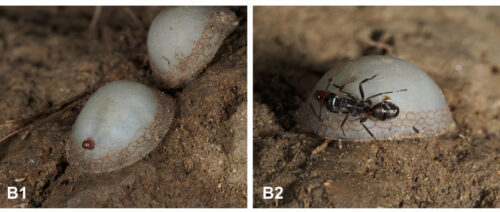
Microdon mutabilis larvae with a worker of Formica cunicularia, one of their host species.
Microdon mutabilis larvae with a worker of Formica cunicularia, one of their host species. Image by Andrea Di Giulio, uploaded by SPaynterTavares, CC BY 4.0, via Wikimedia Commons.

Reflecting on her goals for the project, Paynter-Tavares said, “I really wanted to highlight the life history and biology of Microdon mutabilis — its host specificity and myrmecophilous lifestyle is one of the quintessential features of this species and is what makes it so interesting. There are a lot of avenues for further research associated with these traits alone.”

Anyone who’s ever been a student is familiar with the challenge of getting big projects completed on time. This can be doubly challenging on Wikipedia, where in addition to the desire to find one more source, you’re surrounded by Wikipedia itself with its innumerable rabbit holes. With that in mind, Wiki Education designed the Wikipedia assignment to mitigate this problem. 

As Paynter-Tavares put it, “We were fortunate to have a timeline and activities provided to us, so it was easy to stay on track by completing smaller tasks throughout the semester. I first assessed the original article to see what was already available, then I conducted research and jotted down notes from peer reviewed sources I consulted in a separate document. By having all the information laid out for me in bullet points, it was a lot easier for me to synthesize the information and flesh out the article.”

As they contribute to Wikipedia, students expand the body of information that’s out there for people to use as a starting point for further work. In the case of this hoverfly, there’s a lot that’s still unknown, and students like Paynter-Tavares help to highlight the research still needed.  “I wanted to add to the repertoire of easily accessible knowledge to highlight the potential for further systematics and conservational studies for this species,” said Paynter-Tavares.

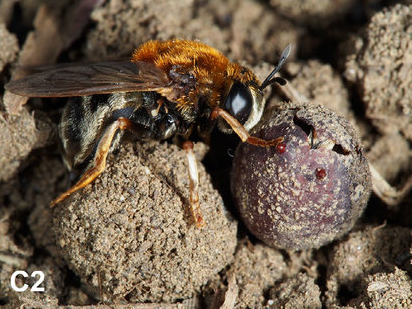
Newly-emerged adult fly with pupae.
Newly-emerged adult fly with pupae. Image by Andrea Di Giulio, uploaded by SPaynterTavares, CC BY 4.0, via Wikimedia Commons.

Microdon mutabilis can only be distinguished from Microdon myrmicae, a closely-related species, by the anatomy of the pupa. Until 2002 they were both thought to be part of a single species. The article said this before Paynter-Tavares started improving it, but it did so in a manner that was neither particularly informative nor accessible: “See references for determination.”

Here again, Paynter-Tavares had something important to contribute. “I already have a strong background in the biological sciences, but this article was helpful for communicating my knowledge in a way that is accessible to those who might not have a strong science background.”

In writing for more general audiences, she also built skills that might be useful in her future. “I see myself being most fulfilled in a career involving evolutionary biology and scientific outreach, and would love to work at a zoo, museum, or research station.”

Finally, doing this kind of work engages students in what they’re writing while giving them agency.

Reflecting on her experience, Paynter-Tavares said, “I really enjoyed this assignment compared to a traditional assignment. It was a lot easier for me to be engaged because it was largely self-driven on a topic that I found interesting.” 

Not only was she able to find an interesting topic relevant to her major in entomology, but she also appreciated the research and writing process, all building up to her article contributions.

“I enjoyed compiling all the information that I learned into one cohesive document,” Paynter-Tavares explained. “It was really satisfying to see my article come to fruition after the countless hours of researching and drafting.”


Our support for STEM classes like Saty Paynter-Tavares’ is available thanks to the Guru Krupa Foundation.

Interested in incorporating a Wikipedia assignment into your course? Visit teach.wikiedu.org to learn more about the free resources, digital tools, and staff support that Wiki Education offers to postsecondary instructors in the United States and Canada.

Language preconference group photo Image by Tochiprecious CC BY-SA 4.0

We are excited to announce that scholarship applications are now open for the Language Diversity Conference 2026, taking place 2–4 October 2026 in Accra, Ghana.

The Language Diversity Conference brings together Wikimedians, language activists, technologists, researchers, and community organisers working to strengthen linguistic diversity within and beyond the Wikimedia movement. The conference will focus on collaboration, knowledge exchange, and building sustainable, inclusive language communities.

To ensure broad and equitable participation, we are offering scholarships to support selected attendees with travel and accommodation costs.

Who should apply?

We invite applications from:

  • Active contributors to Wikimedia language projects
  • Members of Wikimedia affiliates, thematic groups, and user groups
  • Individuals working on language revitalization or documentation
  • Community organizers supporting under-represented languages
  • Anyone interested in starting a Wikimedia project for their language

Whether you are an experienced contributor or just beginning your Wikimedia journey, we encourage you to apply.

What does the scholarship cover?

Scholarships are intended to offset:

  • Round-trip travel to Accra, Ghana
  • Accommodation during the conference
  • Conference participation costs

Full details about eligibility, coverage, and selection criteria are available on the Meta-Wiki Language Diversity Conference Scholarship page.

We can provide support with the visa process; however, we cannot guarantee timely visa approval. Please ensure you have a valid passport for travel, as passport-related costs are not covered.

Scholarship expectations

Scholarship recipients will be asked to:

  • Volunteer for at least one shift during the conference
  • Actively participate in conference sessions and community discussions
  • Share learnings with their communities after the event

Important deadline

Applications close on 13 March at 23:59 UTC.

This is a firm deadline. Late submissions cannot be accepted, so we strongly encourage applicants to submit early.

How to apply

Complete the online scholarship application form here:

All information provided will be kept confidential and reviewed only by the Scholarship Committee and organising team for the purposes of awarding scholarships and planning travel logistics.

If you have any questions, please contact us at:
languagediversitycon@gmail.com

We look forward to welcoming a diverse group of language advocates and Wikimedians to Accra in October 2026. Join us in building inclusive communities through language.

A1 Radio, Bolga FM champion Gurene Wikipedia

Tuesday, 17 February 2026 07:00 UTC

Two prominent media houses, A1 Radio and Bolga FM, have taken active steps to raise awareness about Gurene Wikipedia, a community-driven initiative aimed at preserving and promoting the Gurene language online.

During recent discussions on air, the Project and Logistics Lead, Felicia Ayeti (Wiki username: Amoramah), called for sponsorships; including mobile phones, laptops, and cameras, to strengthen the volunteers’ efforts and broaden the reach of the platform.

Miss Ayeti emphasised that access to these resources is important for documenting and sharing knowledge in local languages.

The radio hosts applauded the volunteers for their dedication and urged indigenes, intellectuals, and regional educational directors to support the project and make use of the growing repository of locally sourced educational materials.

The initiative comes at a time when Education Minister Haruna Iddrisu recently highlighted the importance of teaching primary school pupils in their local languages, emphasizing that early education in native tongues fosters better comprehension, literacy, and cultural preservation.

Community leaders noted that platforms like Gurene Wikipedia can complement these national goals by providing freely accessible content in local languages, helping both educators and learners.

These efforts underscore the community’s commitment to promoting local languages, encouraging volunteerism, and ensuring that technological tools are leveraged to preserve Ghana’s linguistic heritage.

Language and Internationalization/Newsletters/10

Tuesday, 17 February 2026 01:37 UTC

Welcome to the January 2026 edition of the Language and internationalization newsletter by the Wikimedia Foundation Wikimedia Language and Product Localization team! This newsletter provides you with quarterly updates on new feature developments, improvements in various language-related technical projects and support work, community meetings, and ideas to get involved in contributing to the projects.

Subscribe to the newsletter

Key highlights

Language Support for New and Existing Projects and Languages

translatewiki.net is a platform for gathering translations of interface messages for Wikimedia and other open-source projects. This quarter, 17 new projects, including Lingua LibreBroomstick and Lexica, and 2 languages, Shughni [1] and Hyam [2], were added.

In addition, 3 new languages from the African continent, Bole [3], Jju [4] and Bono [5], primarily spoken in Ghana and Nigeria and totaling over 2 million native speakers, were added to MediaWiki. This lays the groundwork for communities to contribute to future Wikimedia projects in their native languages.

Volunteers also made important contributions, including adding Hokkien Hàn-lô writing script [6] and changing numeral symbols in Levantine Arabic’s interface from Eastern Arabic to Western Arabic numerals.[7]

Update on the CapX Translat-a-thon

The Capacity Exchange (CapX) platform hosted a Wikimedia Translat-a-thon in partnership with the Language Diversity Hub, bringing together volunteers from around the world to collaboratively translate and localize the CapX tool, documentation, and capacity directory. A key highlight was the Capacity Exchange translation tool, built specifically for this event to make it easier to translate capacities into many languages. Over the course of two weeks, 43 contributors worked together to produce 5,559 translations across 48 languages.[8]

12 languages selected for the Language Diversity Hub mentoring program

The Language Diversity Hub has selected 12 languages (4 with an existing Wikipedia and 8 currently in Incubator) for its 2025-2026 mentorship program, aimed at helping advance their Wikimedia projects. The program will offer personalized mentorship tailored to each community’s needs, technical support around project infrastructure, workflows, and content development, and peer-learning opportunities to connect communities across regions, languages, and stages of growth.[9]

Universal Language Selector rewrite plans

Universal Language Selector (ULS) is a MediaWiki extension. Its main features include language selection, input methods, web fonts, language search, and other language-related settings. The current codebase is quite old and suffers from performance issues.

The goal of the rewrite is to include ULS in MediaWiki core, so it can become the default language selector across MediaWiki, including mobile skins, and provide a more consistent user experience. The rewrite will use the modern Codex design system and extend ULS to offer clearer entry points for other tools or for modifying its behavior. Overall, these changes aim to address existing performance and accessibility issues.[10][11]

Community meetings and events

  • Sign up to attend the upcoming Language Community Meeting in February 2026.
  • In case you missed the language community meeting in November 2025, you can catch up by watching the video recording and reading the notes. This meeting was co-organized by the Language and Product Localization team and the Language Diversity Hub and featured over 20 attendees, including contributors from the Wikitongues project and Fante Wikimedia Community, who joined as session presenters.
  • The ESEAP conference (for the East, Southeast Asia, and the Pacific region) will take place in Kaohsiung, Taiwan, on 15–17 May 2026. The focus of this conference will be on language diversity, Indigenous knowledge, minority languages, and technical support.

Get involved

  • If you are looking for technical tasks, take a look at the easy tasks related to internationalization, localization and translation of MediaWiki on Wikimedia Phabricator.
  • If you are looking for tools to edit and translate articles and interface messages, you can use Content translation and Special:Translate on Translatewiki.net. These tools make it easier to work with content in different languages. Please share any feedback on the talk pages of these language tools.

Stay tuned for the next release! You can subscribe to this newsletter.

References

  1.  phab:T409846
  2.  phab:T405473
  3.  phab:T409708
  4.  phab:T408150
  5.  phab:T406198
  6.  phab:T392749
  7.  phab:T382781
  8.  https://diff.wikimedia.org/2026/01/12/many-tongues-one-movement-the-capx-translat-a-thon-2025/
  9.  https://diff.wikimedia.org/2025/12/17/announcing-selected-communities-for-the-2025-2026-ldh-mentorship-program/
  10.  phab:T395997
  11.  Wikimedia Language and Product Localization/ULS Rewrite

Tech News 2026, week 08

Monday, 16 February 2026 19:30 UTC

Latest tech news from the Wikimedia technical community. Please tell other users about these changes. Not all changes will affect you. Translations are available.

Weekly highlight

  • The SRE Team will be performing a cleanup of Wikimedia’s Etherpad instance, the web-based editor for real-time collaborative document editing. All pads will be permanently deleted after 30 April, 2026 – if there are still migration projects in progress at that point the team can revisit the date on a case by case basis. Please create local backups of any content you wish to keep, as deleted data cannot be recovered. This cleanup helps reduce database size and minimize infrastructure footprint. Etherpad will continue to support real-time collaboration, but long-term storage should not be expected. Additional cleanups may occur in the future without prior notice. [1]

Updates for editors

  • The Information Retrieval team will be launching an Android mobile app experiment that tests hybrid search capabilities which can handle both semantic and keyword queries. The improvement of on-platform search will enable readers to find what they’re looking for directly on Wikipedia more easily. The experiment will first be launched on Greek Wikipedia in late February, followed by English, French, and Portuguese in March. Read more on Diff blog. [2]
  • The Reader Growth team will run an experiment for mobile web users, that adds a table of contents and automatically expands all article sections, to learn more about navigation issues they face. The test will be available on Arabic, Chinese, English, French, Indonesian, and Vietnamese Wikipedias.
  • Previously, site notices (MediaWiki:Sitenotice and MediaWiki:Anonnotice) would only render on the desktop site. Now, they will render on all platforms. Users on mobile web will now see these notices and be informed. Site administrators should be prepared to test and fix notices on mobile devices to avoid interference with articles. To opt out, interface admins can add #siteNotice { display: none; } to MediaWiki:Minerva.css[3][4]
  • Recurrent item View all 19 community-submitted tasks that were resolved last week. For example, an issue on Special:RecentChanges has been fixed. Previously, clicking hide in the active filters caused the “view new changes since…” button to disappear, though it should have remained visible. The button now behaves as expected. [5]

Updates for technical contributors

  • New documentation is now available to help editors debug on-site search features. It supports troubleshooting when pages do not appear in results, when ranking seems unexpected, and when you need to inspect what content is being indexed, helping make search behavior easier to understand and analyze. Learn more[6]
  • Recurrent item Detailed code updates later this week: MediaWiki

Tech news prepared by Tech News writers and posted by bot • Contribute • Translate • Get help • Give feedback • Subscribe or unsubscribe.

Tawfik Jelassi, Assistant Director-General for Communication and Information, UNESCO, Software Heritage Symposium 2026, Camille Françoise, CC BY-SA 4.0
Tawfik Jelassi, Assistant-Director for Communication and Information at UNESCO, Software Heritage Symposium 2026

January 2026 has been not only the month of Wikipedia’s anniversary. On 28th January, UNESCO’s headquarters in Paris celebrated the 10th anniversary of the foundation of the Software Heritage (SWH) archive. As Wikimedians collaborating with the SWH infrastructure and ecosystem, we see how closely the SWH mission, in terms of licences, digital commons, and reuse, aligns with our own movement. If Wikipedia is the world’s free encyclopaedia, then Software Heritage is its “Library of Alexandria” for source code. Through its ISO/IEC-compliant SWH identifiers (aka SWHIDs, also integrated as P6138 in Wikidata), the archive allows referencing as permalinks and tracking specific release or commit versions.

As we look towards our common future of public digital goods and open knowledge, here are the key insights from the summit and why we believe they matter to the Wikimedia movement too.

Code as Human-Written Cultural Heritage (Not Just Technical)

Tawfik Jelassi (Assistant Director-General at UNESCO) opened the symposium with a powerful declaration. “UNESCO considers software source code to be more than a technical infrastructure; it is knowledge, it is memory, and it is a component of our shared documentary heritage with universal value” — he said, further adding: — “Without preservation, societies lose their ability to understand how systems were built, why decisions were made, and how knowledge evolved over time. Preservation, therefore, is not about looking backwards; it is about enabling continuity. When software is preserved, knowledge remains verifiable. When software is accessible, learning becomes possible. When software is documented, innovation can build on what already exists. This is especially important for communities with fewer resources, where losing digital knowledge means losing opportunities“. Thus, source code is no longer just a technical byproduct, but the primary cultural record of the 21st century, serving the UNESCO-recommended digital commons for an ethical and inclusive AI, particularly for emerging communities from the Global South. Just as we preserve every revision of a Wikipedia article to ensure transparency and accountability, SWH organises, curates, and preserves code so that present and future generations can understand and share the systems governing our lives. Without such preservation, societies lose the ability to verify knowledge and innovate upon what already exists.

Archival request page for the Linux kernel Git repository on the Software Heritage website.

Digital Sovereignty together with Digital Commons, Public & Transparent AI

The SWH-derived dataset “The Stack V2”, used to train BigCode StarCoder2, is receiving thousands of downloads each month on the Hugging Face website.

A theme discussed in the summit was how the Digital Commons enables “Digital Sovereignty”. Hakim Hacid (Technology Innovation Institute) emphasised that sovereignty is not merely about owning data, but about being able to self-determine ourselves on our own infrastructures, tools and algorithms.

Guilherme Canela de Souza Godoi, who directs the division for Digital Inclusion and Policy at UNESCO (he also appeared towards the end of the “Wikipedia 25 virtual birthday party”), remarked that innovation is not a threat to human rights; rather, it can be about advancing digital innovation and advancing human rights together.

This is a crucial conversation for Wikimedians. As Large Language Models (LLMs) become more integrated into how people consume information, public policies should resist “black box” narratives that obscure the underlying technical decisions of AI platforms. SWH leverages its position to ensure AI develops responsibly, based on the principle that the foundations of our digital world must remain open and traceable.

Now, the focus is on ensuring these technologies adhere to the principles of the digital commons. There are challenges, yet also some promising results. BigCode’s StarCoder2, for instance, has been the first-ever AI model for code trained on SWH-derived data and fully aligned with SWH principles for data reuse.

We didn’t set out to do AI, but it happened

– Roberto Di Cosmo, Director and Co-Founder of SWH

Moving Beyond the “Afterthought”

Dario Taraborelli (Head of Research at the Wikimedia Foundation) issued a blunt challenge. We must stop treating software as a research afterthought, as the “invisible” labour of maintainers who look after essential libraries for Python or R provides the foundation of modern science. This vision resonates with our community discussions about the sustainability of the tools, bots, and scripts that keep Wikimedia projects running. Technology is a human product, and maintaining it requires intentional, planned, long-term support.

Connecting with the European and Global Community

One of the most inspiring aspects of the symposium was acknowledging the expansion of the network. The announcement of a new mirror in Spain (IMDEA), joining existing nodes in Italy (ENEA) and Greece (GRNET), demonstrates a commitment to decentralised preservation. There is a forthcoming mirror in Germany (UNIDUE) as well, and the SWH network plans to expand worldwide soon.

Geographical distribution of Software Heritage data centres and mirrors (January 2026).

For the Wikimedia community, this represents a significant opportunity for connection, whether you are a developer working on MediaWiki, a FOSS enthusiast, a researcher and/or an affiliate (as we are) analysing digital ecosystems, or an activist for the digital commons; there is always a seat at the table. Software Heritage is actively seeking to bridge the gap between local infrastructure and international standards, and our movement’s experience in building global, multilingual communities closely aligns with this vision and this endeavour.

Recognition as a Digital Public Good

This celebration also highlighted the official recognition of the Software Heritage Archive as a Digital Public Good by the Digital Public Good Alliance, aligned with the United Nations’ Sustainable Development Goals (SDGs). As with Wikipedia and Wikidata, the SWH archive has been added to the registry, underscoring the project’s centrality in the global digital ecosystem. Archiving source code is a unique opportunity to ensure access to our technical and cultural digital artefacts, enabling software knowledge to be shared with all citizens of the world.

Reinforcing the narrative for the source code as a cultural artefact: a UNESCO exhibition

Source Code as Historical Testimony, from the Software Heritage Exhibition

Beyond recognising international partnerships, there is also a clear need to foster a better understanding of the impact of source code — and its preservation — on everyone’s daily life. Thus, the SWH team developed a UNESCO exhibition titled Source Code as Historical Testimony, elevating programming code to full-fledged human and cultural artefacts, worthy of being at the centre of an exhibition.

The code artefacts on display sought to capture the relationship between world cultures and code at different historical, technical, and societal levels; a journey across different world regions and epochs that provided insights into the data complexity archived in Software Heritage and that underscored its critical mission in preserving human knowledge variety. Of course, beyond providing access to specific code content, the challenge is also to provide access to open knowledge collections hinging on transparent, open-source infrastructure. Wikimedia’s world provides a prominent realisation of this vision; by preserving and curating code, Software Heritage ensures that future generations will continue to have access to current open-source solutions.

Summing Up: Making the Invisible Visible

The symposium concluded by bringing the intangible nature of code into the physical world — using 3D-printed “source code trees” representing the SWH logo and the underlying community (you can find the blueprint here to print your own).

As Wikimedians, we know that knowledge is fragile and deserves care. For us who collaborate with Software Heritage, our efforts help protect the very foundations of our free digital world. If software is the cornerstone of innovation and digital inclusion of our modern era, we must ensure it remains a public good: accessible, transparent, and preserved for the good of everyone.

When we realise the importance of SWH within the digital ecosystem, we cannot wait to witness and participate in what the next 10 years of Software Heritage will be. Happy birthday again, Software Heritage!, and congratulations to the team that has been thoughtfully leading this project.

weeklyOSM 812

Sunday, 15 February 2026 13:03 UTC

05/02/2026-11/02/2026

lead picture

[1] The osm-mapper-globe by Martijn van Exel | map data © by OpenStreetMap Contributors.

Mapping

  • User AndreaDp271 is seeking comments on their proposal of a tagging scheme for civil protection areas used in case of large scale emergencies. Please review the proposal and share your feedback to help refine the technical details and address any potential issues.
  • Voting on the tagging scheme for advisory access restriction signage on destination signs proposal is open until Saturday 21 February.

Mapping campaigns

  • Henry Wilkinson has mapped the Dundas West Station in Toronto, Canada, using the LiDAR sensor on an iPhone 17 Pro, in combination with the Niantic Scaniverse app, to capture 3D data. He then reconstructed the digital 3D scene with Meshroom and Blender before uploading the results to OpenStreetMap through JOSM (using the PicLayer plugin) to align imagery, and iD for streamlined indoor tagging. The completed work enabled detailed indoor mapping of the station, now viewable on OpenLevelUp.

Community

  • darkonus wrote in their diary about elliptical toponyms (geographical names in which generic terms disappear over time) and explained why it is important for OpenStreetMap mappers to verify the full forms of names. The author examined various cases and focused on Ukrainian microtoponyms, emphasising that abbreviations in sources or in speech do not always indicate a change in the proper name.
  • Bart Louwers and others have released the January 2026 edition of the MapLibre Newsletter.
  • Matt Whilden has made an Ultra query to create a map that renders the nickname tag of places in OpenStreetMap.

OpenStreetMap Foundation

  • Paul Norman reported that the OpenStreetMap Operations Team has recently made several improvements to the tile.openstreetmap.org raster map tile service.
  • Minh Nguyễn reported that the OSM Wiki has just switched the CAPTCHA used in the account creation process from hCaptcha to Cloudflare Turnstile, aiming to improve protection against bots.

Local chapter news

  • Oliver Rudzick announced that FOSSGIS e.V. will once again host the FOSSGIS–OSM Community Meeting at the Linuxhotel in Essen. The event is scheduled for the extended first May weekend, from Thursday 30 April to Sunday 3 May. Additional details are available on the event’s Wiki page.
  • OpenStreetMap United States 2026 board candidate nominations closed on 8 February 2026. There are five candidates and you can read their position statements on the Wiki.

Events

  • The FOSS4G 2026 organising team announced that the Call for Proposals (closing 16 March) and Travel Grant Programme (closing 28 February) are now open for the global conference to be held in Hiroshima, Japan (30 August to 5 September 2026).
  • Developers are invited to register for a free GeoSolutions instructional webinar on the Geonode 5.0 open-source software, a web-based application and platform for developing geospatial information systems and for deploying spatial data infrastructures. The webinar will be held on Tuesday 24 February at 4 pm GMT.
  • Recordings of the State of the Map CZ/SK 2025 sessions are available on its Peertube channel. The details can be found in the event’s schedule.
  • The State of the Map US call for proposals closes on 16 February. OpenStreetMap US invites you to share your presentation ideas. Looking for inspiration? Check out the recorded talks from previous conferences. They also have Mapping USA recordings available.

OSM in action

Software

  • [1] Martijn van Exel has developed the osm-mapper-globe, a visualisation dashboard that enables users to watch OpenStreetMap edits in real time on an interactive globe. The code is available on Codeberg under an ISC licence.
  • Stefan blogged about GraphHopper’s route optimisation API and ‘stop timing’, a new feature accounting for location overhead (the time spent at a stop on a delivery route).

Programming

  • Martijn van Exel has developed cosmo, a command-line tool for filtering and converting OSM PBF data into GeoJSON or Parquet formats.

Releases

  • The CoMaps team released version 2026.02.09 featuring OSM data from 7 February and automatic updates of the check_date tag when adding/editing POI. Furthermore, the search now supports Scandinavian letters (æøå), on Android you can now disable the speed limit display during car navigation, and on iOS in the EU you can now set CoMaps as your default map app.
  • Sarah Hoffmann (aka lonvia) announced enthusiastically that Photon 1.0.0 was released with a lot of improvements in its search engine. She also thanked GraphHopper, Komoot, and Entur for their continued support of Photon development, which has made this release possible.

Did you know that …

  • … the Academic Computer Club, at Umeå University, and the Oregon State University Open Source Lab contribute to OpenStreetMap by hosting tile render servers? If you also want to help OpenStreetMap run a tile server in your region, check this guide.
  • … according to OpenStreetMap’s tile usage policy, it is recommended to include a ‘Report a map issue‘ link, so your app users can help improve the data?
  • … Séverin Ménard (Les Libres Géographes) gave a keynote titled Le numérique, vecteur d’une appropriation collective des données environnementales? It was part of the Cycle Annuel 2025, helded by the Institut des hautes études d’aménagement des territoires. He showed the application of open and collaborative data and detailed the mapping carried out in Mayotte. The explanation of this mapping effort was published in the weeklyOSM issues 770 and 775.
  • … the General Bikeshare Feed Specification (GBFS) has used the OpenStreetMap opening_hours format since version 3.0? GBFS is an open data standard designed to make it easier to discover and use shared mobility services.
  • … the statistics of uMap instances are also published as a chart?

OSM in the media

  • Historian Arseniy Chuhuy outlined how place names in Crimea changed during the imperial and Soviet periods and described efforts to restore historical, especially Crimean Tatar, toponyms. He also noted practical issues in the process, including duplicate names and settlements without clearly documented historical alternatives. The article is illustrated with a map by Ukrainian OpenStreetMap contributor and cartographic designer Fedir Gontsa.

Other “geo” things

  • The Editora IVIDES is accepting applications for the selection process to form the scientific committee for volumes 2 and 3 of the series Case studies in collaborative and participatory mapping (in Portuguese). Raquel Dezidério Souto, editor of the series, reported in her OSM user diary that the first volume was released in August 2025 and has already been downloaded by over a thousand people.
  • The Government of Portugal has published a list of municipalities affected by Storm Kristin that are now under a state of public calamity. A humanitarian mapping effort is emerging, and you can learn more about this and other topics by following the Portuguese OpenStreetMap community group on Telegram and Discord.
  • The UCL Warning Research Centre invites you to their free and hybrid launch of the UCL Warning Database, which will occur on 4 March, from 3 pm to 4 pm GMT, at Room 225, Central House, Bloomsbury.
  • Miguel Alvarez has taken a look at the maps of Leonardo da Vinci. Further detail of Leonardo’s mapping career can be found in Christopher Tyler’s 2017 article.
  • Will Dunham wrote in The Japan Times about radar data which shows a cavernous underground lava tube on Venus. Lava tubes are also found in certain volcanic locations on Earth and its moon and are believed to be present on Mars.
  • Melinda Laituri, of Colorado State University, discussed women’s contributions to cartography. We previously reported that Daniel Meßner had highlighted the American geologist and cartographer Marie Tharp and her contribution to the cartographic depiction of the Mid-Atlantic Ridge.

Upcoming Events

Country Where Venue What When
flag Delhi Dosa Coffee, Model Town ILUGD Meetup × OSM Delhi Mapping Party No.26 (North Zone) 2026-02-15
flag Lancaster Lancaster University Welcome center 1 Lancaster FoMSF Mapathon 2026-02-16
flag EPN d’Arlon, rue de Diekirch 37, Arlon EPN d’Arlon – OpenStreetMap – Contribution 2026-02-17
flag Milano Building 3A Ground Floor – Politecnico di Milano PoliMappers Maptedì 2026-02-17
Missing Maps London: (Online) Mid-Month Mapathon [eng] 2026-02-17
flag Online Mappy Hour OSM España 2026-02-17
flag Lyon Tubà Réunion du groupe local de Lyon 2026-02-17
flag Bonn Dotty’s 197. OSM-Stammtisch Bonn 2026-02-17
flag San Jose Online South Bay Map Night 2026-02-17
flag Online Lüneburger Mappertreffen (online) 2026-02-17
flag MJC de Vienne Réunion des contributeurs de Vienne (38) 2026-02-18
flag Karlsruhe Chiang Mai Stammtisch Karlsruhe 2026-02-18
flag Bratislava Prírodovedecká fakulta UK Bratislava Missing Maps mapathon Bratislava #12 2026-02-19
OSMF Engineering Working Group meeting 2026-02-20
flag Karlsruhe Geofabrik, Amalienstraße 44, 76133 Karlsruhe Karlsruhe Hack Weekend February 2026 2026-02-21 – 2026-02-22
flag Belfast School of Geosciences, Queen’s University Belfast Belfast Mapathon 2026-02-21
flag TAK Kadıköy Tasarım Atölyesi OpenStreetMap Outdoor Editing 2026-02-21
flag Kalyani Nagar TomTom Pune Office, India OSM Mapping Party at TomTom Pune, India 2026-02-21
flag Atelier Vélo Utile Rencontre OSM Saint-Brieuc 2026-02-21
flag Toulouse Artilect – 10, Rue Tripière – Toulouse Rencontre OSM Toulouse 2026-02-21
flag Mumbai Third Wave Coffee Roasters, Lokhandwala Market OSM Mumbai Mapping Party No.7 (Western Line – South) 2026-02-22
Missing Maps : Mapathon en ligne – CartONG [fr] 2026-02-23
flag Olomouc Přírodovědecká fakulta Univerzity Palackého Únorový olomoucký mapathon 2026-02-24
flag City of Edinburgh Guildford Arms, Edinburgh OSM Edinburgh pub meetup 2026-02-24
flag Derby The Brunswick, Railway Terrace, Derby East Midlands pub meet-up 2026-02-24
flag Hannover Kuriosum OSM-Stammtisch Hannover 2026-02-25
flag Luxembourg neimënster, Luxembourg & online MSF Luxembourg hybrid Mapathon 2026-02-25
flag Düsseldorf Online bei https://meet.jit.si/OSM-DUS-2026 Düsseldorfer OpenStreetMap-Treffen (online) 2026-02-25
flag Seattle Seattle, WA, US OpenThePaths 2026: Connecting People and Places Through Sustainable Access 2026-02-26 – 2026-02-27
flag Santa Clara Santa Clara University Friends of MSF Mapathon 2026-02-26
flag Online Asamblea General Ordinaria – Asociación OpenStreetMap España 2026-02-26
flag Ferrara Cimitero monumentale della Certosa di Ferrara Ferrara mapping party 2026-02-28
flag Messina Messina Mapping Day @ Messina 2026-02-28
flag नई दिल्ली Jitsi Meet (online) OSM India – Monthly Online Mapathon 2026-03-01
flag Chennai Corporation Mapping Party @ Chennai 2026-03-01

Note:
If you like to see your event here, please put it into the OSM calendar. Only data which is there, will appear in weeklyOSM.

This weeklyOSM was produced by IVIDES.org, MatthiasMatthias, Raquel Dezidério Souto, Strubbl, Andrew Davidson, barefootstache, darkonus, derFred, giopera, jcr83.
We welcome link suggestions for the next issue via this form and look forward to your contributions.

John Cleese on Creativity (Transcript)

Saturday, 14 February 2026 12:00 UTC

The below is transcribed from a 1991 talk by John Cleese titled Creativity in Management. I encourage you to watch the 30-minute recording on YouTube. The delivery is hilarious with great comedic timing that my transcript can’t begin to do justice. I edited the transcript for brevity, and added headings and links.

This speech was given by John Cleese to an international audience linked by satellite at the Grosvenor House Hotel London, 23rd January 1991.

What creativity isn’t

A couple of years ago I got very excited because a friend of mine, who runs the psychology department at Sussex University, Brian Bates, showed me some research on creativity done at Berkeley in the 70s by a brilliant psychologist called Donald MacKinnon, which seemed to confirm in the most impressively scientific way: all the vague observations and intuitions that I’d have over the years. […]

The reason why it is futile for me to talk about creativity, is that it simply cannot be explained. It’s like Mozart’s music, or Van Gogh’s painting. It is literally inexplicable.

Freud, who analysed practically everything else, repeatedly denied that psychoanalysis could shed any light whatsoever on the mysteries of creativity. Brian Bates wrote to me recently: “Most of the best research on creativity was done in the 60s and 70s with a quite dramatic drop-off in quantity after then, largely, I suspect, because researchers began to feel that they had reached the limits of what science could discover about it.”

The only thing from the research that I could tell you about how to be creative, is the sort of childhood that you should have had, which is of limited help to you at this point of your lives.

However, there is one negative thing that I can say, because it’s easier to say what creativity isn’t. Like the sculptor who, when asked how he had sculpted a very fine elephant, explained that he’d taken a big block of marble, and then knocked away all the bits that didn’t look like an elephant.

Creativity is not a talent. It is not a talent. It is a way of operating. […]

When I say a way of operating, what I mean is this: Creativity is not an ability that you either have or do not have. It is absolutely unrelated to IQ.

MacKinnon showed in investigating scientists, architects, engineers, and writers, that those regarded by their peers as most creative were in no way whatsoever different in IQ from their less creative colleagues. So in what way were they different?

Open and closed mode

MacKinnon showed that the most creative had simply acquired a facility for getting themselves into a particular mood, a way of operating, which allowed their natural creativity to function. MacKinnon described this particular facility as an ability to play. He described the most creative, when in this mood, as being childlike. They were able to play with ideas to explore them, not for any immediate practical purpose, but just for enjoyment. Play for its own sake.

I’m working at the moment with Dr. Robin Skynner on a successor to our psychiatry book Families and How to Survive Them. We’re comparing the ways in which psychologically healthy families function, and the ways in which the most successful corporations and organisations function. We became fascinated by the fact that we can usefully describe the way in which people function at work in terms of two modes: open and close. Creativity is not possible in the closed mode. […]

By the closed mode I mean the mode that we are in most of the time when we’re at work. We have inside us a feeling that there’s lots to be done, and we have to get on with it if we’re gonna get through it all. It’s an active, probably slightly anxious, mode. Although the anxiety can be exciting and pleasurable. It’s a mode in which we’re probably a little impatient, if only with ourselves. It has a little tension in it, not much humour, it’s a mode in which we’re very purposeful, and it’s a mode in which we can get very stressed and even a bit manic, but not creative.

By contrast the open mode is a relaxed, expansive, less purposeful, mode in which we’re probably more contemplative, more inclined to humour (which always accompanies a wider perspective), and consequently more playful. It’s a mood in which curiosity for its own sake can operate, because we’re not under pressure to get a specific thing done quickly. We can play. And that is what allows natural creativity to surface. Let me give you an example of what I mean.

Discovery of penicillin

When Alexander Fleming had the thought that led to the discovery of penicillin, he must have been in the open mode. The previous day, he’d arranged a number of dishes so that culture would grow upon them. On the day in question, he glanced at the dishes, and he discovered that on one of them, no culture had appeared. If he’d been in the closed mode, he would have been so focused upon his need for dishes with cultures grown upon them, that when he saw that one dish was of no use to him for that purpose, he would quite simply have thrown it away.

Thank goodness, he was in the open mode, so he became curious about why the culture had not grown on this particular dish. That curiosity, as the world knows, led him […] to penicillin.

In the closed mode, an uncultured dish is an irrelevance. In the open mode, it’s a clue. One more example:

Hitchcock

One of Alfred Hitchcock’s regular co-writers has described working with him on screenplays. He says:

When we came up against a block, and our discussions became very heated and intense, Hitchcock would suddenly stop and tell a story that had nothing to do with the work at hand. At first, I was almost outraged.

I discovered that he did this intentionally. He mistrusted working under pressure. He would say “We’re pressing, we’re pressing, we’re working too hard. Relax, it will come.” And, of course it finally always did.

Implement in the closed mode

Let me make one thing quite clear. We need to be in the open mode when we’re pondering a problem. But, once we come up with a solution, we must then switch to the closed mode to implement it. Once we’ve made a decision we are efficient only if we go through with it decisively, undistracted by doubts about its correctness. For example, if you decide to leap a ravine, the moment just before takeoff is a bad time to start reviewing alternative strategies!

Review in the open mode

We should once again switch back to the open mode to review the feedback arising from our action, in order to decide whether the course that we have taken is successful […], or whether we should create an alternative plan to correct any error we’ve perceived, and then back into the closed mode again to implement that next stage. And so on.

To be at our most efficient, we need to be able to switch backwards and forwards between the two roads.

But here’s the problem: We too often get stuck in the closed mode. Under the pressures which are all too familiar to us. We tend to maintain tunnel vision at times, when we really need to step back and contemplate the wider view.

This is particularly true of politicians. The main complaint about them, from their non-political colleagues, is that they become so addicted to the adrenaline that they get from reacting to events on an hour-by-hour basis, that they almost completely lose the desire or the ability to ponder problems in the open mode.

So, as I say: Creativity is not possible in the closed mode. […]

Conditions for the open mode

There are certain conditions which make it more likely that you’ll get into the open mode, and that something creative will occur. More likely. You can’t guarantee anything will occur. You might sit around for hours, as I did last Tuesday, and nothing, zilch, bupkis, not a sausage.

I can at least tell you how to get yourselves into the open mode. You need five things:

  1. Space.
  2. Time.
  3. Time.
  4. Confidence.
  5. Humor.

[…]

Factor 1: Space

You can’t become playful, and therefore creative, if you’re under your usual pressures. To cope with them, you’ve got to be in the closed mode, right? You have to create some space for yourself away from those demands, and that means sealing yourself off.

You must make a quiet space for yourself, where you will be undisturbed.

Next: Time.

Factor 2: Time

It’s not enough to create space. You have to create your space for a specific period of time.

You have to know that your space will last until, exactly, say, 3:30, and that at that moment your normal life will start again.

It’s only by having a specific moment when your space starts, and an equally specific moment when your space stops, that you can seal yourself off from the everyday closed mode in which we all habitually operate.

Johan Huizinga

I’d never realised how vital this was, until I read a historical study of play, by a Dutch historian called Johan Huizinga. In it, he says:

Play is distinct from ordinary life. Both as to locality, and duration. This is its main characteristic. It’s secludedness. It’s limitedness.

Play begins and then, at a certain moment, it is over. Otherwise, it’s not play.

Oasis of Quiet — Not so fast

Combining the first two factors, we create an Oasis of Quiet, for ourselves, by setting boundaries of space, and of time. Now, creativity can happen, because play is possible, when we are separate from everyday life.

So, you’ve arranged to take no calls, you’ve closed your door, you sat down somewhere comfortable. We take a couple of deep breaths and, if you’re anything like me, after you’ve pondered some problem that you want to turn into an opportunity for about 90 seconds, you find yourself thinking: Oh I forgot I’ve got to call Jim! I must tell Tina that I need the report on Wednesday and not Thursday, which means I must move my lunch with Joe, and […] I must pop out this afternoon to get Will’s birthday present, and those plants need watering, and none of my pencils are sharpened and… Right, I’ve got too much to do, so I’m going to start by sorting out my paper clips, then I shall make 27 phone calls, and I’ll do some thinking tomorrow, when I’ve got everything out of the way.

Because, it’s easier to do trivial things that are urgent, than it is to do important things that are not urgent, like thinking.

It’s also easier to do little things we know we can do, than to start on big things that we’re not so sure about.

So, when I say create an Oasis of Quiet, know that when you have your mind will pretty soon start racing again, but you’re not going to take that very seriously. You just sit there, for a bit, tolerating the racing and the slight anxiety that comes with that, and after a time your mind will quieten down again.

Because it takes some time for your mind to quieten down, it’s absolutely no use arranging a space-time oasis lasting 30 minutes. Just as you’re getting quieter, and getting into the open mode, you’ll have to stop, and that is very deeply frustrating. You must allow yourself a good chunk of time. I’d suggest about an hour and a half. Then, after you’ve gotten to the open mode, you’ll have about an hour left for something to happen (if you’re lucky).

But, don’t put a whole morning aside. My experience is, after about an hour and a half, you need a break. So it’s far better to do an hour and a half now, and then an hour and a half next Thursday, and maybe an hour and a half a week after that; then to fix one four-hour session “now”.

There’s another reason, and that’s factor number three: Time.

Yes, I know we’ve just done Time, but that was half of creating our Oasis. Now, I’m going to tell you about how to use the Oasis you’ve created. Why do you still need time?

Factor 3: Time (really)

Let me tell you a story. I was always intrigued, that one of my Monty Python colleagues, who seemed to be to me more talented than I was, did never produce scripts as original as mine. And I watched for some time, and then I began to see why.

If he was faced with a problem, and fairly soon saw a solution, he was inclined to take it. Even though, I think he knew, the solution was not very original. Whereas if I was in the same situation, although I was sorely tempted to take the easy way out and finish by five o’clock, I just couldn’t. I’d sit there, with the problem, for another hour and a quarter, and by sticking to it, would in the end almost always come up with something more original. It was that simple. My work was more creative than his, simply because I was prepared to stick with the problem longer.

So imagine my excitement when I found that this was exactly what MacKinnon found in his research! He discovered that the “most creative” professionals always played with the problem for much longer, before they tried to resolve it because: they were prepared to tolerate that slight discomfort and anxiety, that we all experience when we haven’t solved a problem. You know what I mean?

If we have a problem and we we need to solve it, until we do, we feel it inside us: a kind of internal agitation or tension or uncertainty that makes us just plain uncomfortable. And we want to get rid of that discomfort. So, in order to do so, we take a decision; not because we’re sure it’s the best decision, but because taking it will make us feel better.

Well, the most creative people have learned to tolerate that discomfort for much longer. So, just because they put in more pondering time, their solutions are more creative.

The people I find it hardest to be creative with, are people who need (all the time) to project an image of themselves as decisive, and, who feel that to create this image, they need to decide everything very quickly, and with a great show of confidence. This behaviour, I suggest sincerely, is the most effective way of strangling creativity at birth.

Please note, I’m not arguing against real decisiveness. I’m 100% in favour of taking a decision when it has to be taken, and then sticking to it while it’s being implemented. What I’m suggesting to you, is that before you take a decision, you should always ask yourself the question: When does this decision have to be taken? And having answered that, you defer the decision until then, in order to give yourself maximum pondering time, which will lead you to the most creative solution.

And if, while you’re pondering, somebody accuses you of indecision say: Look babycakes, I don’t have to decide till Tuesday and I’m not chickening out of my creative discomfort by taking a snap decision before then; that’s too easy!

To summarise, the third factor that facilitates creativity is Time: giving your mind as long as possible to come up with something original.

Factor 4: Confidence

The next factor, number four, is Confidence.

When you’re in your space-time Oasis (getting into the open mode) nothing will stop you being creative so effectively as the fear of making a mistake. If you think about play, you’ll see why.

To play, is to experiment “what happens if I do this”, “what would happen if we do that”. What is the very essence of playfulness, is an openness to anything that may happen; a feeling that whatever happens, it’s okay!

You cannot be playful if you’re frightened that moving in some direction will be “wrong”, something you “shouldn’t have done”. You’re either free to play, or you’re not.

As Alan Watts puts it: “You can’t be spontaneous within reason.”

You’ve got to risk saying things that are silly, and illogical, and wrong. The best way to get the confidence to do that, is to know that, while you’re being creative, nothing is wrong; there’s no such thing as a mistake, and any drivel may lead to the breakthrough.

Factor 5: Humour

Now the last factor, the fifth, Humour.

I happen to think the main evolutionary significance of humour, is that it gets us from the closed mode to the open mode quicker than anything else.

I think we all know that laughter brings relaxation, and that humour makes us playful. Yet, how many times have important discussions been held, where really original and creative ideas were desperately needed to solve important problems, but where humour was taboo, because the subject being discussed was “so serious”? This attitude seems to me to stem from a very basic misunderstanding of the difference between serious and solemn.

Serious does not mean solemn

A group of us could be sitting around after dinner, discussing matters that were extremely serious (like the education of our children, our marriages, the meaning of life, … not talking about the film) and we could be laughing, and that would not make what we were discussing one bit less serious.

Solemnity, on the other hand, I don’t know what it’s for. What is the point of it?

The two most beautiful memorial services that I’ve ever attended, both had a lot of humour. It freed us all, and made the services inspiring and cathartic. But solemnity? It serves pomposity. The self-important [people] always know, at some level of their consciousness, that their egotism is going to be punctured by humour. That’s why they see it as a threat, and so dishonestly pretend that their deficiency makes their views more substantial, when it only makes them feel bigger.

Humour is an essential part of spontaneity; an essential part of playfulness; an essential part of the creativity that we need to solve problems, no matter how serious they may be.

When you set up a space-time Oasis, giggle all you want!

And there, are the five factors which you can arrange to make your lives more creative:

Practicing the open mode

Pondering

Now you know how to get into the open mode, the only other requirement is that you keep your mind gently round the subject you ponder. You’ll daydream, of course, but you just keep bringing your mind back, like with meditation.

The extraordinary thing about creativity is: if you just keep your mind resting against the subject in a friendly but persistent way, sooner or later you will get a reward from your unconscious. Probably in the shower later, or at breakfast the next morning, but suddenly you are rewarded, out of the blue a new thought mysteriously appears. If you’ve put in the pondering time first.

Play requires trust

I think it’s easy to be creative, if you’ve got other people to play with. I always find that if two or more of us throw ideas backwards and forwards, I get to more interesting and original places than I could ever have got to on my own.

But, there is a danger, a real danger: If there’s one person around you who makes you feel defensive, you lose the confidence to play, and it’s goodbye creativity. Always make sure your play-friends are people that you like and trust. Never say anything to squash them, either. Never say “No”, or “Wrong”, or “I don’t like that”. Always be positive, and build on what’s been said: “Would it be even better if …”, “I don’t quite understand that can you just explain it again?”, “Go on!”, “What if ….?” Let’s pretend.

Try to establish as free an atmosphere as possible.

Japanese meetings

Sometimes I wonder, if the success of the Japanese isn’t partly due to their instinctive understanding of how to use groups creatively. You know, Westerners are often amazed at the unstructured nature of Japanese meetings.

But maybe it’s that very lack of structure, that absence of time pressure, that frees them to solve problems so creatively. And how clever of the Japanese, sometimes to plan that unstructuredness by, for example, insisting that the first people to give their views are the most junior. So that they can speak freely, without the possibility of contradicting what’s already been said by somebody more important.

Connect two ideas in a new way

The very last thing that I can say about creativity is this: It’s like human. In a joke, the laugh comes at a moment when you connect two different frameworks of reference in a new way.

For example there’s the old story about a woman, doing a survey into sexual attitudes, who stops an airline pilot and asks him when he last had sexual intercourse. He replies “1958”. Now, knowing airline pilots, the researcher is surprised and queries this. “Well”, says the pilot, “it’s only 21:10 now”.

We laugh at the moment of contact between two frameworks of reference: the way we express what year it is, and the 24-hour clock.

Having an idea, a new idea, is exactly the same thing. It’s connecting two separate ideas in a way that generates new meaning. Now, connecting different ideas isn’t difficult; you can connect cheese with motorcycles, or moral courage with light green, or bananas with international cooperation. You can get any computer to make a billion random connections for you, but these new connections or juxtapositions are significant only if they generate new meaning.

As you play, you can deliberately try inventing these random juxtapositions, and use your intuition to tell you whether any of them seem to have significance for you. That’s the bit the computer can’t do. It can produce millions of new connections, but it can’t tell which one of them smells interesting. Of course, you’ll produce some juxtapositions which are absolutely ridiculous. Absurd. Good for you!

Edward de Bono, who invented the notion of lateral thinking, specifically suggests in his book Po: Beyond Yes and No, that you can try loosening up your assumptions by playing with deliberately crazy connections. He calls such absurd ideas “intermediate impossibles”. He points out that the use of an intermediate impossible, is completely contrary to ordinary logical thinking, in which you have to be right at each stage. It doesn’t matter if the intermediate impossible is right or absurd, it can nevertheless be used as a stepping stone to another idea that is right. Another example of how when you’re playing, nothing is wrong.

If you really don’t know how to start, or if you’ve got stuck, start generating random connections and allow your intuition to tell you if one might lead somewhere interesting.

That really is all I can tell you, that won’t help you, to be creative. Everything.

How to kill creativity

[…] The important part. And that is: How to stop your subordinates becoming creative — which is the real threat.

Believe me no one appreciates better than I do what trouble creative people are, and how they stop decisive hard-nosed bastards like us from running businesses efficiently. We encourage someone to be creative, the next thing is they’re rocking the boat, coming up with ideas, and asking us questions.

If we don’t nip this kind of thing in the bud, we’ll have to start justifying our decisions by reasoned argument. And sharing information, the concealment of which gives us considerable advantages in our power struggle.

So, here’s how to stamp out creativity in the rest of the organisation, and get a bit of respect going.

Allow no humour

One: Allow subordinates no humour.

It threatens your self-importance, especially your omniscience. Treat all humour as frivolous or subversive. Because subversive is, of course, what humour will be in your setup, as it’s the only way that people can express their opposition, since if they express it openly you’re down on them like a ton of bricks.

So, let’s get this clear: Blame humour for the resistance that your way of working creates. Then, you don’t have to blame your way of working. This is important, and I mean that solemnly: your dignity is no laughing matter.

Undermine confidence

Second: Keeping ourselves feeling irreplaceable, involves cutting everybody else down to size.

Don’t miss an opportunity to undermine your employees confidence. A perfect opportunity comes when you’re reviewing work that they’ve done: Use your authority to zero in immediately on all the things you can find wrong.

Never, never, balance the negatives with positives. Only criticise, just as your school teachers did.

Always remember: Praise makes people uppity!

Demand urgency

Third: Demand that people should always be actively doing things.

If you catch anybody pondering, accuse them of laziness and/or indecision. This is to starve employees of thinking time, because that leads to creativity, and insurrection.

Demand urgency at all time. Use lots of fighting talk and war analogies. Establish a permanent atmosphere of stress, of breathless anxiety, and crisis.

In a phrase: Keep that mode closed!

Now, in this way, we no-nonsense types can be sure that the tiny, tiny, microscopic, quantity of creativity in our organisation will all be ours!

But, let your vigilance slip for one moment, and you could find yourself surrounded by happy, enthusiastic, and creative people whom you might never be able completely to control, ever again.

So be careful! Thank you, and good night.


This post appeared on timotijhof.net. Reply via email

This Month in GLAM: January 2026

Wednesday, 11 February 2026 08:55 UTC

Episode 201: Steve Shattuck

Tuesday, 10 February 2026 23:04 UTC

🕑 58 minutes

Steve Shattuck is a retired research assistant who created and runs the wiki AntWiki.

Links for some of the topics discussed:

Twenty-five years ago, Wikipedia launched with the ambitious idea that people around the world could collaboratively create the sum total of human knowledge.

What began as a bold experiment has since become a cornerstone of the modern information ecosystem, shaping how billions of people learn, teach, and make decisions every day. Last month, Wiki Education marked the free encyclopedia’s milestone birthday with a special Speaker Series webinar grounded by one foundational question:

What has Wikipedia taught us about knowledge over the past quarter century — and what comes next?

The anniversary discussion gathered scholars Phoebe Ayers (Massachusetts Institute of Technology), Carwil Bjork-James (Vanderbilt University), Ryan McGrady (University of Massachusetts Amherst), and Steven Mintz (University of Texas at Austin), who brought a combined 60+ years of Wikipedia experience to reflect on Wikipedia’s growth, evolution, and future.

“Early on, [Wikipedia] felt much more like an experiment,” said Ayers, who has edited Wikipedia for more than two decades. “Today, when you’re contributing, you know that Wikipedia is an institution. It matters, and people are going to read this thing. The sense that we have a responsibility to get it right was true then, and it’s still true today.”

1-14-2026 Speaker Series group photo
Top (L-R): Steven Mintz, Carwil Bjork-James. Bottom (L-R): Phoebe Ayers, Ryan McGrady.

At the heart of Wikipedia’s success? A collective commitment to standards, sourcing, and the idea that knowledge improves through collective vetting over time, noted McGrady.

“Wikipedia’s legitimacy comes from a combination of its process and the intentions of its volunteers who are there to support the process,” said McGrady. “Over time, as the standards have evolved and become quite strict…the role of expertise shifted on Wikipedia from just ‘write what you know’ to becoming an expert in the selection and summary of the best possible sources.”

Like Ayers and McGrady, Bjork-James is a long-time Wikipedia editor, bringing his expertise as an anthropologist to his efforts to fill knowledge gaps and add underrepresented perspectives to Wikipedia articles. He has also taught with the Wikipedia assignment for the past ten years, and emphasized the joy of empowering his students to contribute to the encyclopedia, shifting them from knowledge consumers to producers.

“Teaching with Wikipedia gives people the opportunity to switch from being readers to creators on Wikipedia,” said Bjork-James. “That shift to authorship is a really powerful moment.”

The four panelists discussed Wikipedia’s ongoing challenges, including systemic gaps in coverage, misinformation, and the limitations of its secondary source policy when considering topics and groups underrepresented in traditional academic publishing.

While recognizing these challenges, Mintz continued to praise Wikipedia’s commitment to collaboration and transparency, an alternative to long-held assumptions about where expertise resides and how authority is earned.

“What you all have proven with Wikipedia is that intelligence is distributed,” said the history professor, speaking to his fellow panelists and other editors in attendance. “It is not confined to a small number of faculty offices, it’s widespread. Wikipedia is what the internet was supposed to be — not commodified knowledge for sale, but bringing the world together to pool all of our knowledge. It is more reliable because of procedure rather than prestige.”

Join our next Speaker Series webinar tomorrow, February 11!
Inside the Wikipedia Assignment: Student Perspectives

Wednesday, February 11, 2026
10:30 am Pacific / 1:30 pm Eastern

Registration

Interested in incorporating a Wikipedia assignment into your course? Visit teach.wikiedu.org to learn more about the free resources, digital tools, and staff support that Wiki Education offers to postsecondary instructors in the United States and Canada.

Interested in learning how to add your expertise to Wikipedia? Explore Wiki Education’s upcoming courses for subject-area experts.

Wikipedia:Administrators' newsletter/2026/2

Tuesday, 10 February 2026 16:35 UTC

News and updates for administrators from the past month (January 2026).

Arbitration

  • Due to the result of a recent motion, a rough consensus of administrators at the arbitration enforcement noticeboard may impose an expanded topic ban on Israel, Israelis, Jews, Judaism, Palestine, Palestinians, Islam, and/or Arabs, if an editor's Arab-Israeli conflict topic ban is determined to be insufficient to prevent disruption. At least one diff per area expanded into should be cited.

Miscellaneous


Archives
2017: 01, 02, 03, 04, 05, 06, 07, 08, 09, 10, 11, 12
2018: 01, 02, 03, 04, 05, 06, 07, 08, 09, 10, 11, 12
2019: 01, 02, 03, 04, 05, 06, 07, 08, 09, 10, 11, 12
2020: 01, 02, 03, 04, 05, 06, 07, 08, 09, 10, 11, 12
2021: 01, 02, 03, 04, 05, 06, 07, 08, 09, 10, 11, 12
2022: 01, 02, 03, 04, 05, 06, 07, 08, 09, 10, 11, 12
2023: 01, 02, 03, 04, 05, 06, 07, 08, 09, 10, 11, 12
2024: 01, 02, 03, 04, 05, 06, 07, 08, 09, 10, 11, 12
2025: 01, 02, 03, 04, 05, 06, 07, 08, 09, 10, 11, 12
2026: 01, 02, 03


<<  Previous Archive    —    Current Archive    —    Next Archive  >>

Finance ministers from Burundi

Monday, 9 February 2026 19:33 UTC
The English Wikipedia has a list with the past and present finance ministers of Burundi. Its quality is in its existence. These Burundians are all politicians and they all shared the same position.

Some of them were missing in Wikidata. The majority existed because a volunteer added them based on information from a database. Given the list in Wikipedia some were missing and have been added. For all of them it is now known that they shared this position.

Reasonator provides an organised presentation based on the information available real time from Wikidata. This presentation is only available when you know about the availability of this tool AND the data. There is one list on a Wikipedia that will update whenever when there are changes. This list could be on any Wikipedia and dependent on articles for an individual the name of the person is shown in cursive or straight up. So with more local articles less will be shown in cursive. 

Why care about improving information about Burundian politicians? It is because it is part of the sum of all knowledge and it should be knowledge available to the public of any Wikipedia that considers it relevant. 

When a Wikipedia is interested in any list of politicians of any country.. It needs only two things, a Listeria like service needs to run and the definition of a list to start of with. This could be done more efficiently. The query could be part of a template making it easier to change the underlying query. We could have templates for politicians, awards, competitions ... 

One benefit of linking to Wikidata is that implicitly more information is available. Some of these finance ministers became presidents or premiers of Burundi. Obviously linking to a Reasonator will be an improvement from a "reader" perspective.

We do have experience with this approach. The result of combined efforts is in this collection of African politicians. With functionality like this available for use in any project, we will be sharing more of the sum of all the knowledge that is available to us.

Thanks,

      GerardM

weeklyOSM 811

Sunday, 8 February 2026 11:51 UTC

29/01/2026-04/02/2026

lead picture

[1] OSM Kids! | © MapLibreOpenFreeMapOpenMapTiles – map data © OpenStreetMap Contributors.

Mapping

  • Two proposals are waiting for your vote:
    • The flashing_lights=* proposal as of Thursday 5 February 2026. The proposal suggests a new design for flashing lights beyond just crossings.
    • The markers indication proposal until Tuesday 17 February 2026. This proposal is intended to introduce minimal necessary tagging to solve the indication of utility markers on their respective map markers.

Mapping campaigns

  • The Italian OSM community’s January campaign ended and it has resulted in the addition of 30,000 Wikidata links across the country. Following a community vote February’s project will focus on mapping street lamps and lit=* tags.
  • Developed in response to the OpenStreetMap Italia community’s street lamp mapping initiative , Matt Whilden launched an interactive dashboard that visualises street lamp mapping progress, featuring daily data updates, a leaderboard, baseline and newly mapped lamps, and a time-slider for tracking changes over time.
  • DNL852 has created a machine learning algorithm to identify all the pedestrian zebra crossings in Slovakia and Czechia. The newest local orthophoto imagery was used and the process can be also used for other easily recognisable objects (e.g. to identify bus stops painted on the street or colourful recycling containers or others). The results of the ML algorithm were transferred to a MapRoulette challenge.

Community

  • FOSSGIS congratulated OSGeo on its 20th anniversary and expressed hopes for continued wider adoption of open-source software in the geospatial domain, along with healthy growth of a globally active community.
  • reDoubleYou described the status of his mapping activities around the town of Sa Pobla on the Spanish island of Mallorca in a blog post.
  • Andy Townsend has noticed a growing trend in the UK of pubs near railway stations installing electronic departure boards, and subsequently developed a Postpass query to locate OpenStreetMap objects tagged with amenity=pub in combination with departures_board=*.

OpenStreetMap Foundation

  • The SotM Organising Committee explained how the SotM 2026 Travel Grant Programme supports accessibility and diversity for the global SotM, to be held in Paris, France, offering multiple grant sizes from free tickets to up to £1,300 to help with travel and accommodation costs. The programme’s call for applications is open until 1 March 12:00 UTC and includes smaller remote-attendance grants to subsidise mobile data for those with limited connectivity. The selection process uses a points system to rank applications and aims to enhance participation from a diverse range of contributors, especially first-time attendees.
  • The Wikimedia Foundation’s Product and Technology team has notified the OpenStreetMap Foundation system administrators that access to Wikimedia APIs for the OSM wiki may be restricted due to inefficient use of Wikimedia Commons images. To avoid a potential block, the team has requested that image requests be limited to standard thumbnail sizes. As a result, minor adjustments to thumbnail dimensions may appear across the wiki in the coming days, and any resulting layout issues are being monitored.

Local chapter news

  • The Overture Maps Foundation has become a supporter of OpenStreetMap US, as an Organisational Member at the Strategic level. Overture’s membership will be used to support OSM US tooling, namely MapRoulette, which is a tool that makes it easier for mappers to contribute to OpenStreetMap.

Events

Education

  • soundsbeard has published a video on makertube.net with the title ‘openstreetmap (osm). ways to contribute’, which deals with ways to contribute to OpenStreetMap, from JOSM to StreetComplete and other tools.

Maps

  • [1] Daniel Schep announced OSM Kids! at Mapping USA 2026, an OpenStreetMap-based interactive Web map that emphasises the visibility of child-themed points of interest, such as playgrounds, theme parks, and toy shops.
  • Minh Nguyễn has released a proof of concept of OpenHistoricalMap Americana, which applies OpenStreetMap Americana’s cartographic design to OpenHistoricalMap’s historical road coverage.
  • hmaharoof has developed OpenMediaMap, an open and free crowdsourced initiative aimed at digitising and geo-locating historical photographs while preserving their accompanying information. The platform accepts submissions of photographs taken before 1 January 1930.
  • OpenStreetMap Americana can now simulate a globe, as an alternative to a Web Mercator projection.
  • For their detailed mapping and documentation of the historical Jewish cemetery in Gruenstadt (State of Rheinland-Pfalz, Germany) (we reported earlier), Mannheimer Mapathons and its partners in Gruenstadt were named as award-winners in the state competition Ehrenamt4.0 (Volunteer4.0). The award was given by the State President, Alexander Schweizer, at the Chancellery in the castle in Mainz (state capital) on 17 January 2026.

OSM in action

  • Victor M, of Pplware, has reported about several new features of Mapbox’s in-car navigation system. The system has been deployed in select vehicle models, including the 2026 Toyota RAV4.
  • In response to Storm Kristin that severely impacted Portugal, SOS Leiria has launched an emergency platform , powered by OpenStreetMap data, enabling users to request or offer assistance at specific locations. The service requires no account registration and includes offline functionality, allowing it to operate even when internet connectivity is disrupted during emergency situations.

Software

  • Andres Gomez Casanova reported on an ‘OSM Mesh Notes Gateway’ project published on Github by the Asociación de Cartografía Colaborativa de Colombia. It is a system designed to support mapping activities during disasters and other connectivity outages.
  • Eugene highlighted several key features of OsmAnd Web Explore, demonstrating the tool by exploring notable locations across Patagonia in South America.
  • OsmAnd presented their ski profile: detailed piste, lift and route maps for alpine adventures, including 3D terrain and avalanche warning colours. Ideal for skiers and ski tourers, based on OSM-Datenosmand.net.
  • openstreetmap-website welcomed the new year with new progress on the transition to MapLibre, as well as a number of small improvements.
  • Aron Sommer has released OpenMapEditor, an open-source, local-first web editor for personal geographic data. It supports drawing paths, areas, and markers, importing and exporting GeoJSON, GPX, KML, and KMZ files, routing, elevation profiles, custom WMS layers, a POI finder using OpenStreetMap’s Overpass API, and Strava integration. All processing happens in the browser. The source code is available under the AGPL-3.0 licence.
  • Organic Maps launched the gtfs-osm-matcher, a tool to build mappings between stops in various GTFS feeds and OpenStreetMap, enabling GTFS data to be displayed on the map.
  • rphyrin has developed offosm v26.2.3, an OSM map that you can access while you’re offline.
  • TrickyFoxy published a recap highlighting all feature additions made to the better-osm-org userscript throughout 2025.

Programming

  • sphaerophoria, in his streams, has built his own map engine based on OpenStreetMap data in a somewhat chaotic style. He processes OSM in real time, prepares geometry for the GPU, and renders the map using WebGL.
  • Paul Norman explained how to use the OSMF vector tiles to create custom vector tiles, with a focus on rendering trees and forests.

Releases

  • CoMaps is now available on the Linux desktop.
  • Organic Maps has released its January 26 update, fixing out-of-memory crashes when planning cross-country routes and adding GeoJSON export support for bookmarks and tracks.

Did you know that …

  • … you can retrieve statistics about instances of the uMap on GitLab?

Other “geo” things

  • In 2008, the city of North Oaks asked Google to remove its Street View imagery, arguing that it violated the city’s trespassing ordinance. In 2026, Chris later exploited a series of legal loopholes to map the city despite the long-standing restrictions.
  • Citizen science is being used by cryosphere scientists to study and monitor the Arctic permafrost in a project titled UndercoverEisAgenten, which takes us on a drone journey over the ever-changing permafrost landscapes.
  • David Oesch released a proof of concept for the automated detection of topographic features from aerial imagery using AI. This project utilises open-source models to identify objects such as buildings or roads and provides this information for mapping applications. A guide explains the local installation of the tools for individual experiments with geospatial data. Developers and mappers can now experiment with automated terrain mapping using open-source resources.
  • netzbegrünung has published a map illustrating which microblogging network leads in the number of posts using hashtags of the German state capitals, based on data collected between 1 September 2025 and 31 January 2026 across X, the Fediverse, and Bluesky.

Upcoming Events

Country Where Venue What When
flag Montpellier La Base Mapathon OSM à La Base : cartographier Haïti pour la prévention des risques ​ 2026-02-05
flag Dresden Bottoms Up, Dresden Stammtisch Dresden 2026-02-05
flag Montrouge Réunion des contributeurs de Montrouge et du Sud de Paris 2026-02-05
flag Freiburg im Breisgau CCCFR OSM-Treffen Freiburg/Brsg. 2026-02-05
flag Amersfoort De War Amersfoort Workshop OpenStreetMap 2026-02-05
OSMF Engineering Working Group meeting 2026-02-06
flag Braunschweig Stratum 0 Braunschweiger Mappertreffen im Stratum 0 Hackerspace 2026-02-07
flag København Cafe Bevar’s OSMmapperCPH 2026-02-08
Missing Maps : Mapathon en ligne – CartONG [fr] 2026-02-09
flag Grenoble La Turbine Atelier de février 2026 du groupe local de Grenoble 2026-02-09
flag 臺北市 MozSpace Taipei OpenStreetMap x Wikidata Taipei #85 2026-02-09
flag EPN d’Arlon, rue de Diekirch 37, Arlon EPN d’Arlon – OpenStreetMap – Utilisation 2026-02-10
flag Milano Building 3A Ground Floor – Politecnico di Milano PoliMappers Maptedì 2026-02-10
flag Hamburg Voraussichtlich: “Variable”, Karolinenstraße 23 Hamburger Mappertreffen 2026-02-10
flag New York Online MSF USA Virtual February Mapathon 2026-02-11
flag Zürich Bitwäscherei Zürich 184. OSM-Stammtisch Zürich 2026-02-11
flag München Echardinger Einkehr Münchner OSM-Treffen 2026-02-11
flag Wien Schlupfwinkel (Kleine Neugasse 10, 1040 Wien) 77. Wiener OSM-Stammtisch 2026-02-11
Online Mapathon von ÄRZTE OHNE GRENZEN 2026-02-11
flag Seattle 1215 E Columbia St, Seattle, WA 98122, US Olympia, Connected 2026-02-12
UN Mappers: Validation Training 2026-02-13
flag Delhi ILUGD Meetup × OSM Delhi Mapping Party No.26 (North Zone) 2026-02-15
flag EPN d’Arlon, rue de Diekirch 37, Arlon EPN d’Arlon – OpenStreetMap – Contribution 2026-02-17
Missing Maps London: (Online) Mid-Month Mapathon [eng] 2026-02-17
flag Lyon Tubà Réunion du groupe local de Lyon 2026-02-17
flag Bonn Dotty’s 197. OSM-Stammtisch Bonn 2026-02-17
flag Online Lüneburger Mappertreffen (online) 2026-02-17
flag MJC de Vienne Réunion des contributeurs de Vienne (38) 2026-02-18
flag Karlsruhe Chiang Mai Stammtisch Karlsruhe 2026-02-18
flag Karlsruhe Geofabrik, Amalienstraße 44, 76133 Karlsruhe Karlsruhe Hack Weekend February 2026 2026-02-21 – 2026-02-22
flag Belfast School of Geosciences, Queen’s University Belfast Belfast Mapathon 2026-02-21
flag TAK Kadıköy Tasarım Atölyesi OpenStreetMap Outdoor Editing 2026-02-21
flag Atelier Vélo Utile Rencontre OSM Saint-Brieuc 2026-02-21
flag Kalyani Nagar TomTom Pune Office, India OSM Mapping Party at TomTom Pune, India 2026-02-21
flag Mumbai OSM Mumbai Mapping Party No.7 (Western Line – South) 2026-02-22
Missing Maps : Mapathon en ligne – CartONG [fr] 2026-02-23

Note:
If you like to see your event here, please put it into the OSM calendar. Only data which is there, will appear in weeklyOSM.

This weeklyOSM was produced by MarcoR, MatthiasMatthias, Minh Nguyen, PierZen, Raquel Dezidério Souto, Strubbl, Andrew Davidson, barefootstache, derFred.
We welcome link suggestions for the next issue via this form and look forward to your contributions.

Why Wikimedia belongs in education

Friday, 6 February 2026 09:43 UTC

By Dr. Sally Latham, Education Lead at Wikimedia UK |

I came to the role of Education Lead at Wikimedia UK after 20 years of teaching A level Philosophy in a Further Education college. I had always strongly felt that critical thinking skills should be taught to all young people, regardless of social or educational background. This will enable us to move toward a more equitable society and see more diversity in politics, media and society in general.

The changing face of education in the digital age

Over my many years of teaching, I saw gradual changes in how young people engage with the digital world. I also saw how those changes became drastic over time. Students have always been passionate about causes, always curious and keen to learn about the world they lived in. But they were increasingly being exposed to more information than ever before. That information came from more sources and also arrived at a faster pace than ever before.

The philosophical skills I was teaching them had always been about critically engaging with information they are given, learning how to spot good from bad arguments, questioning what they are told and having the confidence to articulate their own thoughts and opinions. But now these skills are crucial in navigating the digital world in an age of misinformation, disinformation and conspiracy theories, and where developments in AI blur the boundaries of truth and fiction. Those students who did not develop these skills are increasingly at risk of polarisation, or at worst radicalisation. 

The digital divide and education.

During my time in education I was also involved in widening participation in Higher Education, running programmes to help students overcome barriers to reaching top universities. Many of our students were the first generation to go into post-compulsory education and came from a variety of challenging backgrounds. Socio-economic barriers had always existed, but now the digital divide added a new dimension to inequality.

Digital poverty includes a lack of access to technology and online information. It also needs to be understood as poor information literacy. If students cannot critically assess the digital information they encounter, they become vulnerable. They are more exposed to misinformation and disinformation. As a result, they are also more vulnerable to harm. Since 16-year-olds will soon be able to vote in general elections, they will become targets online. Fake news and conspiracy theories are likely to focus on them. Students also need to learn how to check sources. They must assess information for reliability. They also need to use AI responsibly and effectively. Without these skills, they may struggle academically at university. This can lead to higher dropout rates. It can also widen educational divides.

From the Classroom to Wikimedia UK

The move from teaching to Education Lead at Wikimedia UK was something that was very natural for me. Wikimedia UK is the UK chapter of the Wikimedia Foundation, a charity supporting all the Wiki projects and community of volunteers. The most well-known of these projects is of course Wikipedia. When I began teaching most teachers still warned against using Wikipedia as a research tool. Times have changed, although some misconceptions about Wikipedia do still exist.

Why Wikipedia should be used in the classroom

At the heart of Wikimedia UK’s work is the belief that every human should have free and equal access to the sum of all human knowledge. The charity works hard to break down barriers which prevent individuals and groups from accessing and shaping open knowledge. Wikipedia itself is the product of collaboration and the work of volunteers across the globe who produce, edit and monitor its content. Campaigns and projects work to increase representation on Wikipedia, both in those contributing and in the content, and young people play an important part in that process. 

Wikipedia also strives for the core principle of neutrality, with articles giving proportionate weight to different viewpoints when they exist and lacking bias or opinion. Combined with the principles of transparency (all edits are visible) and verifiability (articles strive to be clearly sourced) Wikipedia is one of the few places where young people can go for a neutral, unbiased perspective. In a world of fake news and influencers this is more important than ever. 

Where Wikimedia UK comes in

Wikimedia UK encourages critical evaluation of online information, including of Wikipedia itself. Some articles need improving in content or citation, and there are knowledge gaps to be filled. Debates occur on the talk pages about the best way to present information. But all of this encourages complexity resilience, being more comfortable with an increasingly ambiguous, complex, and difficult world, rather than simply offering definitive answers or actions (like conspiracies theories or answers given by AI often do). 

Following the Curriculum and Assessment Review of English schools, media and information literacy has been recognised as a crucial part of education. At Wikimedia UK we are committed to helping teachers and students navigate this increasingly complex and important topic by providing teacher training, classroom materials and workshops.

I am proud to be part of something that will empower young people to build digital resilience, safeguarding their wellbeing and allowing them to make informed decisions as they become the ones to shape the future. 

Interested in Workshops or Collaboration? Let’s Talk

My role as Education Lead at Wikimedia UK involves developing materials and workshops to teach young people crucial media literacy skills. If you are an educator interested in bringing this work to your school or college, or an organisation looking to collaborate on media literacy projects I would love to hear from you.

Dr Sally Latham (sally.latham@wikimedia.org.uk)

The post Why Wikimedia belongs in education appeared first on Wikimedia UK.

Wikipedia:Administrators' newsletter/2026/3

Wednesday, 4 February 2026 12:14 UTC

News and updates for administrators from the past month (February 2026).

Administrator changes

added
readded
removed ·

CheckUser changes

removed Ks0stm

Oversight changes

removed Ks0stm

Guideline and policy news

Technical news

Arbitration

Miscellaneous


Archives
2017: 01, 02, 03, 04, 05, 06, 07, 08, 09, 10, 11, 12
2018: 01, 02, 03, 04, 05, 06, 07, 08, 09, 10, 11, 12
2019: 01, 02, 03, 04, 05, 06, 07, 08, 09, 10, 11, 12
2020: 01, 02, 03, 04, 05, 06, 07, 08, 09, 10, 11, 12
2021: 01, 02, 03, 04, 05, 06, 07, 08, 09, 10, 11, 12
2022: 01, 02, 03, 04, 05, 06, 07, 08, 09, 10, 11, 12
2023: 01, 02, 03, 04, 05, 06, 07, 08, 09, 10, 11, 12
2024: 01, 02, 03, 04, 05, 06, 07, 08, 09, 10, 11, 12
2025: 01, 02, 03, 04, 05, 06, 07, 08, 09, 10, 11, 12
2026: 01, 02, 03


<<  Previous Archive    —    Current Archive    —    Next Archive  >>

To say that biology student Christina Le reworked Wikipedia’s article about scientist Diane S. Littler last term would be quite the understatement. 

A few months ago, the online encyclopedia offered just two brief paragraphs about the marine botanist and phycologist. Today, the text looks strikingly different, thanks to the 8,548 words and 72 new references Le contributed as part of her Wikipedia assignment.

“When I first began researching Diane S. Littler, I hadn’t realized how foundational her work was to marine biology,” said Le. “As I learned more, I saw that her research shaped much of modern marine science. That made it important to me to gather as much information as possible so her Wikipedia article could reflect her true impact and help others recognize her contributions.”

Christina Le
Christina Le. Image courtesy Christina Le, all rights reserved.

Le, who learned to edit Wikipedia as part of her coursework during her final semester at Georgia Gwinnett College, emphasized how the experience deepened skills she’ll now carry into her future career — where accuracy and careful documentation are essential, she explained.

“I strengthened my ability to research thoroughly, verify sources, and connect information from multiple references to build a bigger picture,” noted Le. “I also learned how persistence pays off when sources are limited, and how one lead can open the door to many others.”

For scientists like Littler, whose careers may predate widespread media coverage, it can be difficult to find detailed information from verifiable sources, Le explained.

“The hardest part was when my research led to very few sources or dead ends,” said Le. “It took persistence to track down reliable information, and adding photos was especially challenging. Even so, those difficulties made the final product feel more meaningful once everything came together.” 

And when Le considered the broader impact her work could have beyond the structure of the article itself, the project became even more rewarding.

“Wikipedia has significant gaps in its coverage of women in STEM in its biographies,” said Le. “As a woman in STEM, expanding Littler’s biography felt especially meaningful. It wasn’t just about listing her accomplishments — it was about giving her the recognition she deserves and helping close the gap in representation. Contributing to her page felt like a small but important step toward making science history more inclusive.” 

The student editor hopes readers now have a clearer understanding of the full scope of Littler’s role in advancing marine biology, noting her own amazement at the scientist’s extensive body of published research and involvement in global projects across the field. 

And while her Wikipedia assignment may have ended, the editing work isn’t over yet for the recent college graduate — Le is already planning for her next Wikipedia contribution.

Christina Le’s work is part of a larger Wiki Education initiative sponsored by the Henry Luce Foundation, which supports improving Wikipedia’s coverage of women in STEM. Learn more

Interested in incorporating a Wikipedia assignment into your course? Visit teach.wikiedu.org to learn more about the free resources, digital tools, and staff support that Wiki Education offers to postsecondary instructors in the United States and Canada.

Applications for the Open the Knowledge Journalism Awards (OTKJA) are now open. 

Presented by the International Center for Journalists (ICFJ) in partnership with the Wikimedia Foundation, the nonprofit that operates Wikipedia, the Open the Knowledge Awards recognize African journalists whose reporting helps close knowledge gaps about Africa on Wikipedia.

The Awards celebrate African journalists published in reliable outlets  who uncover untold stories about the continent’s diverse experiences, with a specific focus on the areas of: women and youth, and arts, culture, heritage and sports. Learn more about the awards’ criteria here.

The Awards recognize the essential role journalists play in creating well-researched articles that volunteer editors use daily as source materials to develop content on Wikipedia. The platform relies on evidence-based reporting to inform and expand its content, making journalists essential partners in building a more complete global knowledge base.

“Strengthening the relationship between quality journalism and open knowledge platforms is more critical than ever,” said ICFJ President Sharon Moshavi. “African journalists are producing the credible, in-depth reporting that enriches Wikipedia’s content and ensures that the continent’s stories are accurately represented.” This initiative further strengthens ICFJ’s partnership with Code for Africa through ICFJ+, advancing shared goals of expanding access to reliable and relevant information across the continent.

“Uncovering well-reported, untold stories about Africa makes it easier for Wikipedia editors to create articles about these topics on one of the world’s most visited sites. Quality journalism is essential to building a more complete and representative encyclopedia that reflects perspectives from across the African continent,” said Anusha Alikhan, Chief Communications Officer at the Wikimedia Foundation. “Through these awards, we honor the vital role journalists play in strengthening Wikipedia and ensuring that Africa’s cultural and historical contributions are documented with the accuracy, depth, and visibility they deserve.”

In January 2026 Wikipedia marked its 25th anniversary. Today, it is among the top-ten most-visited global websites, and it is the only one to be run by a nonprofit, the Wikimedia Foundation. Its 65 million articles in over 300 languages, created by nearly 250,000 volunteer editors from around the world, are viewed nearly 15 billion times every month. Yet, many topics about Africa remain missing or incomplete on the site. This issue reflects knowledge gaps in the wider media ecosystem; new information can only be added to Wikipedia by volunteer editors if it is supported by a citation from a published, reliable source. 

The first-place winner will receive USD 2,000 and have the opportunity to join Wikimedia volunteers at one of their Community Conferences, in 2026. The second-place winner will receive a USD 1,000 cash prize and a certificate of recognition. All awardees will be announced publicly.

The awards are open to all African journalists based in Africa. Each applicant may submit one English or French language article, published in 2025 in a reliable outlet. The article must address the award focus areas and meet standards of journalistic integrity. Applications are due by March 1, 2026.

About the Wikimedia Foundation 

The Wikimedia Foundation is the nonprofit that operates Wikipedia and other Wikimedia projects. We support the people, technology, and policies that enable reliable information to be shared with the world. The Wikimedia Foundation is a United States 501(c)(3) tax-exempt organization with offices in San Francisco, California, USA. Visit our website to learn more about the Wikimedia Foundation and Wikipedia. 

About the International Center for Journalists

The International Center for Journalists (ICFJ) enables a global network of tens of thousands of journalists to provide the trustworthy news essential to free and strong societies. Through our new entity, ICFJ+, we are partnering with tech powerhouse Code for Africa and systems builder PROTO to cultivate civic intelligence – information that helps people make sense of their world and act constructively to shape it. We collaborate with journalists, technologists, civil society, researchers and others to forge stronger, more effective news and information ecosystems. Learn more about our work at ICFJ.org.

The post ICFJ and Wikimedia Foundation Seek Applications for Open the Knowledge Journalism Awards in Africa appeared first on Wikimedia Foundation.

weeklyOSM 810

Sunday, 1 February 2026 12:14 UTC

22/01/2026-28/01/2026

lead picture

[1] | ‘Don’t buy fancy wall art city maps, make your own with this free script’ | map data © by OpenStreetMap Contributors.

Mapping campaigns

  • AE35 reported that 22 volunteers participated in MapRoulette challenges across Denmark’s five regions, resulting in a total of 71,251 brand-new roads and paths added to Denmark.
  • Jonny McCullagh announced that a mapathon will take place in Belfast on Saturday 21 February from 11:00 to 13:00. The event is limited to 30 participants, with registration available via the provided sign-up link.

Community

  • The uMap project has improved its online guide, Documentation utilisateur·ice uMap, but is asking for help to translate the content of the tutorials into English, with the aim of reaching more users. You can create an issue in GitHub and explain that you are a candidate to do this.
  • Higashimado has published the 2025 Mainland China Township OSM Element Completeness Analysis Report, which shows the distribution of OpenStreetMap element completeness across townships in 31 provinces, autonomous regions, and municipalities in mainland China.
  • JB Charron highlighted the renewed interest within the OpenStreetMap France community in mapping and maintaining business-related points of interest, including shopping centres and commercial zones.
  • Anne-Karoline Distel showed how to split a building polygon with perfect right angles in JOSM.
  • After substantial review on the OSM Community forum, Penegal has asked for more comments about his updated proposal of a tagging scheme for mapping advance restriction signage (pictograms or text signs) on destination signs.
  • Nicole Siggins and Amar Shahi, from the MapSwipe Governance Team, got together to discuss and celebrate MapSwipe’s major achievements over 2025, as well as to chat about what’s next for the Image detection tool.

OpenStreetMap Foundation

  • Grant Slater, Senior Site Reliability Engineer at OpenStreetMap, reported that more than 100,000 IP addresses operating over proxy and embedded SDK networks were involved in a coordinated attempt by AI robots to scrape OpenStreetMap data this week, with each IP making only a small number of requests. Eva-Maria Weiß, from heise online, contacted Grant Slater and published a longer report.
  • The OpenStreetMap Operations Team reported that they have temporarily blocked new OpenStreetMap account registrations originating from the Tor network, following sustained abuse by a malicious actor.

Events

  • The first ever SotM India has taken place in Nashik alongside the FOSS4G Asia 2026 conference. Presentations and recordings are in the process of being uploaded.

Maps

  • [1] Tim Brookes explained how to create your own fancy wall art city maps using MapToPoster and OpenStreetMap data.
  • Alan McConchie reported that Nathan generated a full set of Bellingham, Washington maps using the City Map Poster Generator, a Python script that generates minimalist map posters using OpenStreetMap data.
  • Using her osm-lump-ways tool, Amanda McCann has shown that OpenStreetMap has relatively good coverage of road surface data across Ireland.
  • The Mountains Recreation and Conservation Authority (MRCA, California, USA), a local public agency dedicated to the preservation and management of local open space and parkland, wildlife habitat, coastal access, watershed lands, and trails in both wilderness and urban settings, has published ‘MRCA-Managed Parks’, an interactive web map based on OpenStreetMap and Mapbox, showing the recreation parks and other areas of interest.

OSM in action

  • In response to Storm Kristin, which recently hit Portugal, Jeremias has developed Apoio Mútuo, based on the collaborative platform apoiomutuo.pt and OpenStreetMap data, in order to map storm support initiatives, requests for assistance, and community aid points. You can create an account and contribute to this effort.
  • Martin Brodbeck, of GNU/Linux.ch, explained how to plan an excursion using QMapShack, an open-source desktop application for route planning, together with Freizeitkarte, vector-based offline maps derived from OpenStreetMap data.
  • The US National Oceanic and Atmospheric Administration has launched a ‘Snowfall Reports from the Last 24 Hours’ web dashboard, built on an OpenStreetMap basemap.
  • Alexander Sinyavsky has urged the mappers of Perm, recognised as the greenest city in Russia, to remember to add greenery and footways paths, as OSM data is used as the basis for the city’s public transportation stop maps. However, chat participants noted that OSM attribution is not being respected. Alexander passed on this comment and reported that the new maps now include OSM attribution.

Software

  • MapLibre has announced MapLibre Tile (MLT), a new modern and efficient vector tile format. MLT is intended to be a successor to Mapbox Vector Tile.
  • Ellen Poe has developed Cardinal Maps, an Android navigation application built using data from OpenStreetMap.
  • fghj753 shared their weekend project building a web-based app to quickly log GNSS coordinates for later OpenStreetMap editing; while technically functional, the prototype revealed issues including GNSS caching, ambiguous data, and challenges in post-processing and mapping.
  • The latest release of ohsome-planet has introduced Parquet files continuously derived from OpenStreetMap replication data. This eliminates costly reprocessing and allows seamless analysis of the full lifecycle of OSM data in near real time.
  • You can now turn GeoPDFs into interactive maps with MapTiler and try the new dark mode for their OpenStreetMap basemap.
  • Glad_torsk is seeking a tool to help add Wikipedia links to OSM objects. OWL Map was suggested as a successor to the unmaintained OSM Wikidata Matcher.

Programming

  • Kyle Walker has written, in the Walker Data blog, about the support available in mapgl 0.4.4 to generate interactive map legends, which can be categorical or continuous.
  • Matt has published an analysis of the WordPress mapping plugins, highlighting some that use OSM data.

Releases

  • CoMaps released version 2026.01.24, which brings fresh OSM data and improves the display of roads, among many other features and fixes.
  • Michael Reichert reported that Geofabrik has just added a new view to OSM Inspector that renders postal code boundaries (postal_code=* polygons).

Did you know that …

  • … the MapServer User Conference 2003 laid the foundation for today’s FOSSGIS conference?
  • … you can easily extract administrative boundaries, such as country, state and regional borders or equivalents, from OpenStreetMap using OSM-Boundaries?

OSM in the media

  • Amid recent US threats toward Greenland, anti-American sentiment targeting big tech companies is growing in Denmark, prompting the Danish national broadcaster DR to recommend OpenStreetMap-based map apps alternatives such as CoMaps and OsmAnd.

Other “geo” things

  • The European Geoscience Union has launched Earth Observation, a new scientific journal with open access, dedicated to the discussion and publication of studies and original research on Earth observation technologies and methods.
  • Miguel García Álvarez has published, in their A Cartographer’s Tale blog, about the world regions which rose above sea level during the last glacial maximum.
  • Indonesia’s National Agency for Border Management reported that a shift in the Indonesia–Malaysia border has resulted in three villages in Nunukan Regency now being designated as part of Malaysia’s administrative region.

Upcoming Events

Country Where Venue What When
[Online] OpenStreetMap Foundation board of Directors – public videomeeting 2026-01-29
flag Amsterdam TomTom HQ Amsterdam 2026 Kickoff Meetup – Mapping, Fireside Chats, Show & Tell, and More! 2026-01-29
Mapping USA 2026 2026-01-30 – 2026-01-31
flag València Las Naves “OpenStreetMap: un mapa para todas”, dentro de la “Tarde de soberanía tecnológica” 2026-01-30
flag Gent Sporewegel 1 OpenStreetMap meetup in Gent 2026-01-30
flag Aosta / Aoste Museo archeologico regionale Compleanno di Wikipedia e mapping party ad Aosta @ Fiera di Sant’Orso 2026-01-31
flag Mumbai Churchgate (approximate location) OSM Mumbai Mapping Party No.6 (Mumbai City) 2026-01-31
flag नई दिल्ली Jitsi Meet (online) OSM India – Monthly Online Mapathon 2026-02-01
flag EPN d’Arlon, rue de Diekirch 37, Arlon EPN d’Arlon – OpenStreetMap – Découverte 2026-02-03
flag Santa Clara Santa Clara University Lucy Lamoureux 2026-02-03
flag Lille Salle Yser, MRES, Lille Rencontre OSM des contributeurs autour de Lille 2026-02-03
flag Essen Verkehrs- und Umweltzentrum Essen OSM-Treffen 2026-02-03
Missing Maps London: (Online) Mapathon [eng] 2026-02-03
flag Marseille Espace Villeneuve Bargemon Marseille à la carte ! 2026-02-04
iD Community Chat 2026-02-04
flag City of Westminster Greene Man pub London OpenStreetMap meet-up 2026-02-04
flag Stuttgart Stuttgart Stuttgarter OpenStreetMap-Treffen 2026-02-04
flag Le Schmilblick, Montrouge Réunion des contributeurs de Montrouge et du Sud de Paris 2026-02-05
flag Montpellier La Base Mapathon OSM à La Base : cartographier Haïti pour la prévention des risques ​ 2026-02-05
flag Freiburg im Breisgau CCCFR OSM-Treffen Freiburg/Brsg. 2026-02-05
OSMF Engineering Working Group meeting 2026-02-06
flag Braunschweig Stratum 0 Braunschweiger Mappertreffen im Stratum 0 Hackerspace 2026-02-07
flag København Cafe Bevar’s OSMmapperCPH 2026-02-08
Missing Maps : Mapathon en ligne – CartONG [fr] 2026-02-09
flag 臺北市 MozSpace Taipei OpenStreetMap x Wikidata Taipei #85 2026-02-09
flag EPN d’Arlon, rue de Diekirch 37, Arlon EPN d’Arlon – OpenStreetMap – Utilisation 2026-02-10
flag Hamburg Voraussichtlich: “Variable”, Karolinenstraße 23 Hamburger Mappertreffen 2026-02-10
flag Zürich Bitwäscherei Zürich 184. OSM-Stammtisch Zürich 2026-02-11
flag Wien Schlupfwinkel (Kleine Neugasse 10, 1040 Wien) 77. Wiener OSM-Stammtisch 2026-02-11
Online Mapathon von ÄRZTE OHNE GRENZEN 2026-02-11
flag München Echardinger Einkehr Münchner OSM-Treffen 2026-02-11
flag Seattle 1215 E Columbia St, Seattle, WA 98122, US Olympia, Connected 2026-02-12
UN Mappers: Validation Training 2026-02-13
flag Delhi ILUGD Meetup × OSM Delhi Mapping Party No.26 (North Zone) 2026-02-15

Note:
If you like to see your event here, please put it into the OSM calendar. Only data which is there, will appear in weeklyOSM.

This weeklyOSM was produced by MatthiasMatthias, PierZen, Raquel Dezidério Souto, Strubbl, Supaplex, Andrew Davidson, derFred, mcliquid.
We welcome link suggestions for the next issue via this form and look forward to your contributions.

Like many organizations, Wiki Education has grappled with generative AI, its impacts, opportunities, and threats, for several years. As an organization that runs large-scale programs to bring new editors to Wikipedia (we’re responsible for about 19% of all new active editors on English Wikipedia), we have deep understanding of what challenges face new content contributors to Wikipedia — and how to support them to successfully edit. As many people have begun using generative AI chatbots like ChatGPT, Gemini, or Claude in their daily lives, it’s unsurprising that people will also consider using them to help draft contributions to Wikipedia. Since Wiki Education’s programs provide a cohort of content contributors whose work we can evaluate, we’ve looked into how our participants are using GenAI tools.

We are choosing to share our perspective through this blog post because we hope it will help inform discussions of GenAI-created content on Wikipedia. In an open environment like the Wikimedia movement, it’s important to share what you’ve learned. In this case, we believe our learnings can help Wikipedia editors who are trying to protect the integrity of content on the encyclopedia, Wikipedians who may be interested in using generative AI tools themselves, other program leaders globally who are trying to onboard new contributors who may be interested in using these tools, and the Wikimedia Foundation, whose product and technology team builds software to help support the development of high-quality content on Wikipedia.

Our fundamental conclusion about generative AI is: Wikipedia editors should never copy and paste the output from generative AI chatbots like ChatGPT into Wikipedia articles.

Let me explain more.

AI detection and investigation

Since the launch of ChatGPT in November 2022, we’ve been paying close attention to GenAI-created content, and how it relates to Wikipedia. We’ve spot-checked work of new editors from our programs, primarily focusing on citations to ensure they were real and not hallucinated. We experimented with tools ourselves, we led video sessions about GenAI for our program participants, and we closely tracked on-wiki policy discussions around GenAI. Currently, English Wikipedia prohibits the use of generative AI to create images or in talk page discussions, and recently adopted a guideline against using large language models to generate new articles.

As our Wiki Experts Brianda Felix and Ian Ramjohn worked with program participants throughout the first half of 2025, they found more and more text bearing the hallmarks of generative AI in article content, like bolded words or bulleted lists in odd places. But the use of generative AI wasn’t necessarily problematic, as long as the content was accurate. Wikipedia’s open editing process encourages stylistic revisions to factual text to better fit Wikipedia’s style.

But was the text factually accurate? This fundamental question led our Chief Technology Officer, Sage Ross, to investigate different generative AI detectors. He landed on a tool called Pangram, which we have found to be highly accurate for Wikipedia text. Sage generated a list of all the new articles created through our work since 2022, and ran them all through Pangram. A total of 178 out of the 3,078 articles came back as flagged for AI — none before the launch of ChatGPT in late 2022, with increasing percentages term over term since then. About half of our staff spent a month during summer 2025 painstakingly reviewing the text from these 178 articles.

Pangram's detection results showed no signs of AI usage before the launch of ChatGPT, and then a steady rise in usage in the terms following. Courtesy of Manoel Horta Ribeiro and Francesco Salvi.
Pangram’s detection results showed no signs of AI usage before the launch of ChatGPT, and then a steady rise in usage in the terms following. Courtesy of Manoel Horta Ribeiro and Francesco Salvi.

Based on the discourse around AI hallucinations, we were expecting these articles to contain citations to sources that didn’t exist, but this wasn’t true: only 7% of the articles had fake sources. The rest had information cited to real, relevant sources.

Far more insidious, however, was something else we discovered: More than two-thirds of these articles failed verification. That means the article contained a plausible-sounding sentence, cited to a real, relevant-sounding source. But when you read the source it’s cited to, the information on Wikipedia does not exist in that specific source. When a claim fails verification, it’s impossible to tell whether the information is true or not. For most of the articles Pangram flagged as written by GenAI, nearly every cited sentence in the article failed verification.

This finding led us to invest significant staff time into cleaning up these articles — far more than these editors had likely spent creating them. Wiki Education’s core mission is to improve Wikipedia, and when we discover our program has unknowingly contributed to misinformation on Wikipedia, we are committed to cleaning it up. In the clean-up process, Wiki Education staff moved more recent work back to sandboxes, we stub-ified articles that passed notability but mostly failed verification, and we PRODed some articles that from our judgment weren’t salvageable. All these are ways of addressing Wikipedia articles with flaws in their content. (While there are many grumblings about Wikipedia’s deletion processes, we found several of the articles we PRODed due to their fully hallucinated GenAI content were then de-PRODed by other editors, showing the diversity of opinion about generative AI among the Wikipedia community.

Revising our guidance

Given what we found through our investigation into the work from prior terms, and given the increasing usage of generative AI, we wanted to proactively address generative AI usage within our programs. Thanks to in-kind support from our friends at Pangram, we began running our participants’ Wikipedia edits, including in their sandboxes, through Pangram nearly in real time. This is possible because of the Dashboard course management platform Sage built, which tracks edits and generates tickets for our Wiki Experts based on on-wiki edits.

We created a brand-new training module on Using generative AI tools with Wikipedia. This training emphasizes where participants could use generative AI tools in their work, and where they should not. The core message of these trainings is, do not copy and paste anything from a GenAI chatbot into Wikipedia.

We crafted a variety of automated emails to participants who Pangram detected were adding text created by generative AI chatbots. Sage also recorded some videos, since many young people are accustomed to learning via video rather than reading text. We also provided opportunities for engagement and conversation with program participants.

Our findings from the second half of 2025

In total, we had 1,406 AI edit alerts in the second half of 2025, although only 314 of these (or 22%) were in the article namespace on Wikipedia (meaning edits to live articles). In most cases, Pangram detected participants using GenAI in their sandboxes during early exercises, when we ask them to do things like choose an article, evaluate an article, create a bibliography, and outline their contribution.

This graph shows the daily total of Pangram's detected generative AI text our participants added to Wikipedia. Early in the term, the hits were primarily to exercises, with more sandbox and mainspace alerts later in the term.
This graph shows the daily total of Pangram’s detected generative AI text our participants added to Wikipedia. Early in the term, the hits were primarily to exercises, with more sandbox and mainspace alerts later in the term. CC BY-SA 4.0 — Wiki Education.

Pangram struggled with false positives in a few sandbox scenarios:

  • Bibliographies, which are often a combination of human-written prose (describing a source and its relevance) and non-prose text (the citation for a source, in some standard format)
  • Outlines with a high portion of non-prose content (such as bullet lists, section headers, text fragments, and so on)

We also had a handful of cases where sandboxes were flagged for AI after a participant copied an AI-written section from an existing article to use as a starting point to edit or to expand. (This isn’t a flaw of Pangram, but a reminder of how much AI-generated content editors outside our programs are adding to Wikipedia!)

In broad strokes, we found that Pangram is great at analyzing plain prose — the kind of sentences and paragraphs you’ll find in the body of a Wikipedia article — but sometimes it gets tripped up by formatting, markup, and non-prose text. Early on, we disabled alert emails for participants’ bibliography and outline exercises, and throughout the end of 2025, we refined the Dashboard’s preprocessing steps to extract the prose portions of revisions and convert them to plain text before sending them to Pangram.

Many participants also reported “just using Grammarly to copy edit.” In our experience, however, the smallest fixes done with Grammarly never trigger Pangram’s detection, but if you use its more advanced content creation features, the resulting text registers as being AI generated.

But overwhelmingly, we were pleased with Pangram’s results. Our early interventions with participants who were flagged as using generative AI for exercises that would not enter mainspace seemed to head off their future use of generative AI. We supported 6,357 new editors in fall 2025, and only 217 of them (or 3%) had multiple AI alerts. Only 5% of the participants we supported had mainspace AI alerts. That means thousands of participants successfully edited Wikipedia without using generative AI to draft their content.

For those who did add GenAI-drafted text, we ensured that the content was reverted. In fact, participants sometimes self-reverted once they received our email letting them know Pangram had detected their contributions as being AI created. Instructors also jumped in to revert, as did some Wikipedians who found the content on their own. Our ticketing system also alerted our Wiki Expert staff, who reverted the text as soon as they could.

While some instructors in our Wikipedia Student Program had concerns about AI detection, we had a lot of success focusing the conversation on the concept of verifiability. If the instructor as subject matter expert could attest the information was accurate, and they could find the specific facts in the sources they were cited to, we permitted text to come back to Wikipedia. However, the process of attempting to verify student-created work (which in many cases the students swore they’d written themselves) led many instructors to realize what we had found in our own assessment: In their current states, GenAI-powered chatbots cannot write factually accurate text for Wikipedia that is verifiable.

We believe our Pangram-based detection interventions led to fewer participants adding GenAI-created content to Wikipedia. Following the trend lines, we anticipated about 25% of participants to add GenAI content to Wikipedia articles; instead, it was only 5%, and our staff were able to revert all problematic content.

I’m deeply appreciative of everyone who made this success possible this term: Participants who followed our recommendations, Pangram who gave us access to their detection service, Wiki Education staff who did the heavy lift of working with all of the positive detections, and the Wikipedia community, some of whom got to the problematic work from our program participants before we did.

How can generative AI help?

So far, I’ve focused on the problems with generative AI-created content. But that’s not all these tools can do, and we did find some ways they were useful. Our training module encourages editors — if their institution’s policies permit it — to consider using generative AI tools for:

  • Identifying gaps in articles
  • Finding access to sources
  • Finding relevant sources

To evaluate the success of these use scenarios, we worked directly with 7 of the classes we supported in fall 2025 in our Wikipedia Student Program. We asked students to anonymously fill out a survey every time they used generative AI tools in their Wikipedia work. We asked what tool they used, what prompt they used, how they used the output, and whether they found it helpful. While some students filled the survey out multiple times, others filled it out once. We had 102 responses reporting usage at various stages in the project. Overwhelmingly, 87% of the responses who reported using generative AI said it was helpful for them in the task. The most popular tool by far was ChatGPT, with Grammarly as a distant second, and the others in the single-digits of usage.

Students reported AI tools very helpful in:

  • Identifying articles to work on that were relevant to the course they were taking
  • Highlighting gaps within existing articles, including missing sections or more recent information that was missing
  • Finding reliable sources that they hadn’t already located
  • Pointing to which database a certain journal article could be found
  • When prompted with the text they had drafted and the checklist of requirements, evaluating the draft against those requirements
  • Identifying categories they could add to the article they’d edited
  • Correcting grammar and spelling mistakes

Critically, no participants reported using AI tools to draft text for their assignments. One student reported: “I pasted all of my writing from my sandbox and said ‘Put this in a casual, less academic tone’ … I figured I’d try this but it didn’t sound like what I normally write and I didn’t feel that it captured what I was trying to get across so I scrapped it.”

While this was an informal research project, we received enough positive feedback from it to believe using ChatGPT and other tools can be helpful in the research stage if editors then critically evaluate the output they get, instead of blindly accepting it. Even participants who found AI helpful reported that they didn’t use everything it gave them, as some was irrelevant. Undoubtedly, it’s crucial to maintain the human thinking component throughout the process.

What does this all mean for Wiki Education?

My conclusion is that, at least as of now, generative AI-powered chatbots like ChatGPT should never be used to generate text for Wikipedia; too much of it will simply be unverifiable. Our staff would spend far more time attempting to verify facts in AI-generated articles than if we’d simply done the research and writing ourselves.

That being said, AI tools can be helpful in the research process, especially to help identify content gaps or sources, when used in conjunction with a human brain that carefully evaluates the information. Editors should never simply take a chatbot’s suggestion; instead, if they want to use a chatbot, they should use it as a brainstorm partner to help them think through their plans for an article.

To date, Wiki Education’s interventions as our program participants edit Wikipedia show promise for keeping unverifiable, GenAI-drafted content off Wikipedia. Based on our experiences in the fall term, we have high confidence in Pangram as a detector of AI content, at least in Wikipedia articles. We will continue our current strategy in 2026 (with more small adjustments to make the system as reliable as we can).

More generally, we found participants had less AI literacy than popular discourse might suggest. Because of this, we created a supplemental large language models training that we’ve offered as an optional module for all participants. Many participants indicated that they found our guidance regarding AI to be welcome and helpful as they attempt to navigate the new complexities created by AI tools.

We are also looking forward to more research on our work. A team of researchers — Francesco Salvi and Manoel Horta Ribeiro at Princeton University, Robert Cummings at the University of Mississippi, and Wiki Education’s Sage Ross — have been looking into Wiki Education’s Wikipedia Student Program editors’ use of generative AI over time. Preliminary results have backed up our anecdotal understanding, while also revealing nuances of how text produced by our students over time has changed with the introduction of GenAI chatbots. They also confirmed our belief in Pangram: After running student edits from 2015 up until the launch of ChatGPT through Pangram, without any date information involved, the team found Pangram correctly identified that it was all 100% human written. This research will continue into the spring, as the team explores ways of unpacking the effects of AI on different aspects of article quality.

And, of course, generative AI is a rapidly changing field. Just because these were our findings in 2025 doesn’t mean they will hold true throughout 2026. Wiki Education remains committed to monitoring, evaluating, iterating, and adapting as needed. Fundamentally, we are committed to ensuring we add high quality content to Wikipedia through our programs. And when we miss the mark, we are committed to cleaning up any damage.

What does this all mean for Wikipedia?

While I’ve focused this post on what Wiki Education has learned from working with our program participants, the lessons are extendable to others who are editing Wikipedia. Already, 10% of adults worldwide are using ChatGPT, and drafting text is one of the top use cases. As generative AI usage proliferates, its usage by well-meaning people to draft content for Wikipedia will as well. It’s unlikely that longtime, daily Wikipedia editors would add content copied and pasted from a GenAI chatbot without verifying all the information is in the sources it cites. But many casual Wikipedia contributors or new editors may unknowingly add bad content to Wikipedia when using a chatbot. After all, it provides what looks like accurate facts, cited to what are often real, relevant, reliable sources. Most edits we ended up reverting seemed acceptable with a cursory review; it was only after we attempted to verify the information that we understood the problems.

Because this unverifiable content often seems okay at first pass, it’s critical for Wikipedia editors to be equipped with tools like Pangram to more accurately detect when they should take a closer look at edits. Automating review of text for generative AI usage — as Wikipedians have done for copyright violation text for years — would help protect the integrity of Wikipedia content. In Wiki Education’s experience, Pangram is a tool that could provide accurate assessments of text for editors, and we would love to see a larger scale version of the tool we built to evaluate edits from our programs to be deployed across all edits on Wikipedia. Currently, editors can add a warning banner that highlights that the text might be LLM generated, but this is based solely on the assessment of the person adding the banner. Our experience suggests that judging by tone alone isn’t enough; instead, tools like Pangram can flag highly problematic information that should be reverted immediately but that might sound okay.

We’ve also found success in the training modules and support we’ve created for our program participants. Providing clear guidance — and the reason why that guidance exists — has been key in helping us head off poor usage of generative AI text. We encourage Wikipedians to consider revising guidance to new contributors in the welcome messages to emphasize the pitfalls of adding GenAI-drafted text. Software aimed at new contributors created by the Wikimedia Foundation should center starting with a list of sources and drawing information from them, using human intellect, instead of generative AI, to summarize information. Providing guidance upfront can help well-meaning contributors steer clear of bad GenAI-created text.

Wikipedia recently celebrated its 25th birthday. For it to survive into the future, it will need to adapt as technology around it changes. Wikipedia would be nothing without its corps of volunteer editors. The consensus-based decision-making model of Wikipedia means change doesn’t come quickly, but we hope this deep-dive will help spark a conversation about changes that are needed to protect Wikipedia into the future.

Wikipedia:Wikipedia Signpost/2026-01-29/Traffic report

Thursday, 29 January 2026 00:00 UTC
File:2025-01-03 New-Year-illustration by-David-Revoy.jpg
David Revoy
cc-by-sa-4.0
250
40
600
Traffic report

The most viewed articles of 2025

Two years after ChatGPT was the most viewed article, it appears the rise of artificial intelligence has affected Wikipedia's viewership numbers. Whether inputting research queries on that chatbot (which mind you, is reappearing on this list but will be excluded from now on) or just accepting what shows up through Google AI Mode, people deciding to get their information from machines rather than our legion of contributors – which at least tries to erase absurd content, not attempt to present it as a valid answer – led to lower pageviews, if only because it took until the finishing days of December to get 50 articles with over 9 million hits (and to think two years had all with at least 11 million!).

With that out of the way, 2025 was far from normal, best demonstrated by the presence of the most subscribed YouTuber and a nonsensical meme. A sport event that is in the future and a war from 80 years ago – but not current ones – are also surprising. Yet we kick off with a constant presence, the death list, and the year's deceased also get eight entries of their own, seven showcasing three topics that tend to shape the annual report – a right-wing activist was assassinated (wrecking Wikipedia viewership records and leading to Wikipedia articles about both his widow and his death), part of a Republican deluge where Trump returning to the White House brought in much of his cabinet, the First Lady, the president list, the election, and a billionaire who both helped and fought the government, though politics unfavorable to the government are here with a Democrat elected mayor and how Trump's reputation is "haunted" by a dead friend of his; four dead actors and an actor-director (two of whom were found dead with their wives) complement movies (three superhero films, two popular horror projects, the latest in two big franchises, two Indian box office smashes along with the country's all-time list, a cartoon that became a streaming phenomenon, the acclaimed latest from a revered director, and the big winner of the Oscars), series (mostly Netflix aside from one from Apple TV) and an actress that generated much discussion; and a deceased rock legend paired with another iconic performer chronicled in a biopic – along with the Pope and his successor. Sports had a dominating tennis player and an aging but still productive footballer. And of course, the country that originated most subjects of the list, including the new pontiff!

Annual Top 50

Prepared with commentary by:

# Article Class Views Image Notes/about Peak
1 Deaths in 2025 49,670,489 Between the link on the main page and being one of the certainties in life – along with taxes, which get much less attention on Wikipedia – readers are always checking the recently deceased. And in this weird year, there was even a week that the death list was the most viewed article. Normally this only happens with the departed themselves, with 13 people topping their weeks, whether young and unexpected (Diogo Jota crashing his car at 28, our #32 having health issues at 39, and the murder of a 31 year old right below this entry, which was so surprising that it led to 15 million views in a single day) or older with much legacy (mostly artists in #10, #17, #42, David Lynch, Brian Wilson, Graham Greene, Robert Redford, Dharmendra and Brigitte Bardot, but also the prominent world figure at #12), a category which also includes two more entries of our list in the actors at #30 (which only didn't reach number one because of people seeking the real life horror story at #4) and #36 (who was found dead the same day as #32). Rather than just list more of the people who left us in 2025, to keep the Top 25 Report's tradition of just discussing this through song lyrics: "It's something unpredictable, but in the end it's right. I hope you had the time of your life." Jul. 24 (Hulk Hogan dies)
2 Charlie Kirk 46,493,112 Kirk was an American conservative political activist, author and media personality, who co-founded Turning Point USA. He was one of the most prominent voices of the MAGA movement and a key ally of US president Donald Trump. Some of Kirk's opinions have garnered criticism and controversy, such as his comments on Black Americans and Martin Luther King Jr., opposition to abortion and gun control, and promotion of COVID-19 misinformation, the Great Replacement conspiracy theory, and climate change denial.

On September 10, Kirk was addressing an audience at an outdoor event at Utah State University when he was killed by a single rifle shot to the neck. A 22-year-old suspect was arrested on September 12, having been convinced to turn himself in by his father. At the time of writing, the motive remains unknown. The killing triggered widespread bipartisan condemnation and international messages of condolences. Multiple high-ranking officials in the US government vowed to punish people who celebrated Kirk's death or otherwise disparaged his legacy. Most prominently, Matthew Dowd, an analyst for MSNBC, was fired after he commented on-air that Kirk was "one of the most divisive [...] younger figures [...] hateful thoughts lead to hateful words, which then lead to hateful actions", and Jimmy Kimmel had his show suspended for a week for a monologue commenting about Trump and his supporters' reaction to the murder.

Sep. 10 (died)
3 ChatGPT 43,040,152 Two years ago, ChatGPT was the most viewed article of the year, with over 52 million pageviews in 2023. The year after that, it fell dramatically to a bit less than 19 million views. When I wrote the ChatGPT entry for last year, I speculated on what had caused this drop. I came to the conclusion that, while ChatGPT had started as a fascinating novelty, in the space of one year it had become normalized, the type of thing people aren’t reading up on. This year, however, the page received over 43 million views; less than 2023 but a lot more than 2024. Why could this be?

In a way, this increase in views may be due to an even greater amount of normalization. So many people are now using AI that a significant number of people are typing "ChatGPT" into a browser and accidentally clicking on the Wikipedia page instead of the chatbot itself. This has happened before. The Wikipedia page for Facebook, formerly the dominant social media platform, featured on the annual Top 50 report every year from 2008 to 2018.

Next year, the views could go up again, as even more people use AI for every question that comes to mind. Those views could decrease if ChatGPT loses popularity to another AI brand. Its current popularity is mostly due to it being the first widely available chatbot, so if something comes out in 2026 with more features it might take over the market. When asked for its thoughts, ChatGPT predicted 32,047,182 views next year.

Jun. 4 (outage)
4 Ed Gein 33,000,749 If you go entirely by the classic horror icons his crimes inspired (Norman Bates in Psycho, Leatherface in The Texas Chain Saw Massacre and Buffalo Bill in The Silence of the Lambs) you will come away with three notions about Ed Gein: first, that he was a serial killer; second, that he liked to wear women's clothing, and third, that he liked to wear human skin. The first is debatable, given that he is only known to have killed two people; the second is false, a distortion of Gein's confession, and the third is probably true. Valid or not, Gein's reputation as a depraved transsexual has coloured views of transgender people across decades, and it is a reputation Ryan Murphy's Netflix series Monster: The Ed Gein Story revels in, even as it attempts to distance itself by imagining an utterly fictional debate between Gein and Christine Jorgensen, one of the first people in the US to undergo sex reassignment surgery, in which she pointedly claims he is not transgender but gynophilic. Truth is he was very likely neither, and Monster's historical distortions don't end there. It not only significantly ups Gein's body count, including his own brother among them, grants him a relationship with one of his victims, and accuses his girlfriend Adeline Watkins of being his accomplice (an assertion for which there is no evidence) but also grants him a Hannibal Lecter-style consulting role in the aprehension of Ted Bundy, which he never had. It also needlessly draws in Anthony Perkins and the making of Psycho, which happened when Ed Gein was already in a mental institution, a fact which drew withering criticism from Perkins's son, horror director Osgood Perkins. Still, the show became Netflix's third to pass a billion viewing hours. Legend is always more impactful than history. Oct. 5 (2 days after Netflix show)
5 Donald Trump 27,489,965 Can you believe we're only a fourth of the way through Trump's second presidency? He's already signed more than 200 executive orders, attempted to unilaterally dismantle and rename government agencies, initiated mass ICE deportations, deployed federal forces to at least five cities, caused a stock market crash due to his sweeping international tariffs (that may or may not be legal), ended "eight wars" (but didn't get the Nobel Peace Prize), razed the East Wing of the White House complex for a larger East Wing containing a ginormous ballroom, and, at long last, (sort of) released the Epstein Files. "And we're just gettin' started." Jan. 20 (inauguration)
6 Pope Leo XIV 22,884,665 Leo XIV. Leone XIV. León XIV. Those are three alternative ways to refer to Robert Francis Provost, who assumed the papacy (i.e. leadership of the Catholic Church) and became ruler of sovereign Vatican City upon the death of #12 as Leo XIV. Among other facts, Leo is the first Bishop of Rome (i.e. pope) with citizenship in either #14 or Peru.

More tangentially, Leo XIV's ascension to the Vatican "throne" marks one of five times this decade, and the first of three times in 2025 alone, a European monarchy has seen a change in leadership. (Contrary to some perceptions, a monarchy is simply a country where a head of state governs for life. This ruler need not be a member of a royal family.) In chronological order, the other instances were:

  1. On September 8, 2022, the death of Elizabeth II occurred. Elizabeth was succeeded by her eldest son, Charles III.
    1. For those interested in Top 25/50 Report history, Elizabeth was #5 in the 2022 report, and Charles was #8. And this was how her death unfolded on Wikipedia.
  2. On January 14, 2024, the abdication of Margrethe II, Queen of Denmark, occurred. Margrethe was also succeeded by her eldest son, King Frederik X.
  3. On May 31, 2025, Joan Enric Vives i Sicília's "reign" as Bishop of Urgell, and by extension Co-Prince of Andorra, ended. His successor: Josep-Lluís Serrano Pentinat (who #12 appointed as Bishop of Urgell).
  4. On October 3, 2025, the abdication of Henri, Grand Duke of Luxembourg, occurred. Henri was also succeeded by his eldest son, Guillaume V, Grand Duke of Luxembourg (who received congratulations from Leo XIV himself).
May 8 (elected)
7 Zohran Mamdani 21,805,460 He was born in 1991 in Uganda. He lived in South Africa. He went to college in Maine. He has rapped and produced a film soundtrack. He started his political career in the New York State Assembly. His mother is a filmmaker. His father is a university professor. His wife is a professional artist. He speaks Arabic, English, French, Hindi, Luganda, Spanish, and Swahili. And above all, on January 1, 2026, he will become the first (Shia) Muslim and Asian American to serve as Mayor of New York City. Who is he? Zohran Kwame Mamdani!

As an aside, despite identifying as a democratic socialist, not all socialists are pleased with Mamdani. For example, see this article by the World Socialist Web Site, of the Trotskyist variety.

Nov. 5 (wins election)
8 Elon Musk 21,462,898 So, this guy. The last four Annual Reports had his entry going "I don't wanna talk about Elon Musk anymore!", and this year didn't help matters. He started the year being hired by the government as a Special Advisor, and right away didn't endear himself by greeting an inauguration celebratory rally extending his arm, as if the current administration didn't get compared to the Third Reich enough. Musk created the Department of Government Efficiency (named after the memecoin Musk is known to champion) to supposedly cut government expenditures and raise productivity, although all the dismissals caused by DOGE might actually cost the taxpayers a lot of money. Once his special government employee's 130 day deadline expired, Musk departed the administration amicably only to spend over a week throwing insults and accusations at Trump, including that he was on the Epstein list. And continuing his documented grudge against Wikipedia he started Grokipedia, which is mostly our content only with AI rewriting some pages to align with Musk's political views. In the meantime, people show their discontent with Musk taking on Tesla, whether selling their cars and stock or downright vandalizing their dealerships – and that's not counting everyone who continues to depart The Website Formerly Known As Twitter. We definitely need a break from this sort of Musk news in 2026. Jan. 21 (defends his salute)
9 Sinners (2025 film) 19,072,494 Gamey as a grouse and almost as subtle as a hammer to the head, Ryan Coogler's gorgeous, woke and omnistic take on From Dusk Till Dawn managed not only to astonish audiences (making $367 million on a $90 million budget) but also thrum a melodious riff on the complex interplay of racial tensions that underlie the history not only of America, but of American folk music. It did not, however, perform as well internationally, suggesting its impact may be limited to the English-speaking world. If so, it is a mark of just how strong that impact was that it remains the most Wiki-ed film of the year, while the highest-grossing English language movie of the year, Disney's Lilo and Stitch remake, did not break the top 80. That impact was especially felt by critics; with 97% on Rotten Tomatoes and 84 on Metacritic, Sinners is the most acclaimed big-budget American film this year, but has become almost as renowned for its backstory, in which Coogler, post-Creed and Black Panther, was able to secure a very favorable deal from the studio prior to release. The Hollywood trades were notably silent on the film's subsequent success, leading many to suspect they were downplaying it in case anyone else tried to follow in Coogler's immensely profitable footsteps. Apr. 20 (finishes opening weekend with $108 million)
10 Ozzy Osbourne 18,490,296 I'm just a rock 'n' roll rebel
I'll tell you no lies
They say I worship the devil
They must be stupid or blind
I'm just a rock 'n' roll rebel

John Michael Osbourne helped create heavy metal music as the singer of Black Sabbath and followed that with an equally successful solo career and all sorts of endeavours, including showcasing the peculiarities of his family in the reality show The Osbournes. It was a downright miracle that he survived for decades taking every drug in existence (scientists even analyzed his genome and found mutations that allowed him to process substances easier!), but eventually Parkinson's disease and various injuries slowed him down, to the point he decided to call his retirement through a massive charity concert in his native Birmingham that had all sorts of rock stars playing before it closed on an Ozzy set and then one with a reunited Sabbath, with him in a throne to show the Prince of Darkness hadn't lost his majesty even if he could no longer walk. Ozzy's goodbye from stages turned out to be very timely, as 17 days later he died at 76, leaving behind an extensive body of work (counting just studio albums, 7 with Sabbath and 13 solo!), 6 children and many grandchildren.

Jul. 22 (died)
11 Superman (2025 film) 17,703,390 It's been a long, strange trip, but James Gunn is now in charge of DC's live action universe. And with Marvel winding down in popularity, it may be just the right time. Just like last time, they started with their best-known property, and struck gold, with a 5x return on a $125 million budget. With an 83% on Rotten Tomatoes and a 68 on Metacritic, it's clear critics found the film overwhelmingly OK. But at least this movie remembered that Superman is a: fun and b: impossible without John Williams. Jul. 13 (day after release)
12 Pope Francis 15,610,627 In 2013, Jorge Mario Bergoglio was elected Pope following the resignation of Benedict XVI. He was the first Pope to be a Jesuit, as well as the first from the Americas and first from outside of Europe in over 1200 years. He was also the first Pope since the 900s to choose a completely new papal name, choosing Francis to honor Saint Francis of Assisi’s treatment of the poor. Over the course of his papacy, Francis was often considered more liberal than his predecessors. He approached the position with less formality, often wearing simpler clothes than was typical of prior Popes, and promoted a higher degree of inclusivity to women and people in same-sex relationships. He was also a firm opponent of the death penalty in all cases, and promoted safe practices and vaccinations during the COVID-19 pandemic.

When he was elected Pope at the age of 76, he was seen to be in relatively good health. Over the last few years of his life, he suffered from respiratory infections, leading to hospital stays in March 2023 and February 2025. His last public appearance was to give his Easter Sunday address at St. Peter’s Square before passing away in the morning of Easter Monday.

He appointed 163 new cardinals from 76 countries, including 25 countries that had never previously had a cardinal. The 110 of these cardinals under the age of 80 made up over 75% of the voters at the 2025 conclave where they elected Robert Francis Prevost, who had been appointed cardinal by Francis in 2023. Prevost, who took the name Leo XIV (#6), has been seen as having broadly similar views to Francis.

Apr. 21 (died)
13 Jeffrey Epstein 15,214,143 The deceased child sex offender and "New York financier Jeff Epstein" continues to be a major influence on American politics from beyond the grave, with his friendship with current president Donald Trump and other high-profile figures continuing to attract widespread public scrutiny. Epstein, a well-known investor, had an elite social circle comprising many prominent public figures who often frequented his private island in the Caribbean. That island has now become a symbol of Epstein's activities there after he was arrested on suspicion of sex trafficking minors by law enforcement in July 2019. After over a month in custody, Epstein died in his prison cell under suspicious circumstances, with authorities later ruling it a suicide. Public interest in the case has persisted, with 2025 bringing in new images and files released by the government in response to public protests and dissatisfaction of Trump's handling of the case, with critics arguing that his administration has not followed through on previous commitments.

The Epstein Files Transparency Act was eventually passed in November, becoming widely criticised due to extensive redactions in the documents. Epstein’s connections also continued to have repercussions abroad. His friendship with the British Prince Andrew led to Andrew being stripped of his royal styles in October, renewing public discussions about the former Prince's status within the royal family. The British Ambassador to the United States Peter Mandelson was also removed from his position following new information on his association with Epstein. Together, these new developments in the deeper controversy surrounding Epstein illustrate his continued shadow over Western political discourse well into the 2020s.

Dec. 20 (after first release of Epstein files)
14 United States 14,851,017 The number one contributor to the English Wikipedia, and its most linked-to article, has maintained a consistent ranking in views over the years, despite almost never appearing in the weekly chart. This position, much like the Deaths in... articles, appears unaffected by outside affairs, changes in technology, or the US's current reputation (which, according to an annual survey of G7 nations, took a nosedive this year, falling 18 slots on a list of 60). Important does not have to mean liked. Jan. 20 (Trump inauguration)
15 Severance (TV series) 14,457,583 The tech giant's streaming service released another acclaimed season as it competes with the streaming giant. This science fiction psychological thriller series created by Dan Erickson; and executive produced and primarily directed by Ben Stiller; follows employees at Lumon Industries, a biotechnology corporation, that have undergone "severance"—a procedure that splits a person's memories between work and their personal life. This creates two separate identities for employees: the "innie", who has no knowledge of the outside world, and the "outie", who lives their life outside without any knowledge of their job. Main cast headed by Adam Scott and Britt Lower returned for the second season along with some new character additions. The second season consisting of 10 episodes, aired an episode every Thursdays from mid-January to mid-March 2025. It received positive reception and acclamation as well as 10 Primetime Emmy nods and 17 Primetime Creative Arts Emmy nods, from which it won 8 awards as of this report. A third season has been confirmed and announced it won't take as long as the second season which was delayed due to the WGA strike and SAG-AFTRA strike. Feb. 21 (after episode 6)
16 2026 FIFA World Cup 14,037,618 Whether you refer to this popular sport as soccer or football, I presume that you know what FIFA World Cups are. However, what you may not know is that Canada (where #8 holds citizenship), #14, and Mexico (on whose goods #5 and #21 have imposed tariffs) will be jointly hosting the 2026 edition of this event. This is the first trio of FIFA World Cup host countries.

To avoid repeating more information in the article, I present you with the tallest completed buildings in each host country, ranked from tallest to shortest:

  1. United States: One World Trade Center (541 meters/1,776 feet) in New York City (governed by #7)
  2. Mexico: T.OP Tower 1 (305 meters/1,002 feet) in Monterrey
  3. Canada: First Canadian Place (298 meters/978 feet) in Toronto
Dec. 5 (groups drawn)
17 Rob Reiner 13,955,892 The son of director and comedian Carl Reiner carved out a name for himself in Hollywood in the 80s and early 90s, when, over the course of nine years, he directed some of the most beloved films of all time: This Is Spinal Tap, The Sure Thing, Stand By Me, The Princess Bride, When Harry Met Sally..., Misery and A Few Good Men, which provided breakthroughs for John Cusack, Robin Wright, Aaron Sorkin, Billy Crystal, Meg Ryan, River Phoenix, Kiefer Sutherland and Kathy Bates. Then he made North, a childhood fantasy so monumentally misguided that Roger Ebert's review of it became legendary: "I hated this movie. Hated hated hated hated hated this movie. Hated it. Hated every simpering stupid vacant audience-insulting moment of it. Hated the sensibility that thought anyone would like it. Hated the implied insult to the audience by its belief that anyone would be entertained by it." Those words apparently, became something of a curse because, aside from the success of The American President (which Sorkin, who wrote the screenplay, has described as essentially the pilot for The West Wing) and The Bucket List, Reiner never attained his prior level of respectablility again. Admittedly, his decline must have been at least partially due to his troubles with his son, Nick, whose struggles with mental health and drug addiction became the subject of his film Being Charlie, which Nick co-wrote. Unfortunately, it seems his son's demons finally won, as, on the 14th of December, 2025, he was arrested for the murder of both of his parents, for reasons currently unknown. Dec. 15 (day after death)
18 Dhurandhar 13,525,394 Just like last year's Pushpa 2; this film also released in the year-end managed to storm its way through to both the Top 50 Report and all-time Box Office rankings bringing the list together (#47) as well. This film is the first of a two-part film series with the second film which was shot together is titled Dhurandhar: Part 2 – Revenge and is set to release on 19 March 2026. Now the events of this film follows an Indian intelligence mission unfolding over ten years as an undercover agent enters Karachi's criminal and political world to dismantle dangerous cross-border terror networks. The story draws inspiration from real-life events involving geopolitical tensions: the 1999 Indian plane hijack, 2001 Indian Parliament attack, 2008 Mumbai attacks, and Operation Lyari conducted by Pakistan's authorities to crack down on gangs and criminal syndicates.

The main cast includes: Ranveer Singh as Hamza Ali Mazari (which is revealed as an undercover alias of Jaskirat Singh Rangi); Akshaye Khanna as Rehman Dakait, leader of the Baloch Gang and founder of the People's Aman Committee; R. Madhavan as Ajay Sanyal, Director of the Intelligence Bureau (IB) (based on Ajit Doval); Sanjay Dutt as Superintendent Chaudhary Aslam of Lyari Task Force, Sindh Police; Arjun Rampal as Major Iqbal of Inter Services Intelligence (ISI) (based on Ilyas Kashmiri); Sara Arjun as Yalina Jamali, Jameel's daughter and Hamza's love interest; Rakesh Bedi as Jameel Jamali, a senior politician from Pakistan Awami Party (PAP) and a Member of the National Assembly of Pakistan (based on Nabil Gabol); along with Naveen Kaushik as Donga, Rehman's right-hand-man; Manav Gohil as Sushant Bansal, Deputy Director of IB; Danish Pandor as Uzair Baloch, Rehman's cousin and second-in-command of Baloch Gang; Gaurav Gera as Mohammad Aalam, IB agent in Lyari; Raj Zutshi as General Shamshad Hassan; and Saumya Tandon as Ulfat Hasin, Rehman's wife, Uzair's sister-in-law and Babu's daughter-in-law.

As of 2026, the film has grossed over has grossed 1,143 crore (US$140 million) becoming only the 9th Indian film to cross the 1,000 crore (US$120 million) mark and currently ranks as the highest grossing Indian film of 2025, 3rd highest grossing Hindi film of all time, and 7th highest grossing Indian film of all time (#47). This commercial success has set high bars of hope for its direct sequel set to be released in March 2026. Also another interesting fact, the film was banned in Gulf Cooperation Council countries due to its anti-Pakistani theme, but it reportedly received 2 million pirated digital downloads in Pakistan alone, where all Indian films have been banned since 2019.

Dec. 14 (completes 2 weeks atop box office)
19 Thunderbolts* 13,203,209 That asterisk was meant to indicate that they're really the Avengers, but seeing it hanging there can't help but put an "allegedly", or "for now" in one's mind. Marvel are not what they used to be. The buzz is long gone; too many underwhelming streaming shows. Too much toxic discourse. Plus there's the simple fact that the story they've been telling since 2008 ended definitively with Avengers: Endgame six years ago. A combination of the pandemic, shifts in viewing habits and at least one arrest for assault left Marvel scrambling to rebuild, with little to show for it so far. The odd thing is, were Thunderbolts* in any other franchise, it would be considered a success: A $390 million gross on a $180 million budget is, more or less. a 2.5x return, the definition of a hit. But Thunderbolts* isn't in another franchise. And the franchise it is in needs to get its mojo back before Avengers: Doomsday serves as its epitaph. May 5 (new title revealed)
20 Weapons (2025 film) 12,684,066 Among a rising crop of hungry horror directors (Ti West, Robert Eggers, Ari Aster, Osgood Perkins), Zach Cregger seems to have established an early lead (at least as far as profitability is concerned) with the same combination of disjointed narrative and genre mashing he displayed in his previous film Barbarian, only at a much higher level, with an emotionally yanking mix of horror, comedy and psychological drama, backed by superb performances. With a global box office of $270 million, a 93% on Rotten Tomatoes and and 81 on Metacritic, Weapons struck more of a chord with both audiences and critics than any horror movie this year not named Sinners. Aug. 8 (released)
21 JD Vance 12,339,381 The new Vice President of the United States has done a lot in his first year in office: he went to Greenland and repeated Trump's interests in purchasing the island, gave a controversial speech at the Munich Security Conference that was considered a declaration of "ideological war" against the United States' European allies, antagonized Volodymyr Zelenskyy as the Ukrainian president visited the White House, and most notably if only for the jokes, visited #12 hours before the Pope died. Jan. 20 (inaugurated)
22 Cristiano Ronaldo 12,290,689 Ronaldo is one of those people who makes it into the Top 50 Report without having done anything special (he's only missed out once in the last twelve editions).

But let's take a look at some of the bigger news stories around Ronaldo from this year. By far the biggest story was when he helped Portugal claim their second UEFA Nations League. Ronaldo scored the most goals (8) throughout the tournament, including in the quarter final, semi final and final.

Other key events in Ronaldo's year included: winning the 2024–25 Saudi Pro League golden boot, a three-month ban and one-year probation for elbowing a player in the back, and confirmation that he will play in his sixth FIFA World Cup, but will retire within the next two years.

Jun. 8 (won Nations League)
23 MrBeast 12,012,142 In June of last year, Jimmy Donaldson surpassed the Indian record label T-Series as the owner of the most subscribed YouTube channel in the world with 267 million subscribers. Later that year, he became the first to pass 300 million, and this year he passed 400 million, currently sitting at 458 million subscribers. When MrBeast became the most subscribed channel, it was seen by many as emblematic of a new era of YouTube. T-Series, a massive corporation, had been surpassed by a 26-year old from North Carolina. However, as his reign has continued, his public image has shifted. At MrBeast headquarters, over 300 employees work to perfect every aspect of videos and other endeavors to maximize viewership and retention. At the beginning of his tenure as most subscribed, Wikipedia considered MrBeast an individual channel. It is now classified as a brand channel: a brand built around one person, but a brand nonetheless.

As for those other endeavors, the MrBeast team has been very busy over the past year. Filmed last year and airing at the beginning of this year, he collaborated with Amazon to put on Beast Games, the largest reality show ever, featuring 1000 contestants and a $10 million grand prize, with another $15 million going to other contestants. Despite the scale, it received mostly negative reviews from critics, and production was marred with allegations of poor treatment of contestants, resulting in a currently ongoing lawsuit. Late in the year, he created a temporary amusement park in Saudi Arabia, a country known for using flashy events to distract from its human rights record. Despite these controversies, the MrBeast brand continues to grow. The YouTube channel is likely to hit half a billion subscribers next year, and Beast Games has already filmed its second season, with a third on the way.

Jan. 20 (expresses interest in buying TikTok)
24 World War II 11,913,039 This article needs no introduction. This is another article with multiple appearances in the Top 50 Report. This article appeared in the first nine additions of this report. Since then its appearance are less frequent, but it returns for a second consecutive year. This year, viewership figures were boosted with it being the 80th anniversary since the war ended, with many events held around the world to remember this tragic moment in our recent history. May 8 (80th anniversary of VE Day)
25 Adolescence (TV series) 11,884,240 One of the bigger TV series this year. The series is about a 13-year-old boy, Jamie, who is accused of murdering a girl from his school. The first episode explores his initial arrest, ending with CCTV footage of him committing the crime. Episode 2 explores the motives behind the murder through talking to some of the other students at the school. Episode 3 explores Jamie's own psychology, with episode 4 focussed on the effect of the murder on Jaime's immediate family. The series received high praise both for its excellent story telling, acting and direction but also for how it tackled the themes of knife crime, violence against girls by boys and, more broadly, the effect of the manosphere, with Andrew Tate being explicitly named by characters. Mar. 23 (10 days after release)
26 KPop Demon Hunters 11,856,384 While one anticipated Netflix show didn't live up to its expectations, and another one smashed it, this unprecedented release set off another worldwide Netflix phenomenon. Produced by Sony Pictures Animation for Netflix, this animated musical urban fantasy made-for-streaming film was released to Netflix on June 20, while a sing-along version of the film received limited theatrical releases from August 23–24 and October 31 – November 2. It became the most-watched original title in Netflix history with 325 million views, and its sing-along theatrical release became the Netflix film first to top the box office in the US and went on to become eliglble for the Oscars but couldn't get to BAFTAs.

The film's soundtrack achieved similar success as well: highest debut on the Billboard 200 chart for 2025 soundtracks at 8th, highest-charting animated film's soundtrack album on the chart since Spider-Man: Across the Spider-Verse, and first Netflix soundtrack to reach number one on the Top Soundtracks since Stranger Things 4. The fictional in-film K-pop groups Huntrix and the Saja Boys – with "Golden" and "Your Idol" respectively – topped the US Spotify chart with Huntrix becoming the highest-charting female K-pop group surpassing Blackpink, and the Saja Boys becoming the highest charting male K-pop group surpassing BTS. The soundtrack went on to get GRAMMY nods as wells as VMA nods.

So in a nutshell, Netflix delivered yet another pop culture phenomenon, and Sony continues its animation victories, but live-action not exactlywill it change?

Jun. 22 (2 days after release)
27 Karoline Leavitt 11,813,280 Karoline Leavitt worked for the White House during the last years of Trump's presidency, followed that with a failed campaign to be elected as a representative for New Hampshire and more work for Trump, first in his Super PAC MAGA Inc. and then his 2024 campaign. With the re-election, Leavitt was appointed as the youngest White House Press Secretary ever at the age of 27, so she served as a spokesperson for the administration across the year, with a few bad moments (her very first press conference had Leavitt falsely say that $50 million in taxpayer dollars had been intended for use in funding condoms in the Gaza Strip), serving as a defendant in the lawsuit regarding the Associated Press having its journalists barred simply because they don't call the Gulf of Mexico "Gulf of America", and having to juggle work with newfound motherhood, being photographed working while feeding her son and ending the year announcing she was pregnant again. Jan. 28 (first press conference)
28 Sydney Sweeney 11,484,277 With the formidable curves and glimmering locks of an 80s teen movie bombshell and a penchant for shedding her clothing, Sydney Sweeney singlehandedly kickstarted Gen-Z's collective sexual awakening. She even managed to obtain critical acclaim, earning Emmy nominations for her work on Euphoria and The White Lotus, and box office clout in the 2023 hit Anyone But You. She showed admirable moxie by producing the modest horror hit Immaculate, and artistic ambition by playing whistleblower Reality Winner in the drama Reality. Not since Angelina Jolie have Hollywood's doors opened so wide and so soon for one so young. In a sane world, Sweeney would be following Jolie on the path to enduring stardom. But this not a sane world and, unlike Jolie, who rode initial horror at her BDSM admissions and repeated homewrecking scandals all the way to the top, Sweeney's offscreen actions may yet derail a promising career.

It all began with, of all things, an ad for American Eagle Outfitters. There are many who would decry the current state of "woke culture": that people are oversensitive and make a fuss about nothing. But I grew up in the 80s. I have an entire mental library of jokes I can't tell anymore. And speaking as an ambassador from that time, I can say with certainty that a commercial stating that a blonde, blue-eyed registered Republican has "great jeans" (har har) would have caused commotion even then. Perhaps more so. Remember, my little Back to the Future cultists: the 80s were as far from the Holocaust as they are from now. And as far from segregation as you are from Iron Man. That said, advertisers do stupid things all the time. It could have blown over. But again, insane world, and the right-wing media ecosystem exploded in response, far more intensely than the initial outcry had been, turning what had been a minor cultural blip into a political firestorm, to the point that the President of the United States commented on it, calling it "the HOTTEST ad out there", because apparently we live in a simulation crafted by a toking frat lounger. Subsequently, some would argue as a result, her two next films, the boxing drama Christy and the crime drama Americana, bombed. Still, her latest film, the domestic thriller The Housemaid, opened to a respectable $19 million, so perhaps the madness has passed.

Aug. 4 (Trump comments on ad)
29 The Fantastic Four: First Steps 11,460,518 In 1986, Marvel sold the rights to their most iconic team as they teetered on the brink of bankruptcy, leading to four (apropos) underwhelming if not downright terrible screen adaptations. And one good one if you count The Incredibles. Only in 2019 did Marvel regain the rights, though it cost Disney $70 billion. To be fair, they got a rash of other IP with it; though given that the performances of former Fox propterties since the deal, such as Alien and Predator, have proven just OK, a lot was riding on the success of Marvel's first family once they finally returned home. And again, it proved... OK. With a budget of $200 million and a final gross of just over $500 million, Fantastic Four: First Steps broke even in theatres. But that clearly wasn't what Disney were expecting, given that they used the movie to set the stage for Avengers Doomsday. With a Rotten Tomatoes score of 86% and a Metacritic score of 65, this film appears to have a similar critical consensus to Superman, that is, OK. But DC can take OK. Marvel can't. Jul. 25 (released)
30 Diane Keaton 10,913,909 When your second film role is a lead in The Godfather, it's fair to say you will be remembered. And if that and her even more intense turn in The Godfather, Part II were all Diane Keaton ever did, her legacy would be secure. But she also secured a longstanding working (and occasionally more-than-working) relationship with Woody Allen, with whom she made eight films, including the title role in the Oscar-winning Annie Hall. Beyond Allen, in the 80s she starred in underrated films like Gillian Armstrong's Mrs. Soffel and Alan Parker's Shoot the Moon, and had a modest hit to call her own in the working comedy Baby Boom. But it was in the 90s and 2000s that her career really blossomed. At an age when many actresses of previous generations would have retired, Keaton saw a string of hits with Father of the Bride, The First Wives Club, Something's Gotta Give and The Family Stone. And when she finally died this year, at the age of 79, she still had three projects in the pipeline. Oct. 11 (died)
31 Bob Dylan 10,733,399 Robert John Zimmerman has had a truly impressive oeuvre over his long (and still ongoing!) career, but what propelled him into this list was not any work of his own, but the Oscar-nominated biographical film A Complete Unknown starring the nigh-omnipresent Timothée Chalamet. It covers his life from 1961 to 1965, including his rise in the folk scene, his interactions with other prominent musicians such as Woody Guthrie, Pete Seeger, and Joan Baez, and his exploration with electric instruments and rock music—much to the dismay of some.

Of course, it's a biopic, not a documentary; people and events are added, removed, changed, and composited throughout. Director James Mangold fully states that the film is "not a Wikipedia entry". Perhaps that's a good thing; his Wikipedia entry is already one of the best. Dylan's artistic process was actually quite wiki-ish itself: he ravenously listened to and took (often heavy) inspiration from many other folk musicians during his rise, and conversely was awed and inspired by covers of his songs such as the Byrds' "Mr. Tamborine Man" or Jimi Hendrix's "All Along the Watchtower", and this attitude cemented him not only as a great musician, but as a great contributor to the musical canon. And in this turbulent world (see... most of the other entries), his poetic verse still finds resonance with us.

Mar. 3 (day after Oscars)
32 Michelle Trachtenberg 10,715,729 There is frustratingly little known about the sudden and tragic death of this former child star at the age of just 39. Despite her having acted since the age of three, her death appears unconnected to the standard child star meltdowns or excesses. It just... happened. Last year, she required a liver transplant, and it seemed that diabetes formed as a result, which played a role in her death. Due to their Jewish faith, her family refused an autopsy.

Though she starred in films, including modest hits like Ice Princess and Inspector Gadget, Trachtenberg was primarily known for her television roles. She made her breakthrough at the age of nine in the surreal Nickelodeon sitcom The Adventures of Pete & Pete, which likely led to her starring role in the Nickelodeon-produced film Harriet the Spy, and had a recurring role on Gossip Girl, but is likely best known as Dawn, the magically created sister of Buffy Summers in the final seasons of Buffy the Vampire Slayer.

Feb. 26 (died)
33 6-7 meme 10,703,152 One of the most prominent so-called "brain rot" memes to emerge since the unfortunate rise of Skibidi Toilet in 2023, the latest internet craze left many parents and teachers confused as children began sniggering when the seemingly innocent numbers 6 and 7 were mentioned together. This phenomenon originates from the song "Doot Doot (6 7)" by drill rap artist Skrilla, released in February, and gained further notoriety when a YouTube video by creator Cam Wilder depicted a teenager yelling the phrase while watching a basketball game, leading to ironic (and later unironic) memes which only increased in popularity throughout the year. The boy, whose real name is Maverick Trevillian, has capitalised on his newfound fame (much like the "Hawk Tuah Girl" in 2024) by hosting fan meetups with the so-called "67 Kid". With memes beginning to remain popular for longer than a week again, the meme's rise is shown by the vast viewership to this article, which has made it into the Top 50 despite only being created in August. The meme's unprecedented invasion into every corner of the internet has probably caused irreparable damage to 6 and 7's reputation, with those two unlucky numbers likely to become nostalgic to the Gen Alphas as they reminisce about the good ol' days of the big '25. Oct. 22 (CNN article)
34 Jannik Sinner 10,600,212 At the beginning of 2024, Sinner won his first major title at the Australian Open, beating world number one Novak Djokovic along the way. He ended the year as the new number one, having won many more tournaments. Early in 2025, he defended his Australian Open title, but only came runner-up at the French Open, losing to his rival Carlos Alcaraz in the final. He rebounded less than a month later when he defeated Alcaraz in the finals of Wimbledon. A month later, Alcaraz struck back by beating Sinner in the finals of the US Open, putting him at first in the standings where he still remains. Despite his current number one status in tennis and competitive rivalry throughout the year, Alcaraz did not get a spot in the Top 50 of this report. Jul. 13 (won Wimbledon)
35 Assassination of Charlie Kirk 10,575,676 The American conversative political activist Charlie Kirk, best known for co-founding Turning Point USA and being one of the leading figures of the MAGA movement, was assassinated while speaking at a debate event at Utah Valley University on September 10. The event was the first of a planned tour of several campus debates organised by TPUSA, and was attended by a crowd of around 3,000 people. Kirk was debating a student on the subject of mass shootings in the United States when he was shot once in the neck from a sniper on the roof of a university building. He was rushed to hospital but was pronounced dead shortly after aged 31. A 33-hour manhunt resulted in authorities capturing the suspected gunman, 22-year-old Tyler Robinson from Washington, Utah, whose parents reportedly recognised him from CCTV footage of the alleged assassin. Robinson faces 10 charges in court, including one count of aggravated murder and one count of felony discharge of a firearm, with a preliminary hearing scheduled to begin on May 18. Prosecutors have announced that they will seek the death penalty for Robinson, citing aggravating factors alleging Robinson targeted Kirk based on his political beliefs and committed the crime in the presence of children. The assassination has been generally condemned by American politicians and other figures worldwide, with the public reaction's being much more polarised due to Kirk's controversial views. Sep. 10 (occurred)
36 Gene Hackman 10,375,917 Another acting death emerged on the same day as #32, Gene Hackman, who moved away from the public eye to live in New Mexico after a health-related retirement in 2004 (thus his acting career ended in a forgettable if not shameful note, Welcome to Mooseport), and passed away in odd circumstances: Hackman's wife died suddenly of hantavirus pulmonary syndrome, advanced Alzheimer's made him not notice she died or that their dog was in a nearby closet (leading him to starve to death), and six days later Hackman perished at 95 to a heart attack, but only 8 days later authorities broke into their home and found the bodies. An unusual end to a life that included a stay in the Marines (he even narrated two documentaries on the Corps after retiring) before working a lot across five decades, with 101 credited acting roles! Highlights included two Academy Awards for The French Connection and Unforgiven and three more nominations, #11's archenemy Lex Luthor in three Superman films, techno-thrillers The Conversation and Enemy of the State, a brief and hilarious appearance in Young Frankenstein, and even voicing a villainous ant in Antz. Feb. 27 (found dead the day before)
37 Jurassic World Rebirth 10,191,595 In 1983 Michael Crichton conceived a screenplay about a pterosaur being cloned from fossil DNA, which he eventually developed into a novel which would release in 1990. Before the novel's release, Universal Pictures outbid Warner Bros., Columbia Pictures and 20th Century Fox for the rights to the novel. Thus the novel was adapted into a film directed by Steven Spielberg and released in 1993 which would set off a new cinematic era and become its own franchise. The film spawned a trilogy with The Lost World and Jurassic Park III. Then in 2015, Jurassic World introduced a new theme park built upon the ruins of the original park, and went on to spawn its own trilogy as well with Fallen Kingdom and Dominion. Although Dominion was marketed as "The End of the Jurassic Era", following the Jurassic World trilogy's success, a seventh film in the franchise was confirmed. Initially rumored to be a reboot of the franchise, it was revealed to be a continuation but with the subtitle "Rebirth" and a new cast including MCU alumnus Scarlett Johansson, to-be-MCU actor Mahershala Ali and Wicked star Jonathan Bailey.

The film received mixed reviews from critics, though some deemed it an improvement over previous entries. But, it grossed less than the previous Jurassic World films with $868 million worldwide against a budget of $180–$225 million while, all three previous films (including the worst received film in the franchise, Dominion) grossed over a billion dollars. This shows that critics are very different from the real audience, or that those who didn't like the previous movies wouldn't give the franchise another shot. Meantime as of this report, there has been no official information about future installments in the franchise but, there are rumours and speculations that a sequel to the film is in development with the cast returning and is expected to be released in June 2028...!

Jul. 6 (finishes opening weekend with $318 million)
38 Pete Hegseth 10,148,750 As a South American who hates politics, this here writer wouldn't be writing so much about the U.S. government if he didn't want to complete this page. A Princeton graduate and Army National Guard veteran, Pete Hegseth worked for a decade on Fox News, mostly as a host of Fox & Friends Weekend, where his opinions often influenced Trump's policymaking during his presidency. So upon re-election he brought in Hegseth to become the Secretary of Defense, the second youngest after Donald Rumsfeld under Gerald Ford, even if there was questioning regarding his lack of experience, stories about alcoholism, and even a sexual assault allegation. And a few months into the government he already was criticized once a journalist was mistakenly added to a private Signal group chat where Hegseth discussed a pending airstrike on Yemen, and promptly made what he saw public. He was also accused of war crimes as the military started attacking vessels in the Caribbean Sea that were supposedly used for drug trafficking, which preceded a land strike on their country of origin just after the year turned. Jan. 20 (assumed office)
39 List of presidents of the United States 10,062,502 The 47th presidency started early on in 2025. Many of you will think I phrased that weirdly. And I did, but deliberately so. Donald Trump is the 45th and 47th president of the United States, because non consecutive terms are given different numbers. Trump became just the 2nd president to have two presidencies, after Grover Cleveland (22nd president from 1885 to 1889 and 24th president from 1893 to 1897). Historically, presidents were not term limited, but after Franklin D. Roosevelt was president for four terms (the first and only president to have more than two), the Twenty-second Amendment to the United States Constitution limited presidents to just two terms. Among the many controversial things Trump has said that he intends to be president beyond two terms. Although considered unlikely, there are two possible legal routes to achieve this. One: have the 22nd amendment repealed (that would require a Twenty-eighth Amendment to the United States Constitution). Two: Became a vice-president, have the actual "president" resign, promoting the "vice president" (Trump) to the presidency. Could Trump be the first president with three numbers? Jan. 20 (Trump's inauguration)
40 One Battle After Another 9,929,720 Paul Thomas Anderson has one of the most acclaimed filmographies out there, so Warner Bros. gave him a blank check once he decided to take a stab at the action genre, filming with old VistaVision cameras many firefights and chases alongside the character work and black comedy that built Anderson's career. Leonardo DiCaprio is a retired revolutionary trying to raise the teenage daughter he had with a partner-in-arms (in a dynamic inspired by Thomas Pynchon's Vineland), only for her to be kidnapped by a colonel played by Sean Penn, who in previous brushes with the revolutionaries developed an obsession with the girl's mother, so he's forced to take up weapons again to rescue her. One Battle After Another opened at number one, but did not have legs at the box office (for instance, the following week had it fall to second behind Taylor Swift: The Official Release Party of a Showgirl — ironically, for all her success Ms. Swift is not in this list...) and the highest earnings of Anderson's career at $200 million were ultimately not profitable given it barely surpassed a big budget estimated at $130–175 million. But the important part is that the movie was one of the best reviewed of the year, so Anderson, DiCaprio, Penn and everyone involved will start many battles during the awards season. Sep. 28 (finishes opening weekend with $48.5 million)
41 2024 United States presidential election 9,868,808 The Most Important Election of Our Lifetimes has come and gone yet again, though the 60th edition has proven itself to be more deserving of the title as #5's term continues. Some new light has been shed on the chaotic campaign since its conclusion, including from Democratic nominee Kamala Harris, who published a new memoir in which she vents her frustrations with Joe Biden and his costly decision to run for re-election, despite concerns about his age. A few key players in the election have also continued relevancy into the second Trump era: Democrat-turned-independent Robert F. Kennedy Jr. is now spearheading the infamous "Make America Healthy Again" movement as Trump's new Health Secretary; former VP candidate Tim Walz became a target of scrutiny from the MAGA crowd over reignited allegations of fraud; and Harris herself briefly flirted with the idea of running for governor of California, though ultimately decided against it. Don't be surprised if we end up seeing the same faces pop up in 2028 (if there even is a 2028...). Feb. 8
42 Val Kilmer 9,851,675 Few people start their careers with leading roles, and Val Kilmer got two already in the comedies Top Secret! and Real Genius. Afterwards he was propelled to stardom when he played the rival in Top Gun, leading to many hits (Batman Forever, Heat, The Prince of Egypt) and acclaimed performances (The Doors, Tombstone, Kiss Kiss Bang Bang). His career would stumble with some flops, getting out of shape, and a reputation of being difficult to work with. (While Kilmer made the infamous The Island of Dr. Moreau stressed by a divorce, his on-set behavior led director John Frankenheimer to declare "There are two things I will never do in my life. I will never climb Mount Everest, and I will never work with Val Kilmer again. There is not enough money in the world.") Kilmer would ultimately stop working due to a throat cancer in the 2010s that took away his voice, as shown in his last two film releases: the 2021 documentary Val, where Kilmer told about his life and career through home movies and narration spoken by his son Jack Kilmer; and a heart-wrenching scene returning to his breakout role in 2022's Top Gun: Maverick. Respiratory problems would also be what took Kilmer's life at the age of 65. Apr. 2 (died)
43 Anora 9,768,633 Writer-director Sean Baker told once again the story of a sex worker – in this case a stripper played by Mikey Madison who marries the son of a Russian oligarch, and once he runs away with the arrival of daddy's henchmen, she is forced to help them find him. The result got glowing reviews and recouped its modest budget many times over. Though Anora never managed to get the attention of the world at large until it emerged as the big winner of the Academy Awards, missing only Best Supporting Actor while scoring four major categories (Best Picture, Director, Actress and Original Screenplay) and Best Editing. Especially as, unlike previous Best Picture winners Everything Everywhere All At Once and Oppenheimer, it wasn't going that well against heavy competition in other awards (The Substance, The Brutalist, Wicked, Conclave, Dune, etc.), having won none out of 5 nods at the Golden Globes, and 2 out of 7 at the BAFTAs. So, soon the netizens were asking "Did Anora deserve all those Oscars?", and those who disagreed tended to say "This is just soft porn/a rehash of Pretty Woman!" or "Passing over Demi Moore for a younger actress just proves the point of The Substance!". Or that it's just another case of the Oscars being irrelevant, as – even if the nominations aren't mostly blatant Oscar bait with hollow storylines – AMPAS still has a big disconnect with actual filmgoers, not recognizing box office hits and giving Best Picture to movies the audience barely heard of, and it's reflected by the low viewership numbers of the ceremony. But it could be worse, as at least before voting, the Academy realized their mistake in nominating Emilia Pérez so much, and it's better to see debates on whether Anora was worthy than this getting all the awards... Mar. 3 (day after Oscars)
44 Erika Kirk 9,726,927 Uniquely for this list, her article was created on September 10, meaning it got all of its views in a bit under four months, ⅓ the time any other article got. This demonstrates the speed of Erika Kirk’s rise to prominence. On September 9, she was almost entirely unknown, but since the assassination of her husband, she has become a nationally recognizable political figure. She has taken over his role as CEO of Turning Point USA, and has spent the last several months promoting Republican politicians. Her most high-profile appearance was at the massive memorial service, which had over 90,000 in attendance. Appearing on stage to fireworks and accompanied by Donald Trump, she gave a speech saying she forgave the shooter, immediately before Trump’s speech where he blamed the shooting on the left and stated that he hates his opponents. Sep. 10 (husband died)
45 Stranger Things 9,720,440 The Duffer Brothers were rejected by 15 cable networks pitching their idea of a show that would revisit the 1980s with a combination of both Steven Spielberg-esque adventure films such as E.T. and The Goonies and Stephen King-esque horror of the decade. Netflix took a chance on it, and in 2016 we were introduced to a group of kids that stumbles upon a telekinetic girl and a monster from another dimension. Stranger Things quickly became one of the biggest streaming originals ever, so more horrors were inflicted upon the small town of Hawkins, Indiana in further seasons, albeit with an sporadic nature as it took 9 years for the show to get 5 seasons, leading many to mock how the teen cast grew up too much yet supposedly only 4 years passed in the story. In a way the journey of Stranger Things was parallel to our Top 50 Report, as the show was in both our first official edition in 2017 and the 2016 test run, the third season was four positions short of the 2019 list, only to double-down in 2022 as both the series and the fourth season entered, and this repeated with the final season down there at #50, making clear it's a show that resonates with Wikipedia readers. Nov. 25 (day after season 5 starts)
46 Chhaava 9,646,152 Bollywood epic historical action film; an adaptation of the Marathi novel Chhava by Shivaji Sawant, directed by Laxman Utekar and produced by Dinesh Vijan under Maddock Films. The film follows life of Chhatrapati Sambhaji Maharaj (who is played by Vicky Kaushal), the second ruler of the Maratha Empire, after his father Chhatrapati Shivaji Maharaj's death in the final period of Mughal Empire. The cast also includes: Akshaye Khanna (who is also playing the main antagonist in #18) as Mughal Emperor Aurangzeb; Rashmika Mandanna as Yesubai Bhonsale, Sambhaji's wife, Maratha queen; Ashutosh Rana as Hambirrao Mohite, Soyarabai's brother and Sambhaji's loyal general; Divya Dutta as Soyarabai, Sambhaji's stepmother plotting to overthrow him from throne; Vineet Kumar Singh as Kavi Kalash, Sambhaji's friend and advisor; Neil Bhoopalam as Mughal Prince Muhammad Akbar, Aurangzeb's son; and Diana Penty as Zinat-un-Nissa Begum.

The film received mixed-to-negative reception and faced controversies and was threatened with a 100 crore (US$12 million) lawsuit for allegedly depicting historical inaccuracies and misrepresentation. The film also fueled religious hostility of the long-strained Islamic–Hindu relations in India. Right-wing Hindu groups condemned the glorification and threatened to demolish the Tomb of Aurangzeb, as they claimed it as "a reminder of centuries of oppression, atrocities, and slavery of Hindus during his [Muslim] rule", which even led to the 2025 Nagpur violence. Despite all this, the film managed to gross over 809 crore (US$96 million) to emerge as the 2nd highest grossing Indian film of 2025, 9th highest grossing Hindi film of all time, and 15th highest grossing Indian film of all time (#47).

Feb. 16 (finishes opening weekend with ₹157 crore)
47 List of highest-grossing Indian films 9,463,733 Two biggest Indian films of the year, Dhurandhar (#18) and Chhaava (#46), both from Bollywood have made it onto the Top 50 list, as these two films went onto emerge as the 3rd and 9th highest-grossing Hindi films of all-time and as the 7th and 15th highest-grossing Indian films of all-time respectively. On an overall look, out of the top 10 grossing films, four came from Tollywood, with five from Bollywood but, out of the top five, three from Tollywood and only one from Bollywood. Although Kollywood has actors with international fandom, unlike the others, it couldn't make it past 17th place. At the end of 2025, the top three highest-grossing Indian films are Dangal (2016 – Bollywood film), Baahubali 2: The Conclusion (2017 – Tollywood film) and Pushpa 2: The Rule (2024 – Tollywood film).

Now there is a saying (in South Asia at least) that, "Indian cinema is the second biggest film industry in the world after Hollywood"; but is it true..? These are the only three non-US, non-UK cinema-related entries this year as was last year (but with Pushpa 2 and Kalki) so, maybe, in terms of that. But in terms of box office, not yet; not even close.

Another interesting coincidence I must add: 2025 had three billion-dollar Hollywood movies (Zootopia 2, Avatar: Fire and Ash and Lilo & Stitch – none of which made the report), all from Disney! Meanwhile, the highest grossing Indian film of 2025, Dhurandhar (#18), was co-produced and distributed by Jio Studios whose parent company Reliance Industries co-owns JioStar – which was formed by their Viacom18 merging with Disney Star and is co-owned by Disney India as well. So, Disney everywhere...!

Dec. 26 (#18 passes ₹1000 crore)
48 Mission: Impossible – The Final Reckoning 9,434,191 Other entries here discuss how hard it is to define "box office success" lately, specially when film fans go around trying to paint everything as a failure as if they were studio shareholders. Case in point, the eighth installment of Mission: Impossible, which ends the story of spy Ethan Hunt, as even if Tom Cruise is quite spry for 63, he deserves a break from life-threatening stunts. The movie was very expensive, estimated in the $300–400 million range, as along with the usual epic scope (the climactic scene involves a biplane chase with Cruise dangerously holding onto the aircraft), there were many problems that led to five release date changes, most prominently the pandemic that started during the production of predecessor Dead Reckoning and the strikes that halted production for months. And unlike how Dead Reckoning underperformed because Barbenheimer opened right afterwards, The Final Reckoning was one half of a quite disparate opening weekend against the Lilo & Stitch remake (coincidentally, the original opened against another Tom Cruise movie), and in spite of the best opening of the franchise, it didn't beat its family-friendly competitor and finished its theatrical run just short of $600 million. Thus, it didn't double its budget and was labeled as a flop, but good video-on-demand numbers and the fact both critics and audiences had a positive response shows this is one movie that shouldn't be reduced to box office data. Mar. 23 (finishes opening weekend with $204 million)
49 Melania Trump 9,425,271 As mentioned above, Trump is the second U.S. president to serve non-consecutive terms, and this also means his wife follows Frances Cleveland in being a non-consecutive First Lady. Melania has kept a low profile since returning to the White House, with rare public appearances and barely using the Office of the First Lady of the United States that was demolished to build a ballroom, instead spending time in the Trumps' New York and Florida residences. She also decided to follow the footsteps of Michelle Obama in audiovisual production, producing a documentary on her last 20 days before the 2025 inauguration. And all the discussion regarding #13 ended up hitting her as well, with claims that Epstein introduced Melania to Trump, prompting her to threaten legal action against those who said so, and HarperCollins even removed offending passages in a biography of the former Duke of York to avoid problems with Melania. Jan. 20 (husband's inauguration)
50 Stranger Things season 5 9,339,392 As already mentioned, Netflix released the final season of one of its most popular shows, and to do so chose quite an unusual scheme across the holiday season: 4 episodes the day before (American) Thanksgiving, 3 more on Christmas, and the extra long 2-hour finale on New Year's Eve. The season starts 19 months after the previous one, in 1987, with the city of Hawkins quarantined so the military can investigate the "Upside Down" attached to it, while the protagonists seek the villainous Vecna, who in turn orders the kidnapping of children, including the sister of Mike Wheeler, to empower himself and cause a merger of the dark dimension with Earth. It all culminates in an assault on the Upside Down, and Eleven thinking she should sacrifice herself instead of letting the army experiment on her again. Preceded by a marketing and merchandise barrage, the new episodes had huge viewership numbers (the first volume had Netflix's third most viewed debut, after seasons 2 and 3 of Squid Game – which were contentious enough to make that show drop from an astonishing 4th in our 2021 list to far from entering this year... – and both it and the final episode crashed the platform) that included over a million tickets sold for theatrical screenings of the series finale. While mostly positive, responses were all over the place, not helped by some review-bombing from those who disliked seeing Will Byers coming out (if only to match the sexuality of his actor). In any case, even as the show ended, Netflix had already expanded it with a play on Vecna's origins performed on West End and Broadway, and they don't seem ready to let this world go, as this year comes animated spin-off Stranger Things: Tales from '85. Nov. 17 (day after Volume 1)

Exclusions

Toolforge's list, along with not including redirect views (for instance, Pope Leo XIV got many views under the pontiff's birth name Robert Francis Prevost, Mission: Impossible had over 100k from its various working titles, and the last season of Stranger Things got 60k from Stranger Things (season 5), with parenthesis) and excluding the pages we eliminate for suspicious numbers or activities:

Wikipedia:Wikipedia Signpost/2026-01-29/News from Diff

Thursday, 29 January 2026 00:00 UTC
File:Wikimedia CEO Maryana Iskander gives the UC Santa Cruz Peggy Downes Baskin Ethics Lecture.jpg
CrystalBirns
CC-BY-SA 4.0
50
1
450
News from Diff

Solving puzzles together

This article by the WMF's outgoing CEO Maryana Iskander was originally published in Diff on January 19, 2026. CC-BY-SA 4.0. Thank you, Maryana, for everything you've accomplished over the last four years. – S
TKTK
Maryana Iskander at Wikimania Singapore 2023, photo by Pedro J Pacheco CC-BY-SA 4.0

On May 6, 2025, I shared my decision to step down as part of a long-planned CEO transition at the Wikimedia Foundation. Tomorrow, I will join all of you in warmly welcoming Bernadette Meehan as she formally begins her tenure.

Wikipedia turned 25 last week! And it has been the privilege of my career to serve this remarkable human endeavor, something that is so unique, powerful and enduring – and unlike anything else in the history of all humankind. I have loved learning from volunteers all over the world and sharing what Wikipedia means to the world.

On my last day, I offer these final reflections to close the circle from where I started in late 2021.

Closing the circle

In a listening tour I completed before I started at the Wikimedia Foundation, I had the opportunity to speak with nearly 300 people across 55 countries, and meet hundreds more through community events. I heard many strong views related to the Wikimedia projects, the Foundation, our ways of working together, and the need to respond better to the world around us.

I then played back what I heard in the form of these 5 puzzles – they were "puzzles" because I felt they needed collective ingenuity and shared problem-solving to reach ambitious aspirations and tackle complex challenges together. And I certainly couldn't solve any of them on my own. For me, these puzzles have continued to guide what I think is the most important work ahead in responding to the world around us, which is feeling more uncertain and volatile for many of us.

"What does the world need from us now?"

The first puzzle – asking "what does the world need from us now" – was the only topic where Wikimedians had a strongly shared view. There was broad agreement about the urgent need for the Wikimedia projects, now more than ever before. Four years ago, many of you talked to me about misinformation, disinformation, disintermediation and polarization – and that our principles of open knowledge and neutrality were essential and non-negotiable. That has only become more true now.

And yet, a worrying number shared that "we have a very insular view of the world" and that we can be "too inward looking… a false oasis that is not engaging enough with the outside world." Many of you told me that we need to ask more hard questions like: "Are we still relevant compared to so many other online platforms? Why would people come to us? How easy is our technology to use?" When I probed further, I heard: "On some very emotive issues, we have no baseline data."

On this, I feel that we've made significant strides, even though of course, on a changing internet there is always more to do. When I joined, generative AI wasn't yet shaping the online media ecosystem at its current pace, but Wikipedia's critical role as the internet's knowledge backbone was clear. At the Wikimedia Foundation, we revamped all of our planning to always start with a look outward – at the data, research, and trends that we must face into about how people are using the internet differently or what new regulations will impact our work or how to talk more bravely about the statistics showing that fewer humans than before are coming to our platform in face of increased disintermediation. To recognize that Wikipedia is becoming more vital but less visible as its content is used, reused, and relied on across the internet, everywhere in the world.

This puzzle must continue to guide our future. To ensure we don't become too insular or too afraid and fail to respond to a rapidly changing world that needs the Wikimedia projects now more than ever before.

Making all contributions count

The second puzzle was how to close knowledge gaps and to make all contributions count. A historic emphasis on an 'edit count' as the only metric of contribution misses all the things we need so many more people to do who share our vision and values. There is a recognition that there isn't only one way to strengthen the Wikimedia projects, there are many that are needed now: we need more people to edit articles, to upload photos, to organize and build community, to grow strong partnerships.

The past few years have seen us strengthen and celebrate these many forms of contributions – WikiCelebrate to Wikimedians of the year – from influencers explaining Wikipedia to the world to 'users with extended rights' keeping things up and running to contributors everywhere adding content in hundreds of languages. As one example, our growing support for Wikimania (the annual gathering of global volunteers) as well as regional, thematic, and community conferences has resulted in record numbers of contributors coming together to strategize, share and learn on issues from AI to technical improvements.

Human-led, tech-enabled

The third puzzle was how to fuel a human-led, tech-enabled mission. The Wikimedia projects are founded on the revolutionary idea that anyone, anywhere can contribute collaboratively and in real-time to the sum of all human knowledge. And 25 years later, hundreds of thousands of contributors have delivered on this promise of the Internet. This has powerful lessons for society's leaders, policymakers, and other platforms around the world.

I understood that the Wikimedia Foundation has a central role to play in shaping and enabling the technical infrastructure that is core to every aspect of this mission. While we can't solve this puzzle alone, I took accountability for the leadership, focus, and clarity that is needed to improve our technical support and delivery.

On this front, we have actively reoriented the entire Wikimedia Foundation to prioritize these responsibilities. Probably the best decision I made as CEO was convincing Selena Deckelmann to join us – she has built an impressive track record in 3 short years demonstrating that change is possible at the Foundation. We have added new data centres, prioritized the essential maintenance of Mediawiki and accelerated ways of supporting users with extended rights. We are also sharing more transparent information about the impact of AI tools on our traffic and our technical infrastructure, and leading strategies to address these challenges. Last week, we publicly announced more partnerships with technology companies that rely heavily on Wikimedia content as we strengthen a system of responsible reuse that contributes to our shared digital commons.

A global movement

The fourth puzzle was about our truly global movement. With 300+ language Wikipedias, our multilingualism exceeds any other online platform in the world and is one of our superpowers. And yet, the puzzle is that our conversations and decisions continue to be dominated by the English language. While we are not the only group to face this challenge, I think it comes with opportunity costs to our social and encyclopedic purpose.

In the past several years, the Wikimedia Foundation has expanded its language translation and interpretation support from 6 to 30+ languages. We reoriented programmatic work in the Foundation's annual plan to focus more intently on regional, thematic and local language communities so that people closest to the issues can identify opportunities and solve problems together. As one example, the Global Resource Distribution Committee pilot launched in 2024 aims to intentionally put resources in the hands of communities working in non‑English and underrepresented languages, increasing their participation in movement-wide decision making. I was also delighted to welcome Bobby Shabangu as the first volunteer from Africa to be elected to the Board of Trustees.

We are in a moment when I know that we can all learn more from colleagues around the world about how they respond to threats from special interest groups, influencers, and governments intent on undermining the credibility of information that they may disagree with. I have strong conviction that our response to these threats, in the United States where the Foundation is based and around the world, are guided by our values and will not change in the face of pressure.

We will always welcome everyone who shares our vision and values – this will not change. We will always protect and defend volunteers and the Wikimedia projects from pressure, harassment and interference – this will not change.

We must also always remain open to ideas that can help us improve if we want to be more impactful than we are today – whether that is safeguarding neutrality or responding to feedback that we need to explain our sourcing more clearly to the public. I believe Wikipedia's humility to always change and improve also can never change.

Projects and organizations: changing ourselves even more quickly

For me personally, the most vexing puzzle in my time as CEO was the last one, about how we work together across highly decentralized communities to get big things done in the world. I asked everyone when I started: how do we draw on similar pillars and principles even though our organisations cannot be run like our Wikimedia projects?

We made a lot of progress toward this goal, especially inside of the Wikimedia Foundation. There continues to be space for conversations not only about incremental improvements but also about large-scale transformation in how we are set up to achieve our vision in the years ahead. I am grateful to so many people who have acknowledged these improvements and shared proposals to help us to do better and be better.

While I am the author of this post, the achievements it describes belong to many others: the Foundation's Board of Trustees, who always gave me their unwavering support; our tight-knit, world-class executive team who continue to provide leadership and accountability across so many critical areas of challenge and success; as well as hundreds of staff and thousands of volunteers who remain completely committed to collective success.

Generational opportunity ahead

As you know, we kicked off Wikipedia@25, a once-in-a generation opportunity to tell the stories of this inspiring global community! To remind the world that our values and principles have withstood the test of time and can do so for another generation to come. While Wikipedia may be known as "the factual netting that holds the whole digital world together" – I think the reason we are here is a more profound calling. To ask what it will take to create – not only to imagine – a world in which every single human being can freely share in the sum of all knowledge?

I am proud of the progress we have made increasing trust in Wikipedia – in a world that is becoming even more polarized and fragmented; the successes we have had in representing and explaining the Wikipedia model to regulators, judges, lawmakers, donors and members of the public everywhere; and I am proud of the growing technical, linguistic and financial support the Foundation has provided to volunteer communities all over the world.

I am most proud of the progress we have made in changing ourselves, as communities and as a global movement. In being open to new ideas, to more experiments, and to asking harder questions. To naming the elephants in the room and to deciding to tackle them together. I know that when we can change ourselves, we can change absolutely anything. My wish is that we stay bold in changing ourselves so that we can adapt at a time when we are most needed.

It's been my honor to have held the responsibility of CEO for these past four years, contributing to this inspiring mission and being in a global community that is building a better world.

Thank you again. I'll be watching to see where all of you take us next!

Wikipedia:Wikipedia Signpost/2026-01-29/News and notes

Thursday, 29 January 2026 00:00 UTC
File:Join the Public domain and see the world - Mickey Mouse.png
Archives nationales DJI (remix)
cc-by-4.0
300
News and notes

Good news... but also bad news for the Public Domain

Betty Boop entered public domain this year.

What's new in the Public Domain in 2026?

Dizzy Dishes, featuring Betty Boop, now in the public domain

Public Domain Day arrived on January 1 this year. Copyright terms for works expire on an annual basis, so each new year brings a fresh set of works into the public domain. This is great for everyone, but great in particular for Wikipedia and other WMF projects, as it means we can use them without restriction! Images, quotes, videos – all on the table.

The Secret of the Old Clock, the first Nancy Drew novel

The earliest versions of Betty Boop entered the public domain. 1930 was a good year for detectives, as Agatha Christie's The Murder at the Vicarage (the first novel featuring Miss Marple) is now publicly usable, as are The Maltese Falcon (the novel version) and the first four Nancy Drew novels. Nine more Mickey Mouse cartoon shorts are now free, including The Chain Gang and The Picnic, which introduced the earliest versions of a character later known as Pluto the dog. While the novel All Quiet on the Western Front already hit the public domain a few years earlier, its 1930 film adaptation is now freely available, as well. William Faulkner's As I Lay Dying is another notable item freed up. This is just a small slice of what's available – 2026 in public domain has a much more extensive list.

The Center for the Study of the Public Domain at Duke University wrote their annual write-up here:

The Public Domain Review also wrote a good article:

If you're interested in helping use some of the recently freed material, there are some more detailed suggestions at this 2024 Signpost article on the topic. In particular, images and video can be uploaded on Wikimedia Commons, while text transcriptions of PDF scans can be made on Wikisource. As examples, see the Wikisource transcription projects at The Murder at the Vicarage or The Secret of the Old Clock, but to be clear, there's plenty more obscure works that editors should feel free to take a hack at.

While they're a bit less "spicy" than the novels and films listed above, for Wikipedia purposes, some of those old 1930 textbooks, atlases, and other reference works still have relevant images that can now be scooped up with no fear of surprise copyright issues. Sometimes an old picture of goat teeth or the like is better than nothing, if there isn't a more recent version of a reference image, or if the fact it was created in 1930 is itself of interest, such as old maps. – SF

Until last December, the Italian copyright law used to allow non-creative pictures to enter the public domain twenty years after their publication, in contrast with stronger and longer rights reserved to works of art photography. However, a slight change introduced by a new law meant to reinforce the rights of photographers moved the limit from 20 to 70 years – the same as fine-art pictures – raising eyebrows and worries over the impact it could have on pictures available in the public domain and used by cultural institutions.

As first reported by user Friniate on Commons' Village pump and in a discussion at the it.wiki Bar, on November 26, 2025 the Chamber of Deputies, the lower house of the Italian Parliament, officially passed a bill named "Provisions for the simplification and digitization of procedures relating to economic activities and services for citizens and businesses", which was later published on the Gazzetta Ufficiale on December 2, and came into full effect on December 18. The bill had officially been presented in the Senate of the Republic – the Parliament's upper house – in July 2024, as an initiative of Ministers without portfolio Paolo Zangrillo (Public Administration) and Elisabetta Casellati (Institutional Reforms); it was later approved and sent to the Chamber of Deputies in October 2025, before completing its iter the next month.

Albeit much larger in its scope, the newly-approved bill has been criticized by the open access community due to a specific passage included in its Article 47, which changes just a single word of Article 92 from the 1941 Italian copyright law, but provides significant changes to the PD-Italy rules. The original version of Art. 47 set a clear distinction between fine-art photographic works and non-creative pictures: the former category was granted moral rights for the entirety of the author's life and up to 70 years after their death; the latter category – which includes images of notable people, historical events, cultural heritage and other works of art shot by professional photographers and other authors – received related rights limited to use for economic purposes, and non-creative pictures were allowed to enter the public domain twenty years after their publication. The formulation introduced by the new law does not change the types of copyright granted to these respective categories, but sets a 70-year limit for both of them to enter in the public domain, effectively blurring the lines between the two concepts. For context, this means that non-creative pictures shot and published from 2005 onwards will enter the public domain only in 2076 under the current law. However, since the law will likely be non-retroactive due to constitutional principles, it will not apply to pictures that were already in the public domain on December 18, 2025.

Promoters of the law and the Ministry of Culture – which had already sparked controversy over a public domain ruling in the past – defended it by describing it as a tool to reinforce the rights of photographers and major commercial archives, like ANSA and LaPresse, in a professional environment where digitalized and/or non-creative pictures bear economic and personal advantage for decades. However, associations such as Creative Commons (CC) and Wikimedia Italia (WMIT) have raised concerns over the impact the law might have not only on photographers themselves, but also on civil society, potentially affecting non-profit organizations and cultural institutions, like museums and libraries, that actively promote the use of open access data for public research. CC and WMIT already expressed criticism on a "sister" bill that had been originally presented at the Chamber by deputies Alessandro Amorese and Federico Mollicone in February 2025, and took part in an audition on the same subject at the house's Commission for Culture in June 2025, with Ferdinando Traversa representing Wikimedia Italia as president.

In an analysis of the new law on non-creative pictures, lawyer Arlo Canella also noted how the changes to the copyright law seem to be in contrast with European laws on intellectual property, such as Article 14 of the Directive on Copyright in the Digital Single Market (2019/790), which states that reproductions of works of visual art in the public domain cannot be subject to copyright, nor related rights, unless they constitute original creative works. – O

Brief notes

TKTK
Caption not true; it comes with a free mop, too.