The Urban Mind
Cultural and Environmental Dynamics
Edited by
Paul J.J. Sinclair, Gullög Nordquist,
Frands Herschend and Christian Isendahl
African and Comparative Archaeology
Department of Archaeology and Ancient History
Uppsala University, Uppsala, Sweden
2010
�Cover: NMH THC 9113
Artist: Cornelius Loos
Panorama over the southern side of Istanbul facing north east.
Produced in 1710.
Pen and brush drawing with black ink, grey wash, water colour on paper. The illustration
is composed of nine separate sheets joined together and glued on woven material. Original
retouching glued along the whole length of the illustration.
Dimensions (h x b) 28,7 x 316 cm
Photograph © Erik Cornelius / Nationalmuseum
English revised by Laura Wrang.
References and technical coordination by Elisabet Green.
Layout: Göran Wallby, Publishing and Graphic Services, Uppsala university.
ISSN 1651-1255
ISBN 978-91-506-2175-4
Studies in Global Archaeology 15
Series editor: Paul J.J. Sinclair.
Editors: Paul J.J. Sinclair, Gullög Nordquist, Frands Herschend and Christian Isendahl.
Published and distributed by African and Comparative Archaeology, Department of Archaeology
and Ancient History, Uppsala University, Box 626, S-751 26 Uppsala.
Printed in Sweden by Edita Västra Aros AB, Västerås 2010 – a climate neutral company.
341 009
Trycksak
�Table of Contents
Preface
.. . . . . . . . . . . . . . . . . . . . . . . . . . . . . . . . . . . . . . . . . . . . . . . . . . . . . . . . . . . . . . . . . . . . . . . . . . . . . . . . . . . . . . . . . . . . . . . . . . . . . . . 9
The Urban Mind: A Thematic Introduction
Paul J.J. Sinclair .. . . . . . . . . . . . . . . . . . . . . . . . . . . . . . . . . . . . . . . . . . . . . . . . . . . . . . . . . . . . . . . . . . . . . . . . . . . 12
1. Climate Variability in the Eastern Mediterranean and the Middle
East during the Holocene
Martin Finné and Karin Holmgren . . . . . . . . . . . . . . . . . . . . . . . . . . . . . . . . . . . . . . . . . . . . . . . . . . . 29
2. Cultural Interaction and Cognitive Expressions in the Formation
of Ancient Near Eastern Societies
Kristina J. Hesse . . . . . . . . . . . . . . . . . . . . . . . . . . . . . . . . . . . . . . . . . . . . . . . . . . . . . . . . . . . . . . . . . . . . . . . . . . . 61
3. Climate Change, Ecology and Early Sedentism in Interaction: Visible
Traces of the Early Urban Mind in Continental and Northern Europe
Julia Mattes . . . . . . . . . . . . . . . . . . . . . . . . . . . . . . . . . . . . . . . . . . . . . . . . . . . . . . . . . . . . . . . . . . . . . . . . . . . . . . . . . 89
4. Cities and Urban Landscapes in the Ancient Near East and Egypt
with Special Focus on the City of Babylon
Olof Pedersén, Paul J.J. Sinclair, Irmgard Hein and Jakob Andersson . . . . . 113
5. Social and Environmental Dynamics in Bronze and Iron Age Greece
Erika Weiberg, Michael Lindblom,
Birgitta Leppänen Sjöberg and Gullög Nordquist . . . . . . . . . . . . . . . . . . . . . . . . . . . . . . . 149
6. The Urban Mind is the Normalcy of Urbanity
Svante Fischer and Frands Herschend . . . . . . . . . . . . . . . . . . . . . . . . . . . . . . . . . . . . . . . . . . . . . 195
7. The Role of Natural Phenomena in the Rise and Fall of Urban
Areas in the Sistan Basin on the Iranian Plateau (Southern Delta)
Behrooz Barjasteh Delforooz .. . . . . . . . . . . . . . . . . . . . . . . . . . . . . . . . . . . . . . . . . . . . . . . . . . . . . . . . . 221
8. Concepts of the City-State in Ancient Greece
Susanne Carlsson . . . . . . . . . . . . . . . . . . . . . . . . . . . . . . . . . . . . . . . . . . . . . . . . . . . . . . . . . . . . . . . . . . . . . . . . 243
9. Long-term Resilience: The Reconstruction of the Ancient Greek
Polis of Kos after Earthquakes in the Period c. 200 BCE to c. 200 CE
Kerstin Höghammar . . . . . . . . . . . . . . . . . . . . . . . . . . . . . . . . . . . . . . . . . . . . . . . . . . . . . . . . . . . . . . . . . . . . 261
10. The Fall and Decline of the Roman Urban Mind
Svante Fischer, Hans Lejdegård and Helena Victor . . . . . . . . . . . . . . . . . . . . . . . . . . . 277
11. Why Are the So-Called Dead Cities of Northern Syria Dead?
Witold Witakowski . . . . . . . . . . . . . . . . . . . . . . . . . . . . . . . . . . . . . . . . . . . . . . . . . . . . . . . . . . . . . . . . . . . . . 295
12. Lost in the City: An Essay on Christian Attitudes towards
Urbanism in Late Antiquity
Mats Eskhult . . . . . . . . . . . . . . . . . . . . . . . . . . . . . . . . . . . . . . . . . . . . . . . . . . . . . . . . . . . . . . . . . . . . . . . . . . . . . . . 311
�13. Constantinople in the Transition from Late
Antiquity to the Middle Ages
Ewa Balicka-Witakowska . . . . . . . . . . . . . . . . . . . . . . . . . . . . . . . . . . . . . . . . . . . . . . . . . . . . . . . . . . . . 329
14. The Urban Anthropocene: Lessons for Sustainability from
the Environmental History of Constantinople
John Ljungkvist, Stephan Barthel,
Göran Finnveden and Sverker Sörlin . . . . . . . . . . . . . . . . . . . . . . . . . . . . . . . . . . . . . . . . . . . . . . . 367
15. Innovative Memory and Resilient Cities: Echoes from
Ancient Constantinople
Stephan Barthel, Sverker Sörlin and John Ljungkvist .. . . . . . . . . . . . . . . . . . . . . . . . . . 391
16. What’s in a Name? Mistra – The Town.
Gullög Nordquist . . . . . . . . . . . . . . . . . . . . . . . . . . . . . . . . . . . . . . . . . . . . . . . . . . . . . . . . . . . . . . . . . . . . . . . . 407
17. The Linguistic Landscape of Istanbul in the Seventeenth Century
Éva Á. Csató, Bernt Brendemoen, Lars Johanson,
Claudia Römer and Heidi Stein . . . . . . . . . . . . . . . . . . . . . . . . . . . . . . . . . . . . . . . . . . . . . . . . . . . . . . 415
18. Multilingualism and Language Contact in Urban
Centres along the Silk Road during the First Millennium AD
Christiane Schaefer . . . . . . . . . . . . . . . . . . . . . . . . . . . . . . . . . . . . . . . . . . . . . . . . . . . . . . . . . . . . . . . . . . . . . 441
19. Is There an “Urban Mind” in Balochi Literature?
Carina Jahani . . . . . . . . . . . . . . . . . . . . . . . . . . . . . . . . . . . . . . . . . . . . . . . . . . . . . . . . . . . . . . . . . . . . . . . . . . . 457
20. ‘ James His Towne’ and Village Nations: Cognitive
Urbanism in Early Colonial America
Neil Price . . . . . . . . . . . . . . . . . . . . . . . . . . . . . . . . . . . . . . . . . . . . . . . . . . . . . . . . . . . . . . . . . . . . . . . . . . . . . . . . . . 471
21. Early Urbanism in Scandinavia
Charlotta Hillerdal .. . . . . . . . . . . . . . . . . . . . . . . . . . . . . . . . . . . . . . . . . . . . . . . . . . . . . . . . . . . . . . . . . . . . . 499
22. Greening the Ancient City: The Agro-Urban
Landscapes of the Pre-Hispanic Maya
Christian Isendahl . . . . . . . . . . . . . . . . . . . . . . . . . . . . . . . . . . . . . . . . . . . . . . . . . . . . . . . . . . . . . . . . . . . . . . 527
23. Southeast Asian Urban Minds: An Example From Laos
Anna Karlström . . . . . . . . . . . . . . . . . . . . . . . . . . . . . . . . . . . . . . . . . . . . . . . . . . . . . . . . . . . . . . . . . . . . . . . . . . 553
24. Conceptualising the Urban Mind in Pre-European Southern Africa:
Rethinking Mapungubwe and Great Zimbabwe
Munyaradzi Manyanga, Innocent Pikirayi and Shadreck Chirikure . . . . . . 573
25. Towards an Archaeology of the Future: the Urban Mind,
Energy Regimes and Long-term Settlement System Dynamics
on the Zimbabwe Plateau
Paul J.J. Sinclair .. . . . . . . . . . . . . . . . . . . . . . . . . . . . . . . . . . . . . . . . . . . . . . . . . . . . . . . . . . . . . . . . . . . . . . . . . 591
. . . . . . . . . . . . . . . . . . . . . . . . . . . . . . . . . . . . . . . . . . . . . . . . . . . . . . . . . . . . . . . . . . . . . . . . . . . . . . . . . . . . . . . . . . . . 617
Participants
�10. The Fall and Decline
of the Roman Urban Mind
Svante Fischer, Hans Lejdegård and Helena Victor
Contact details
Dr Svante Fischer
Department of Archaeology and Ancient History
Uppsala University
Box 626
751 26 Uppsala, Sweden
svante.fischer@arkeologi.uu.se
Dr Hans Lejdegård
Department of Archaeology and Ancient History
Uppsala University
Box 626
751 26 Uppsala, Sweden
hans.lejdegard@antiken.uu.se
Dr Helena Victor
Kalmar Läns Museum
Box 104
391 21 Kalmar, Sweden
helena.victor@kalmarlansmuseum.se
ABSTRACT
This chapter discusses the 5th-century west Roman imperial residences of Rome and
its substitutes Arles and Ravenna, as understood within the framework of an imperialist
ideology of urbanism, the “Roman urban mind”. During the late Roman Empire, the city of
Rome was the central focus of the old Roman infrastructure. Ideally, the highest echelons
of the imperial administration also ought to be located in Rome. There was an underlying
idea that the purpose of the Roman Empire was to sustain the city of Rome – the capital
of the world – and its ever-growing population. In this paper the authors argue that in
spite of the fascination with Rome as the caput mundi, urban sustainability and resilience
were problematic matters within the West Roman Empire. The imperial state apparatus
proved incapable of resolving these issues in the face of barbarian attacks and internal
strife. This spelled the end for the Roman urban mind.
Introduction
This chapter discusses the 5th-century West Roman imperial residences of Rome
and its substitutes Arles and Ravenna, as understood within the framework of
an imperialist ideology of urbanism, the “Roman urban mind”. Paraphrasing and
reversing the order of Edward Gibbon’s classic title, The Decline and Fall of the
277
� Roman Empire1 the paper seeks to offer a new, widened frame of interpretation.
It attempts to take into account different perspectives on how urban societies are
incapable of change and transformation not only vertically in terms of order and
hierarchy, but also horizontally in terms of mutuality between city and hinter-
land and the overall support system in terms of infrastructure. In addition, the
perspective of the barbarian outsider, who prefers to act outside of established
networks and mutuality, must be taken into account.
In this chapter we argue that, in spite of the fascination with Rome as the
caput mundi ‘the capital of the world’, urban sustainability and resilience were
problematic matters within the West Roman Empire. The imperial state appa-
ratus proved incapable of resolving these issues in the face of barbarian attacks
and internal strife. When an urban population is faced with warfare, an irregu-
lar climate and food shortages, the urban leadership has to act. Yet the ensuing
consequences of these actions may be quite far-reaching and go well beyond the
intended results. During the apex of the Roman Empire, the city of Rome was
the central focus of the Roman infrastructure. Ideally, the highest echelons of the
imperial administration also ought to be located in Rome. This was no longer the
case in the late 5th century, however.
Roman political action appears to have lagged behind and followed the law
of least possible resistance, relying on the recruitment of barbarian warriors who
were paid in gold coinage. The reason for the western Roman military estab-
lishment’s increased recruitment of barbarian troops lay at least partially in the
two major defeats suffered by western usurpers against Theodosius I in the late
fourth century (Maximus in 388 and Eugenius in 394). In 395 Theodosius died,
leaving Stilicho in charge of the depleted western armies. Before Stilicho could
rebuild the military strength of the West he was faced with severe challenges in
the form of invasions of Italy by Alaric, the fall of the Rhine-frontier in 406 and
the usurpation of Constantine III in 407. The only course open to him was to
recruit barbarian troops on a scale hitherto unseen. For the rest of the western
empire’s existence barbarian troops would form the core of the army. It was very
difficult for the financially strained state apparatus to pursue, at times, very am-
bitious but short-lived enterprises against barbarian attacks and food shortages
with other alternatives once the first initiatives failed. Cases in point are the un-
successful military campaigns of the emperors Majorian and Anthemius against
the Vandals in North Africa and the Visigoths in Gaul and Spain in 458–461 and
467–471. Both Majorian and Anthemius were murdered by disgruntled barbarian
officers. Anthemius’ death coincided with a lengthy siege of Rome and a subse-
quent plundering in 472, as well as a widespread famine followed by an epidem-
ic.2 Many unexpected reactions followed instead, notably internal strife amongst
the military leadership within the imperial administration, which benefited the
barbarian aggressors. This led to the collapse of the West Roman Empire as a
political entity which, in turn, caused substantial de-urbanisation.
The late Roman Empire of the 5th century may be described accordingly:
two emperors rule one half of the empire each by means of a hierarchical state
apparatus. Each emperor rules his half from a palace. This was usually located
within an urban environment, normally Rome and Constantinople (Fig. 1). These
two cities were to become dominant in imperial ideology during the 5th century,
1 Gibbon 1897.
2 Stathakopolous 2004.
278
� Fig. 1. Map of 4th-cen-
tury Rome
since the 4th-century western capital of Trier was no longer used as an impe-
rial residence after 391 and fell prey to a barbarian plundering in 406. In times
of crisis, the western imperial residence could only be relocated from Rome or
Milan to the safe outpost of Ravenna or to Arles, the residence in southern Gaul.
And the crises came all the more frequently in the 5th century. Arles was to as-
sume the position as seat of praetorian prefect of Gaul and thus as the imperial
residential city of Gaul after the fall of Trier in 406. In Italy, the previous alterna-
tive capital of Milan was permanently replaced by Ravenna in 402 (see Fig. 2).
Ravenna then also periodically came to replace Rome, especially during the reign
of Valentinian III (425–455). Why did these shifts take place?
In regard to the 5th- and 6th-century decline of the city of Rome, the fall of
the West Roman Empire, and the establishment of Germanic successor kingdoms
on its former territory, there are two main theories: gradual transformation and
rapid collapse. Peter Brown formulated an influential theory on a slow transfor-
mation with important regional differences.3 Walter Goffart has also argued for
a slow reshaping of Roman society rather than an abrupt break.4 Lately, however,
the traditional theory of catastrophe has become en vogue in Late Antique re-
search. Bryan Ward-Perkins and Peter Heather describe the same chain of events
as the collapse of a civilization with tangible repercussions.5 In particular, Ward-
Perkins points to the fall in overseas commerce, notably the import of pottery
to Italy.
Sustaining the Roman Urban Mind
During the Late Roman Empire, the city of Rome was the central focus of the
old Roman infrastructure. Ideally, the highest echelons of the imperial admi-
nistration also ought to be located in Rome. There was an underlying idea that
3 Brown 1971.
4 Goffart 1980.
5 Ward-Perkins 2005; Heather 2005.
279
� Fig. 2. City Plan of
Ravenna
the purpose of the Roman Empire was to sustain the city of Rome – the capital
of the world – and its ever-growing population.6 What was wrong with Rome,
then? Urban areas were in general incapable of supporting their own populations.
The residential cities were supplied with fresh water and comestibles from the
outside. The population of Rome received state subsidies in terms of cheap food-
stuffs, the annona. Oil and grain were transported from Egypt and North Africa
via the ports of Portus and Ostia some 20 km downstream the Tiber River from
Rome.7 In the late 4th century, the imperial administration had divided Italy into
two administrative units, Italia annonaria and Italia suburbicaria, that is, the part
of Italy that was providing the annona, and the part of Italy that was within reach
of the city. This had little effect on sustaining the city of Rome, however.
It is apparent that the 5th-century urban centres were vulnerable to sudden
changes in the equilibrium of military security, fresh water supply, grain import,
and the real monetary value of commodities. In order to maintain the status quo,
the urban population of the imperial residential cities had to rely on a function-
ing military protection while being supported by the emperor by means of fresh
water via aqueducts and heavily subsidized grain imports. On occasion, the im-
perial bureaucracies failed to provide all of this to the urban population. Life in
5th-century Rome proved to be difficult in comparison to life in the expanding
Constantinople.
During the 4th century and most of the 5th century the Roman infrastructure
guaranteed the city of Rome both security and a relatively stable supply of neces-
6 Sirks 1991.
7 Sirks 1991.
280
�sary foodstuffs. 8 With the fall of the West Empire in 476 and the Ostrogothic
conquest of Italy in the 490s, there were only subtle changes to this order, and
they were more in terms of scale.9 But the Byzantine conquest (534–554) and
the Lombard invasion (568–571) caused significant changes. Breaks in settlement
patterns and demographic reproduction along the main roads and junctions be-
came apparent. It is clear that suburban settlements along the main entry routes
into Rome, as well as larger towns and villages in the peripheral intersections, de-
clined at a rapid pace at this time.10 People did not simply move to different loca-
tions; faced with changing conditions which had an adverse effect on their ability
to sustain themselves, they disappeared completely. The Roman infrastructure
remained to a large degree intact. But the network that enabled favourable condi-
tions at nodal settlements within the infrastructure had become disadvantageous.
Roads were open, but the opportunities to use them were limited and entailed
considerable risks. A still functioning urban network was abandoned in a time of
crisis. The traditional use of the network, for which it was built, disappeared and
was replaced by one in which those who had previously benefited from it came to
suffer. This is a reversed infrastructural order which benefited a few, but worked
to the detriment of the population at large.
The impressive infrastructure of roads and aqueducts has been seen as a nec-
essary prerequisite for urban growth within the Roman Empire and especially
for the viability of the city of Rome itself. 11 Cartographic material indicates
that similar ideas were current among Romans. There was a clear emphasis on
the layout of roads rather than an accurate graphical representation of the areas
through which the roads passed.12 However, as will be shown below, this infra-
structure could be equally instrumental in providing the means for depopula-
tion and de-urbanisation. The main Roman roads in Italy were well built with
the central part made of basalt stone.13 They therefore required relatively little
maintenance. During the lengthy periods when the safety of the infrastructure
was guaranteed by the military strength of the Roman Empire, road intersections
generally attracted trade and settlement, that is mutuality. In the Roman Empire
first roads, then aqueducts and fortifications spurred urban growth during half
a millennium. But what happened during periods of economic decline and de-
urbanisation? Without military security, the land-based network ceased to be a
resource for mutuality and for the reproduction of the hierarchical order and be-
came a broad, horizontal security risk within the immediate reach of small units
of highly mobile cavalry units engaging in asymmetrical warfare.14 The likelihood
of being exposed to violence and terror is greater the closer one is to an intersec-
tion in the network, as it is most likely that this is where the asymmetrical intru-
sion will take place.
The city of Rome underwent depopulation during the 5th century. This de-
population process then spread from the city of Rome to the entire Italian coun-
tryside during the 6th century. Current population estimates of the city of Rome
around 400 suggest approximately 800000 inhabitants. Some 300000 urban
8 Sirks 1991; cf. Symmachus Rel. 18, 35, 37.
9 Moorhead 1992.
10 Ward-Perkins 1984; 2005, 139–141.
11 Ward-Perkins 1984; Laurence 1999.
12 Salway 2005
13 Laurence 1999.
14 Mack 1975.
281
� denizens disappeared during the crisis of 408–419 when Italy was invaded by
the renegade Visigoth army unit under Alaric. By the 6th century the popula-
tion of Rome had fallen to a mere 80000.15 This made things easier for the new
Ostrogothic rulers of Italy in the late 5th and early 6th centuries. With a city
population that had suffered a 90% decrease since 400, the Ostrogoths no longer
needed to use the ports to import the annona from abroad. Instead, it was gath-
ered within Italy and transported by means of the regional road network.
“The Noble Order of Cities”
An Apology for the Roman Urban Mind
How is one to appreciate the Roman ideological perception of urbanism? Civili-
zation, according to the Romans, was based on the city.16 Only barbarians lived in
non-urban societies. It is furthermore important to understand that the Roman
imperialist conception of the state and its urban civilisation was one of inertia,
very slow to change, largely reactionary, and eager to put the blame on irrelevant
factors. There were fixed notions that were supposed to be followed slavishly and
little room for any major reform or radical critique. This was especially true in
regard to urbanism as understood by the imperialist ideology. While working as a
tutor for young Gallo-Roman nobles in Burdigala (present-day Bordeaux, France)
c. 334–364, the poet Ausonius ranked the city of Arelate (present-day Arles,
France) tenth among the top 20 Roman cities within the following order in his
poem Ordo Urbium Nobilium (The Noble Order of Cities), see Table I:
Table 1.Twenty Roman Cities Ranked According to the Ordo Urbium Nobilium
Latin name Current name Sack
Roma Rome, Italy 410, 455, 472
Constantinopolis Istanbul, Turkey
Carthago Carthage, Tunisia 439
Antiochia Antioch, Turkey 484
Alexandria Alexandria, Egypt
Augusta Treverorum Trier, Germany 406, 419
Mediolanum Milan, Italy 409, 488
Capua Capua, Italy
Aquileia Aquileia, Italy 488
Arelate Arles, France 411, 471
Hispalis Sevilla, Spain 409–411
Corduba Cordoba, Spain 409–411
Tarraco Tarragona, Spain 409–411
Baraco Braga, Portugal 409–411
Athenae Athens, Greece
Catania Catania, Italy 455
Syracusa Syracuse, Italy 455
Tolosa Toulouse, France 418
Narbona Narbonne, France 418
Burdigala Bordeaux, France 418
15 Durliat 1990.
16 Revell 2009, e.g. 54.
282
�This urban ranking is clearly subjective. It is meant as an expression of local chau-
vinism and a didactic piece for young Gallo-Roman aristocrats, with the learned
addition of towns credited with a great past such as Capua and Athens. Mean-
while, important 4th-century cities that struck gold coinage, such as Heraclea,
Nicomedia, and Thessalonica, are missing. Note that Ausonius further claimed
that Arles was the Rome of Gaul:
”Pande, duplex Arelate, tuos blanda hospita portus, Gallula Roma Arelas,
quam Narbo Martius et quam accolit Alpinis opulenta Vienna colonis, pra-
ecipitis Rhodani sic intercisa fluentis, ut mediam facias navali ponte plateam,
per quem Romani conmercia suscipis orbis nec cohibes populosque alios et
moenia ditas, Gallia quis fruitur gremioque Aquitania lato.”17
“Open your gates, double Arles, friendly hostess, Arles – little Rome of
the Gauls, neighbour of Narbonne and Vienne, which have enriched the
settlers of the Alps. The rapid current of the Rhône divides you in such a
way that a boat-bridge forms a place in your middle. This river brings you
all the produce of the Roman world, you do not steal it, and you enrich the
other peoples and cities within Gaul and Aquitaine.”
It is quite debatable, however, whether the adjective “duplex” in conjunction with
the place name Arles was there to emphasize ideological grandeur or simply to
emphasize the fact that the city was divided by the Rhône.18 It is rather evident
that Arles never quite measured up to the two sisters, Rome and Constantinople,
nor was it ever allowed to take on an ideological identity of its own, like Trier
did in the 4th century when Ausonius composed his greatest poem Mosella in
praise of the most distant imperial capital. Arles remained, at best, a provincial
copy of Rome. Eleven of the twenty cities listed by Ausonius were under barba-
rian control by the 5th century and most cities had been sacked by barbarians
or renegade army units. These cities were thus already part of the general urban
decline beyond the reach of the imperial administration. Another city not men-
tioned by Ausonius is Ravenna, which effectively came to replace Rome as the
most favoured place of residence in the first half of the 5th century. The ideo-
logical reason for Honorius to transfer his residence from Rome to Ravenna was
debatable, but it was clearly a wise decision given the fall of Trier in 406, Milan
in 408, Rome in 410, and Arles in 411.19 But despite the fact that Ravenna was,
by and large, the exclusive imperial residence in the west during 402–440, and
the seat of the praetorian prefect of Italy, this did not confer it a new status of
ideological power at the expense of Rome – on the contrary. Rome was the burial
ground of the Theodosian dynasty ever since Theodosius I had been buried there
after his death in Milan in 395. The destroyed Church of San Giovanni Battista
in Ravenna has been attributed to the empress Galla Placidia as a sort of dynastic
church with a strong expression of the Christian faith of the Theodosian dyna-
sty, but religious piety is not tantamount to ideological orthodoxy. Instead, the
idea that Ravenna somehow stood for the supreme ideological power in Italy and
that this was tied to religion should rather be attributed to the 6th century and
17 Ausonius, Ordo Urbium Nobilium, 73–80.
18 Constans 1921.
19 Lejdegård 2002.
283
� the Arian Ostrogothic king Theoderic and later the Byzantine emperor Justinian
with the foundation of the Exarchate of Ravenna.
Rome and Its Hinterland
Very few emperors were able to reside in Rome, although this was a key point
in the imperial ideology that constituted the Roman urban mind. This had to do
with the inconvenient location of Rome. Rome lies in the province of Lazio on
seven hills on the Tiber River, a body of water that allows for boat traffic some
100 km upstream from the seaports of Ostia and Portus, the distance to Rome
from the ports being some 20 km. As the Tiber is relatively narrow and shal-
low, it is prone to flooding with ensuing complications for the grain stores along
the city shores. If the ports were shut down or the Tiber was blocked, the road
network remained the only alternative. The water supply of Rome, known as the
cura aquarum, was maintained by a water system covering over 500 km. Eleven
aqueducts and a further eight channels delivered water to the fountains and baths
of Rome.
Even if the main part of the water supply system was constructed between
312 BC and AD 109, the aqueducts were maintained and repaired by the govern-
ment well into the mid-6th century.20 Ward-Perkins argues that the aqueducts
fulfilled an ideological rather than a sustaining role.21 In support of this view, he
argues from a number of cases during the many 6th-century wars when aque-
ducts do not appear to have had a major impact on the sustainability of the urban
population. However, the water supply that was able to provide 800000 people
with water in the city of Rome during the late 4th century does not stand in
reasonable proportion to that of a population that had shrunk by 90% a century
later.
The imperial capital of Rome was both a liability and an asset. The main
defence of the city was its outer wall. First begun in the 270s, it measured 6 me-
tres at its lowest point and was 3.8 metres wide. It stretched some 19 km with
29 gates and 381 towers, and enclosed some 2500 hectares and 46000 building
blocks known as insulae, which at the population peak in the mid-4th century
may have housed as many as one million people.22 The wall underwent significant
changes during the first half of the 5th century, especially after the 442 earth-
quake. Despite this massive defensive structure, Rome was plundered in 410, 455
and 472. This was mainly due to lack of food. When communications between
Rome, and Ostia and Portus, the two main ports of Rome, were cut by a besieg-
ing army the problem of feeding the huge population became insurmountable.
Later in the 6th century, when the population of Rome had shrunk significantly;
the city walls of Rome were simply so vast that they could not be defended by the
military resources available to the city authorities. The emperor was no longer
safe there. So what were the alternatives to Rome?
Arles and Its Hinterland
Arles is located in the Rhône River delta in the south of France (Fig. 3). This
20 Lancon 2000; Bruun 1991.
21 Ward-Perkins 1984, 123–124.
22 Durliat 1990; Fields 2008.
284
� Fig. 3. The Rhône River
Delta
region faces the Mediterranean with an area of intermittent brackish-water la-
goons. It is therefore not a good arable area, although it served for the grazing of
livestock. In the 2nd century, the export of wine from the Rhône valley was quite
important for Arles.23 By the fourth and fifth centuries Arles was important both
for the commercial distribution of goods and as a major centre of the annona,
the state-controlled distribution system devised to supply the imperial court,
army and the city of Rome.24 It is safe to assume that trade volumes continued to
expand throughout the 3rd century and the first half of the 4th century. Strategi-
cally located on the shores connecting the Iberian and Italian peninsulas right on
the major body of water from inland Gaul, it became a vital military strongpoint
after the fall of Trier, the invasion of Spain and Gaul by Vandals and Visigoths.
Fifth-century Arles is interesting in that it has many features that initially qua-
lified it to be a successful imperial residence. But the three first usurpers of the
5th century residing there must be regarded as failures. This had repercussions
for the city. The town underwent no less than seven different sieges 411–508.
After having taken control over much of Gaul and Spain after the fall of Trier in
406, Constantine III was trapped in Arles during a siege in 411. The city fell, and
Constantine III was captured there and later executed, his and his son Julian’s
decapitated heads reaching Ravenna on September 18th 411. Later the usurper
Jovinus surrendered to Honorius’ forces further south at Narbonne in 413, his and
his brothers Sebastianus’ and Sallustius’ decapitated heads eventually reaching
Ravenna on August 30th 413. From his base in Ravenna, Honorius appears to
have been able to re-establish a real military presence in Arles, minting in the city
in 418. Later Avitus fled to Arles after his failure to hold power in Rome during
the famine of 455 caused by the Vandal sack of the city. Once secure in Arles, he
raised an army to go back into Italy but was defeated on October 17 at Placentia.
He was allowed to resign and was ordained a bishop, soon after which he died.
His death was attributed to his successor, Majorian, who ran the West Empire
from Arles 458–461 after having first established military security in Italy before
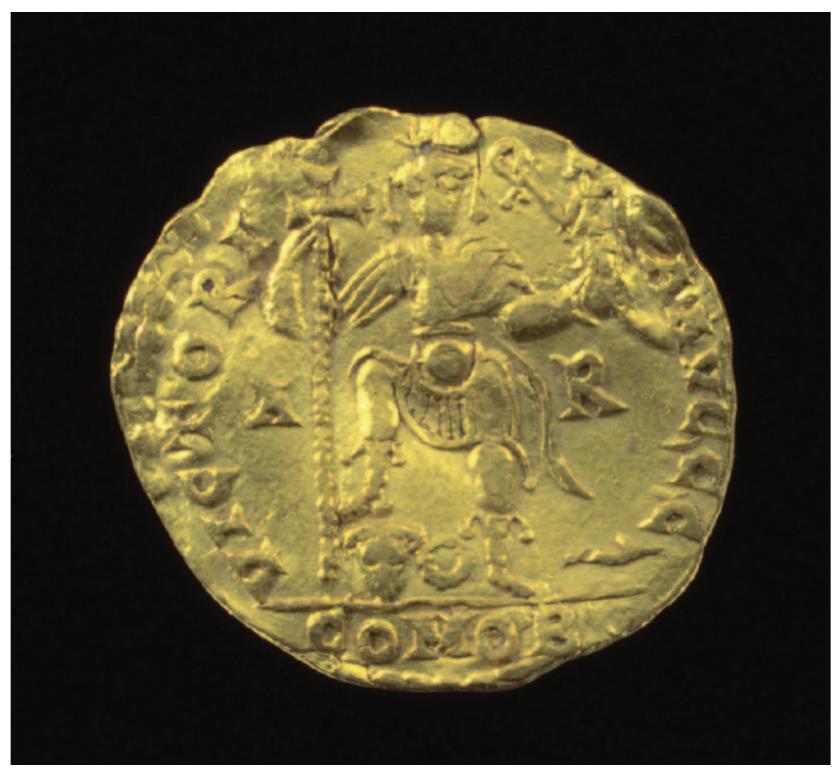
his campaigns in Spain and Gaul that were to cost him his life (Plate 1). Gold
coinage was later struck in Arles by the two last western emperors Julius Nepos
and Romulus Augustus, and this coinage reached Italy. After the fall of Romulus
Augustus in 476, Arles became less important. Yet in 508 the Ostrogothic king
23 Constans 1921.
24 Loseby 1996, 46–47.
285
� Plate 1. Reverse image of a solidus
struck for Majorian in Arles, 458. Photo
courtesy of the Royal Coin Cabinet,
Stockholm.
of Italy, Theoderic, wrote to the habitants of Arles urging a reconstruction of
the ramparts.25 Whether for sentimental or strategic reasons, Theoderic was still
prepared to invest in the upkeep of the fortified city that was a key bridgehead
between Spain, Gaul and Italy.
Ravenna and Its Hinterland
Ravenna lies at the southern end of the Po River delta along the Adriatic shores
of north-east Italy. It is specifically located in a moist, brackish-water area, which
is a perfect breeding ground for mosquitoes. Indeed, malaria is endemic to the
Veneto region and the Po Valley.26 Malaria infection is most frequent in the late
summer and early fall. Ravenna was always a relatively minor settlement on a few
sandy islands along a long, coastal, sand dune facing the Adriatic to the east and
inland marshes and lagoons to the south, west and north. The harbour was enlar-
ged during Augustus, who also had grand plans for connecting Ravenna directly
to the Po River by means of the Fossa Augusta, a vast canal project, but the main
harbour would remain further south at Classe. Ravenna replaced Milan, as the
latter city had inadequate defences to withstand a siege. Besieging Ravenna was
a completely different matter. It was fortified by its surrounding biotope, hostile
to human intervention.
In contrast to Milan and Rome, Ravenna was also easily accessible from the
Adriatic Sea and thus close to Constantinople. Milan remained an important gar-
rison and imperial mint in close contact with Ravenna, but the imperial court
usually refrained from staying in Milan after Alaric besieged the emperor Hono-
rius there in 401. The link to Rome was another issue. Mobile military units
could cut off communications between Ravenna and Rome across the Italian
peninsula without exposing themselves to more than minimum danger. A key
explanation of the decline of the city of Rome, the isolation of Ravenna, and the
inversed function of the network in the 6th century is that a hierarchical order
was needed to sustain the old Roman network. A disciplined army under compe-
tent leadership with an ability to act for a prolonged period of time within rather
than outside the network was needed in order to guarantee its security. But this
could not be organized from Ravenna as time progressed.
25 Constans 1921, 224–225; Cassiodorius Var VIII.
26 Stathakopoulos 2004.
286
�Table II
The Late 4th- and Early 5th-Century Imperial Residences in Comparison
City Population Hippodrome Theatre Arena Imperial Mints
(est) residence (officinae)
Rome 500000 270000 50000 50000 440–455,
462–465,
468–474 5
Constantinople 350000 30000 324– 4–5
Trier 100000 20000 18000 293–311,
367–391,
407–408 3
Arles 75000 20000 10000 20000 409–411,
455–456,
458–461 3
Ravenna 50000 402–440,
467–468
474–476 1
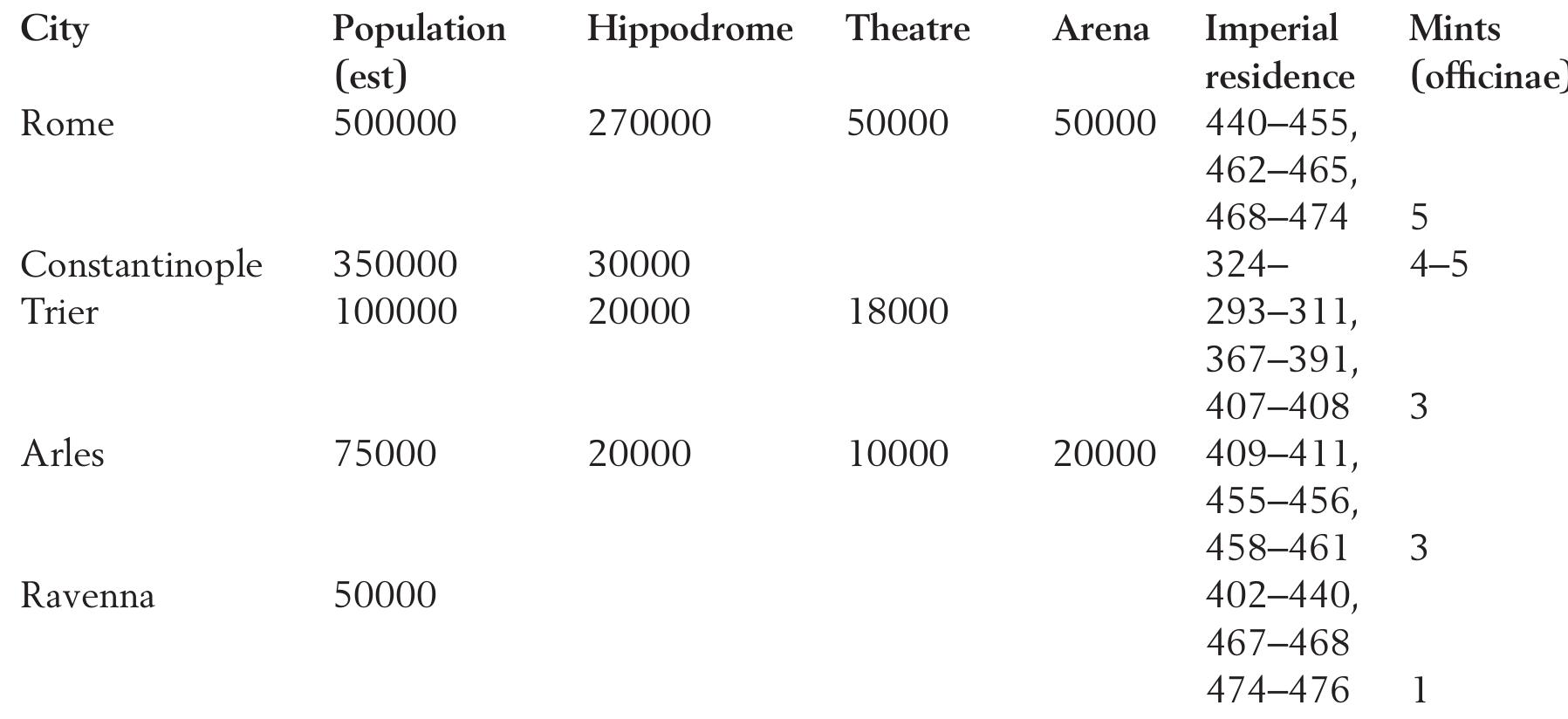
One may contrast the three imperial residences in the 5th-century West
Empire by first evaluating them according to a number of criteria in terms of
infrastructure and public accommodation, and then contrasting their collective
timeline against the successful eastern imperial residence of Constantinople and
the lost 4th-century western capital of Trier.
In Table II, the various aspects of urbanism and imperial administration are
plain to see. Firstly, Rome, Trier and Arles all have large arenas, theatres, and hip-
podromes to accommodate the inhabitants of their respective hinterlands, who
entered the cities to partake in spectacles and games on given holidays. Rome
could theoretically have fitted all the inhabitants of Constantinople into its three
main public arenas. By contrast, the still smaller and younger city of Constantino-
ple had no large theatres or arenas and only a relatively small hippodrome, which
was a very complicated imperial propaganda piece that required substantial mili-
tary security measures. Following the precedent set by the Circus Maximus and
the imperial palace in Rome, the hippodrome was in direct contact with the
imperial palace via the VIP section known as the kathisma (Plate 2). Indeed, this
hippodrome was the scene of two serious rebellions in 505 and 531, respectively.
No comparable buildings have yet been identified in Ravenna, although at least
a minor hippodrome is likely. Rome and Arles were old-fashioned cities tied to
a functioning infrastructure whereas Trier was a vast outcrop at the very end of
the infrastructure. By contrast, Constantinople was a successful meta-city above
the network (albeit with some serious internal security problems) while Ravenna
was too insignificant to play any major role for its hinterland at all.
Roman Gold Coinage as
Analysed by the LEO Project
To pay for all supplies and military security, the imperial state apparatus had to
use real money – hard currency meant only for the state and its functionaries.
287
� Plate 2. The Theodosian imperial
family in the kathisma surrounded
by their Germanic bodyguard.
From the Theodosian obelisque
celebrating the defeat of Magnus
Maximus in 388 in the Constanti-
nople hippodrome. Photo by An-
neli Sundkvist 2008.
Roman gold coinage, solidi, was only struck in the imperial residences and usu-
ally in the vicinity of the emperor. Roman gold coinage is thus very apt research
material as its relative frequency is highly indicative of the allotted importance
of a given imperial city in a specific period. The research of the LEO project is
focused around two databases, BLEO and CLEO. BLEO (Baltic/European Liber
Excelsis Obryzacusque) is constructed at a micro level and currently consists of
approximately 7300 individual gold coins from the period AD 249–565. CLEO
(Continental Liber Excelsis Obryzacusque) is constructed on a macro level and
consists of 180 gold hoards in Europe, the Middle East, and North Africa with
approximately 22000 gold coins.27 The ultimate goal of the LEO project is to
relate the two databases to climate data and to correlate this with historical
sources.28 It will thus establish a more coherent timeline for coinage, climate data
and historical sources, visualizing a multi-dimensional frame of reference where
urban sustainability and resilience can be assessed from a new perspective. One
way of establishing the comparative role of urban centres in the Roman Empire is
to look at the aftermath of the coinage reforms of Diocletian in 294 and Constan-
tine in 326 and Valentinian I in 367. By means of these reforms, 13 Roman cities
were allotted the right to strike coinage for the empire within 10 given dioceses
out of a total of 13, see Table III.
27 Fischer et al. 2011.
28 Stathakopoulos 2004; Fischer et al. 2009.
288
�Table III. Cities with Imperial Gold Mints after the 326 Reform
City Diocese
Trier Galliae
Lyon Galliae
Arles Viennensis
Aquileia Italia annonaria
Rome Italia suburbicara
Siscia Pannoniae
Thessalonica Moesiae
Heraclea Thracia
Constantinople Thracia
Cyzicus Pontica
Antioch Oriens
Alexandria Aegyptus
In regard to Table III one may first note that the three dioceses of Britanniae,
Hispaniae, and Africa were not given mints even though urban centres such as
Sevilla, Carthage and London clearly could have supported these. Secondly, when
one looks at the number of imperial mints located in each city, it is abundantly
clear that Rome and Constantinople retained an absolute hegemony. They struck
gold, and lots of it. Arles rarely struck gold but had three mints for the substantial
amounts of bronze coinage that were needed in the hinterland economy of south-
ern Gaul. After 367, the imperial mints became more mobile and tied to the
imperial persona. Following the deaths of two senior emperors, Valentinian I in
375 and Valens in 378, the imperial administration became unstable. A lengthy
interim period with a number of itinerant rival emperors followed, so that state
finances in the western part of the Empire became sporadic, see Table IV.
Table IV. Sporadic Gold Mints of the Late 4th Century AD
City Issuer Chronology
London Magnus Maximus 383
Sirmium Theodosius I 383–388
Lyon Magnus Maximus 385–388
Lyon Valentinian II 388–392
Lyon Eugenius 392–394
Table IV shows how rival emperors had to move the imperial mints during their
internal wars that further weakened the empire. This coinage was struck in al-
ternate cities when the imperial courts had to finance military expeditions away
from the normal residences. In 394, Theodosius I emerged as the sole victor,
settling down momentarily in Milan. With the death of Theodosius the next year,
these alternative mints ceased to be of any major importance save for the usurpa-
tion of Constantine III in 407–411 when the latter reactivated the dormant impe-
rial mints of Trier and Lyon. Instead, the number of imperial mints became even
smaller, yet the output was to become even more disproportionate, see Table V.
289
� Table V. Mid- to Late 5th-Century Cities with Imperial Gold Mints
City Diocese
Arles Galliae
Ravenna Italia annonaria
Milan Italia annonaria
Rome Italia suburbicara
Thessalonica Moesiae
Constantinople Thracia
Table V is quite revealing, showing how Constantinople monopolized state fi-
nances in the East Empire while the West Empire was undergoing a compara-
tive downsizing in the number of imperial mints but without the corresponding
growth and affluence demonstrated by Constantinople. Gold coinage began to be
issued in Ravenna in 402 with the transfer of the Milan mint to Ravenna under
Honorius. Ravenna was soon given its own acronym on coinage, RV. It was to
be frequently imitated. The Ravenna mint does not identify separate officinae
within its coinage although it struck gold and silver to begin with, suggesting that
separate officinae must have been active from early on. The Ravenna mint was
not in constant operation, although its peak is clearly measurable against Milan in
particular. Its hiatuses are quite easily measured, though, in particular in relation
to the mints of Rome in 450–455 and Arles in 455–561. After 450, Ravenna only
struck gold coinage, just as Milan had before. A larger overview of all the gold
coins recorded in CLEO with certain mint marks identifying the city in question
shows the ascendancy of Constantinople in an even more obvious fashion, see
Table VI.
Table VI. Gold Coinage Recorded in CLEO with Certain Mint Marks, AD 317–565.
City Gold Coins Percentage
Constantinople 3300 55.4 %
Milan 804 13 %
Rome 683 11 %
Ravenna 425 7%
Trier 360 6%
Thessalonica 94 1.6 %
Antioch 92 1.5 %
Lyon 89 1.4 %
Arles 71 1.1 %
Sirmium 70 1.1 %
Total: 5988 100 %
Furthermore, Table VI shows that the city of Rome was in a poor financial state
that progressively grew worse during the 5th century. More than half of all gold
coinage with certain mint marks was struck in Constantinople and dates to the
mid-5th century and the reign of Theodosius II (408–450) and Leo I (457–474).
Much of this coinage must be regarded as subsidies directed to aid the inept
western emperors. The entire Italian output amounts to only 31% of the total.
Note also that the two alternative residences of Arles and Ravenna produced the
equivalent of two thirds of the total output from Rome, but only during relatively
short periods. The study of Roman gold coinage of the LEO project shows that
the imperial administration did not have the financial means to support the costs
for sustaining the city of Rome, and that the attempts to run the administration
290
�from the alternative cities were doomed to fail, given the constant threat of bar-
barian incursions and the financial dependency on Constantinople.
The 6th-Century Decline
of the Roman Urban Mind
After the deposition of the last West Roman emperor in 476, the supply system
to Rome continued to function more or less as usual under the Ostrogothic king
Theoderic. Subsistence demands had diminished as the urban population had de-
creased, yet a precondition for the continuity of the Italian urban system was the
relatively strong and legitimate central power that Theoderic had established and
which was able to maintain and control the network that sustained urbanism. But
during the Byzantine conquest of Italy 534–554, this precondition was notably
absent. Neither the Byzantines nor the Ostrogoths after the death of Theoderic
could maintain a central authority. It was by no means obvious to Italian urban
magistrates who represented legitimate power. In 536 the city of Rome accepted
the troops of the Byzantine general Belisarius. Naples, on the other hand, refused
to do so, causing Belisarius to lay siege, storm and sack the city. Furthermore, the
small military forces available to the combatants prevented both sides from esta-
blishing any sort of long-term and viable hegemony. It was not until after 562 that
the Byzantine armies finally succeeded in defeating the Ostrogoths after Narses
in 553 had secured Via Flaminia by conquering the strategic town of Spoleto.
Before that, the control of Italy and Rome had changed hands several times. The
Roman urban mind that had survived the fall of the West Empire a hundred years
earlier disappeared with the Byzantine conquest. The economy was shattered and
there was a significant depopulation.
The Lombard Invasion and the
Dissolution of the Roman Urban Mind
In 568, the Lombards invaded and gained control of substantial parts of Italy.
They consciously avoided attacking large urban centres, successfully negotiating
surrenders on a local level. Confiscated lands were divided between the leading
Lombard families. This is mirrored in the Lombard cemetery of Castel Trosino
where as many as 90% of all buried men in the period 570–610 have swords in
their graves.29 It is possible to trace the creation of a new network of genealogical-
ly related power spheres diffused throughout Italy in the shape of Lombard lan-
downership in the old Roman network. The Lombards, however, lacked resources
to control all of Italy and soon lost hierarchical cohesion. A periodically strong
kingdom was established in the north with the town of Pavia as its capital.30 Me-
anwhile a number of smaller principalities were established to the south.31
The result of the Lombard invasion was the creation of a number of smaller
enclaves, power spheres above and outside yet within the old Roman network.
These developed along road intersections which had previously been of lesser
29 Åberg 1923; Lindqvist 1926; Paroli & Ricci 2008.
30 Paulus Diaconus 27–28.
31 Christou 1991, 177.
291
� importance, such as Monza and Pavia to the north of Rome, and Spoleto, Fer-
mano and Benevento along Via Flaminia and Via Appia further south. During
the Byzantine conquest and the Lombard invasion, military tactics were dictated
by the old Roman network. The antagonists strove to avoid fortified intersec-
tions in the network by staying off the roads as much as possible before amassing
sufficient strength to attack more vulnerable intersections. This type of asym-
metrical warfare required a high level of mobility. The solution was a reliance on
small cavalry units.32 One may note a failed Frankish attempt to invade northern
Italy with infantry in 539–540. The Frankish force was severely weakened by
starvation, disease and illness and soon disappeared from the historical sources.33
Belisarius intentionally recruited his cavalry units from distant places and thus
often employed Alans and Huns34, a practice also used by the Lombards. Being
short of manpower, the Lombards invited other groups of Indo-Iranian and Slavic
origin to settle in Italy. Late Antique and early medieval cavalry units did not as
a rule use shod horses. Since hoofs are sensitive35 and since the surface of Roman
roads were of stone, cavalry units would avoid the road network as much as pos-
sible. Instead they used the surrounding hinterland where suburban green areas
and abandoned cultivated areas provided cover prior to assaults on settlements
and intersections. Thus, the mobile military units could cut off communications
between Ravenna and Rome across the Italian peninsula without exposing them-
selves to more than minimum danger.
An explanation for the decline of the city of Rome and the inversed function
of the road network in the 6th century is that a hierarchical order was needed to
sustain the old Roman network. A disciplined army under competent leadership
with an ability to act for a prolonged period of time within rather than outside
the network was needed in order to guarantee its security. The long wars did not
lead to any definite results except the demographic collapse of the Italian popula-
tion. For want of real results all combatants allowed their small cavalry units to
roam the hinterlands of enemy strongholds. After 533 there was no legitimate
central power in Italy. The last emperor, Romulus Augustus, had been deposed
in a coup d’état two generations earlier in 476 by the Germanic officer Odoacer.
The Ostrogoths, Byzantines, and Lombards could not claim to represent a legiti-
mate power that could guarantee sustainability and mutual flow within the old
Roman network. Nor could any of these groups be considered to be native to
Italy. A trait shared by all three groups is that they lacked a number of common
interests or mutuality with the Italian population, especially regarding sustain-
ability in terms of agriculture and manufacture.
Conclusion
The city of Rome was the ball and chain of the western imperial administration.
It could not be sustained in the face of the onslaught of rapid change and had a
very limited capacity for resilience as the administration was unable to reform or
32 Mack 1975; Elton 1996, 43–51, 59.
33 Procopios 6, XXV; Stathakopolous 2004, 275–276.
34 Procopios 5.
35 Sundkvist 2003; Fischer 2005, 92–93.
292
�to finance an indefinite status quo. When the population of Rome had dwindled
into that of a regular Roman town, there were no longer any great transports by
sea. The old road network, however, could not be used to sustain Rome having
become a liability in a new age of asymmetrical warfare. Arles and Ravenna, the
two western alternatives to Rome, were advantageous as they could be supp-
lied from the sea, the cheapest form of transport. Located in lagoons, they were
easy to defend as any siege would require huge resources beyond the capacity of
barbarian invaders. The two alternative residences had relatively small popula-
tions while still being able to provide sufficient ideological legitimacy. Rome on
the other hand was difficult to defend, had initially a huge population and was
difficult to supply. But a puppet imperial administration, pampered with gold
coinage, soldiers and food by the increasingly resilient and dominant city of Con-
stantinople from overseas while hiding out in Ravenna, was no solution to the
Roman problem. In the end, Constantinople dispatched an Ostrogothic general,
King Theoderic, to take over the remains of urbanism in Italy. This he did. But
he also set up his own rule where Constantinople wielded little influence. A ge-
neration later, Constantinople dispatched its own army against Rome and laid to
waste much of the Roman urban mind for good. Arles and Ravenna soon fell back
into relative obscurity in the early medieval world, very much like Trier had done
a century earlier. The Dark Ages had arrived in Western Europe. This spelled the
end for the Roman urban mind.
References
Abbreviations of Classical sources
Mosella Ausonius, Mozella. The works of Ausonius, R.P.H. Green (ed.),
1991. Oxford: Clarendon Press.
Ordo Urbium Nobilium Ausonius, Ordo Urbium Nobilium. The works of Ausonius, R.P.H.
Green (ed.), 1991. Oxford: Clarendon Press.
Cassiodorius Cassiodorius Variae, S.J. Barnish (transl., ed.), 1992. Liver-
pool: Liverpool University Press.
Paulus Diaconus Paulus Diaconus, Historia Langobardorum, Helge Weimarck,
(transl.), 1971. Langobardernas Historia. Uddevalla: Bohuslän-
ningen.
Procopios Procopios, History of the Wars, H.B. Dewing (transl.), 1952.
Cambridge, Mass.: Harvard University Press, Heineman.
Symmachus Symmachus, Relationes. In Prefect and emperor: the relationes
of Symmachus A.D. 384, R.H. Barrow (transl. ), 1973. Oxford:
Clarendon Press.
Modern literature
Åberg, Nils 1923. Die Goten und Langobarden in Italien. Uppsala: Almqvist & Wicksell.
Brown, P. 1971. The World of Late Antiquity AD 150–750. London: Thames and Hudson.
Bruun, C. 1991. The Water supply of Ancient Rome. A Study of Roman Imperial Administra-
tion.. Helsinki: Societas Scientiarum Fennica.
293
� Christou, K. P. 1991. Byzans und die Langobarden. Von der Ansiedelung in Pannonien
bis zur endgültigen Anerkennung (500–680). Athens: Historical Publications St. D.
Basilopoulos.
Constans, L.A. 1921. Arles antique. Paris: E. de Boccard.
Durliat, J. 1990. De la ville antique à la ville byzantine : le problème de subsistence. Coll.
De l’école francaise à Rome 136. Rome: Ècole francaise de Rome.
Elton, H. 1996. Warfare in Roman Europe AD 350–425. Oxford: Oxford University Press.
Fields, N. 2008. The Walls of Rome. London: Osprey.
Fischer, S. 2005.Roman Imperialism and Runic Literacy. The Westernization of Northern
Europe 150–800 AD. AUN 33. Uppsala: Department of Archaeology and Ancient
History.
Fischer, S., H. Victor and N.L. Wicker (eds) 2009. Climate and Coinage. Political Conflict
and Social Crisis.2nd International LEO Conference (LEO II) November 5th–6th 2009.
Uppsala.
Fischer, S., F. López Sánchez and H. Victor 2011. A Preliminary Result of the LEO-Pro-
ject: The 5th Century Solidus Hoard in Stora Brunneby, Öland, Sweden. Fornvännen
(forthcoming).
Gibbon, E. 1897. The Decline and Fall of the Roman Empire, J.B. Bury (ed.). London.
Goffart, W. 1980. Barbarians and Roman, AD 418–584. The Techniques of Accommoda-
tion. Princeton: Princeton University Press.
Heather, P. 2005. The Fall of the Roman Empire: A New History of Rome and the Barbar-
ians. Oxford: Oxford University Press.
Lançon, B. 2000. Rome in Late Antiquity. Everyday Life and Urban Change, AD 312–609.
Edinburgh: Edinburgh University Press.
Laurence, R. 1999. The roads of Roman Italy: mobility and cultural change. London: Rout-
ledge.
Lejdegård, H. 2002. Honorius and the City of Rome. Unpublished dissertation, Uppsala
University.
Lindqvist, S. 1926. Vendelkulturens ålder och ursprung. KVHAA Handlingar 36:1. Stock-
holm: Kungl. Vitterhets-, Historie- och antikvitetsakademien.
Loseby, S.T. 1996. “Arles in Late Antiquity: Gallula Roma Arles and Urbs Genesii“, in
Towns in transition. Urban Evolution in Late Antiquity and the early Middle Ages, N
Christie & S.T. Loseby (eds.), 45–70. Aldershot: Ashgate.
Mack, A. J.R. 1975. „Why Big Nations Lose Small Wars: The Politics of Asymmetric
Conflict”, World Politics, Vol. 27, No. 2 (January 1975), 175–200.
Moorhead, J. 1992. Theoderic in Italy. Oxford: Clarendon Press.
Paroli, L. and M. Ricci, 2008. “The necropolises in Castel Trosino and Nocera Umbra in
Italy”. In Rome and the Barbarians. The Birth of a New World, Jean-Jacques Aillagon
(ed.), 476–485. Milan: Skira.
Revell, L. 2009. Roman imperialism and local identities, Cambridge: Cambridge Univer-
sity Press.
Sirks, Boudewijn. 1991. Food for Rome. The Legal Structure of the Transportation and Pro-
cessing of Supplies for the Imperial Distribution in Rome and Constantinople. Studia
Amstelodamensia ad epigraphicam, ius antiquum et papyrologicam pertinentia 31.
Amsterdam: Gieben.
Stathakopolous, D. Ch. 2004. Famine and Pestilence in the Late Roman and Early Byzan-
tine Empire. A systematic Survey of subsistence, crises and epidemics. (Birmingham
Byzantine and Ottoman Monographies vol 9), Aldershot: Ashgate.
Sundkvist, A. 2003. Hästarnas land: aristokratisk hästhållning och ridkonst i Svealands
yngre järnålder. OPIA 28. Uppsala: Department of Archaeology and Ancient His-
tory.
Ward-Perkins, B. 1984. From Classical Antiquity to the Middle Ages. Urban Public Build-
ing in northern and central Italy AD 300–850. Oxford: Oxford University Press.
Ward-Perkins, B. 2005. The Fall of Rome and the End of Civilization. Oxford: Oxford
University Press.
294
�


 Helena Victor
 Svante Fischer