
Introduction
Anthophyllite is an amphibole with an orthorhombic crystal symmetry, unlike the more common monoclinic amphiboles. Anthophyllite is the Mg-dominant end member, forming a continuous series with the relatively much rarer ferro-anthophyllite. The Mg/(Mg+Fe) ratios is normally over 0.6, showing clear evidence of the Mg dominance in these minerals. This is also reflected in the number of entries in mindat. Anthophyllite is listed form 747 localities (2020) and ferro-anthophyllite from only 5 (2020). The anthophyllite minerals form a continuous series towards the gedrite minerals, and Beeson (1978) notes that “orthoamphiboles termed anthophyllites by one author overlap with gedrites of other authors and vice-versa.”The anthophyllite minerals are typical minerals in metamorphic magnesium rich rocks such as serpentinites ( metapyroxenites and metaperidoties) and Mg-rich carbonates, in particular near the contact of these rocks towards any surrounding rocks. Anthophyllite also is found in amphibolites and gneisses together with other Mg/Al minerals such as other amphiboles, cordierite, phlogopite and plagioclase feldspars.
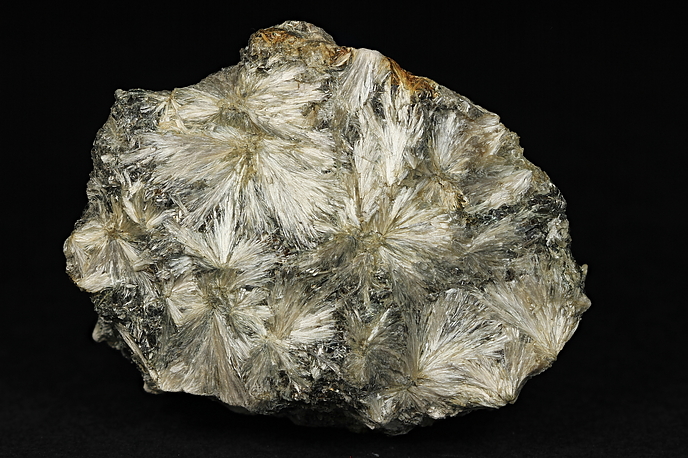
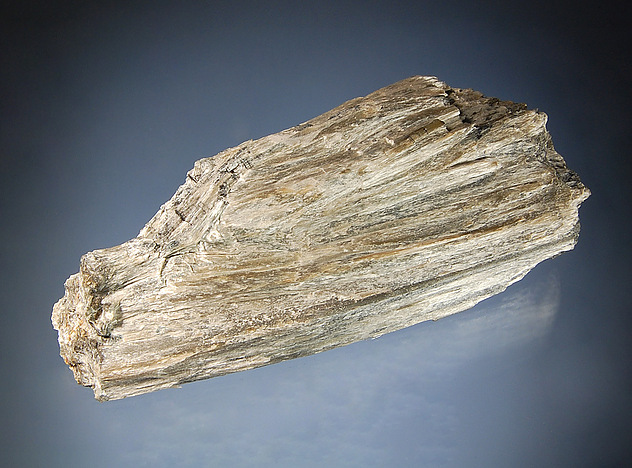
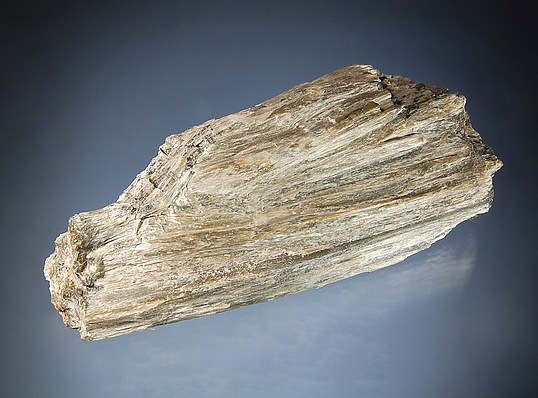
Anthophyllite-series minerals do not form well developed crystals, but rather fibrous crystalline masses. These masses can exceed multiple tons in weight and several m3 in volume, with individual fibers approaching 50 cm in length are known. Anthophyllite has previously been mined as a source of asbestos, with the Paakilla district in Finland as the largest producer. Significant health issues have been reported. Today anthophyllite are not mined but can still be a problem when it occurs in larger masses in quarries operated for other rocks.
Czech Republic
Pohled, Havlíčkův Brod District, Vysočina Region, Czech Republic
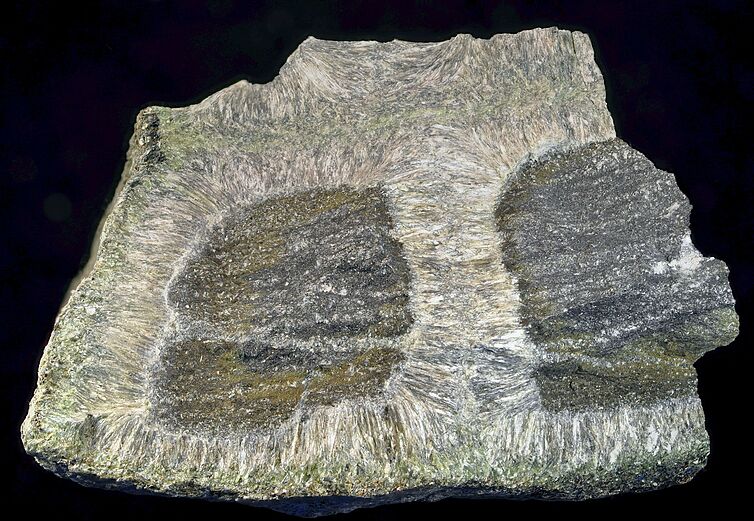
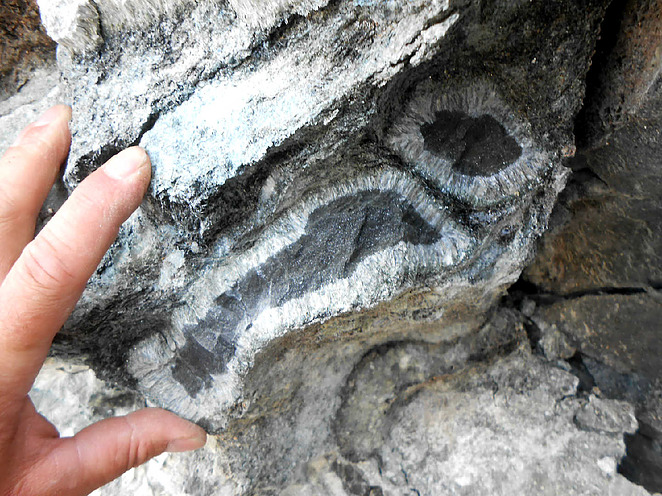
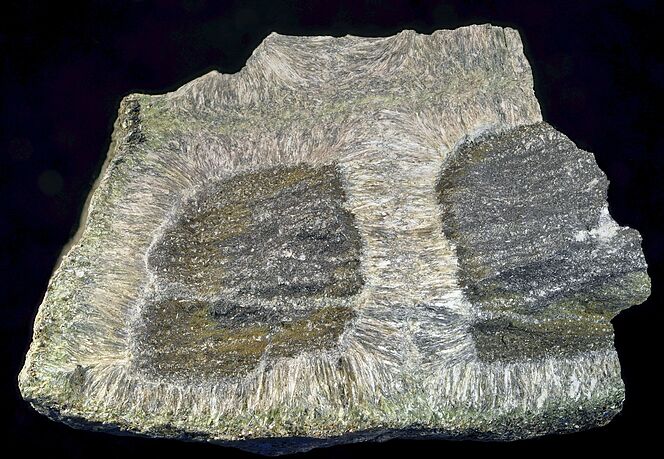
Anthophyllite occurs in reaction rims around ultramafic (peridotite) xenoliths in acid gneisses and granites. The xenoliths can be up to 1m wide. The anthophyllite forms a fibrous crust around the xenolith, where the fibers are perpendicular to the surface of the ultramafic rock. The thickness of the anthophyllite crust can be a few cm.
Dlouhá Ves, Havlíčkův Brod District, Vysočina Region, Czech Republic
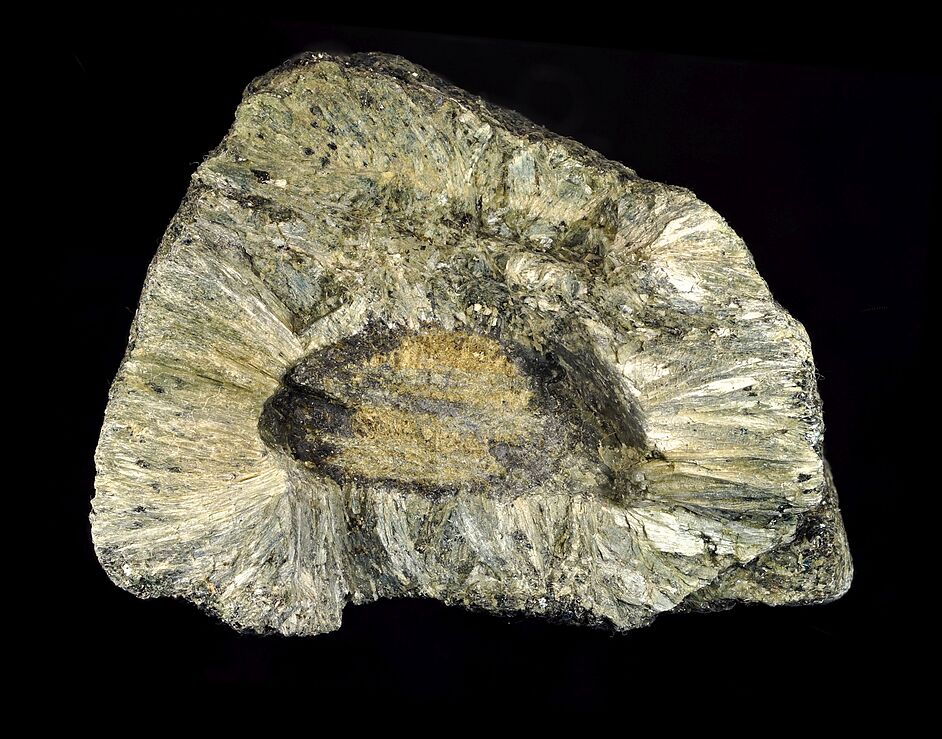

The occurrence of anthophyllite at this locality is similar to the nearby locality of Pohled.
Heřmanov, Žďár nad Sázavou District, Vysočina Region, Czech Republic
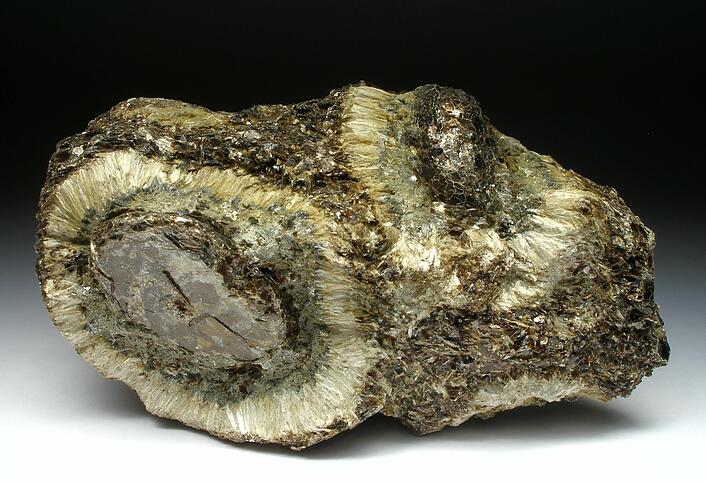
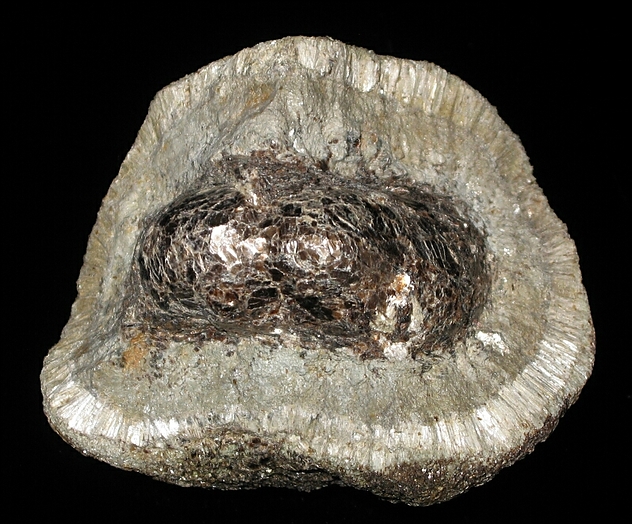
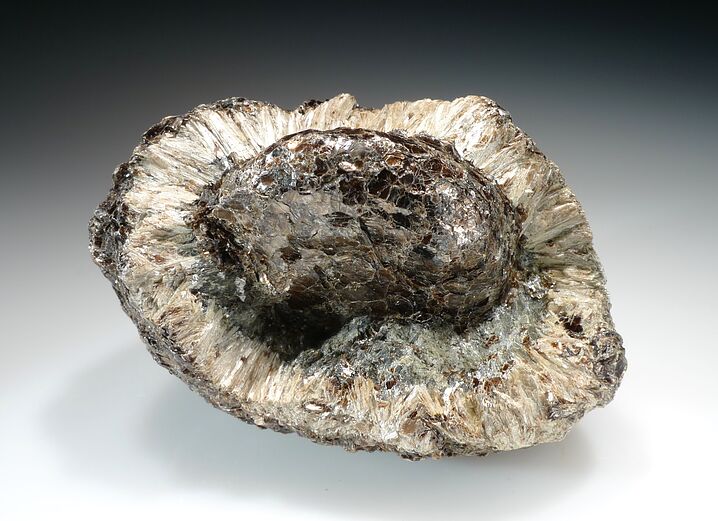
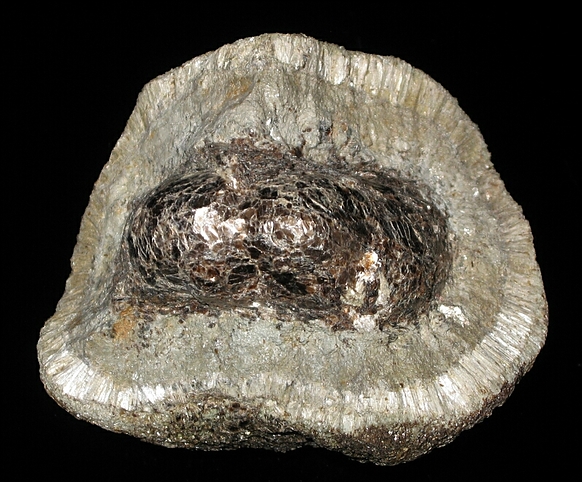
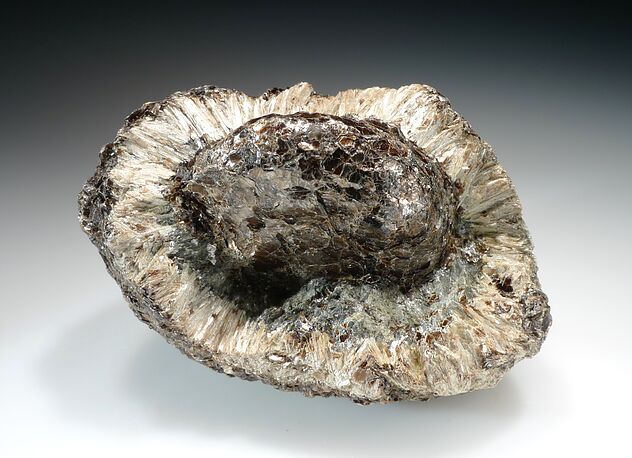
Antophyllite occurs here in irregular “ball” shaped nodules. The nodules are layered with a phlogopite core, a thin intermediate talc layer with a thicker (up to a few cm) anthophyllite layer surrounded by dark mica (“biotite/phlogopite”). The anthophyllite is often intergrown with tremolite. These “Hermanov balls” are normally between 3 and 9 cm in size and can give quite attractive mineral specimens. Larger "balls" exceeding 10 cm are known.
The anthophyllite bearing nodules are found in the contact zone between a serpentinized ultrabasic rock and an intruding granitic pegmatite.
Finland
Paakkila mine, Tuusniemi, North Savo, Finland
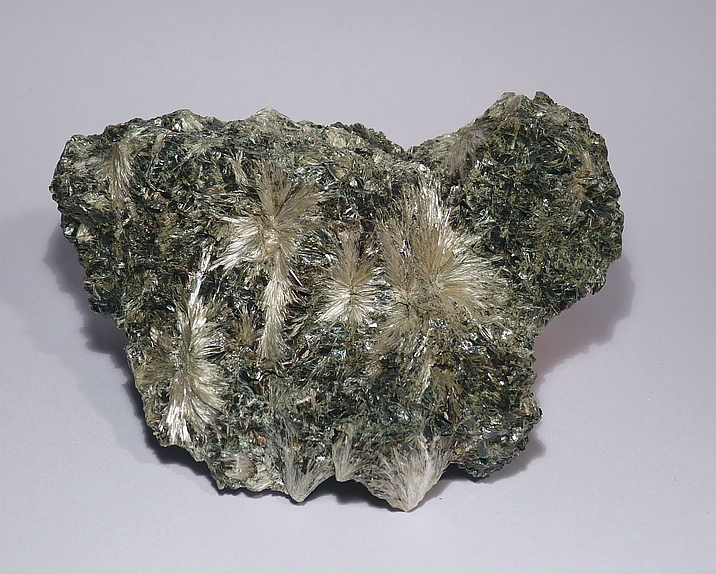

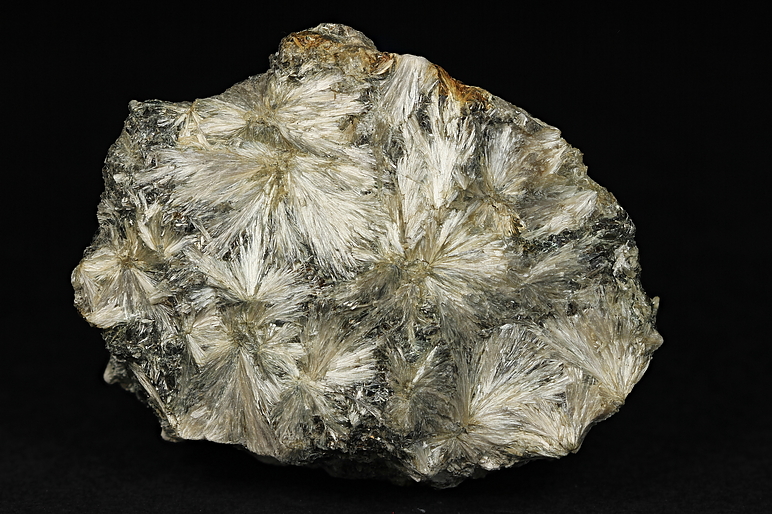
Anthophyllite occurs as asbestiform fibers in ellipsoidal bodies and lenses. Around 50 of these lenses have been found, averaging 5000 to 7000 cubic meters. Asbestos from these lenses has been mined for over 4000 years, and modern industrial mining from 1918 to 1975 yielded some 350.000 tons of asbestos. Medical studies have shown extensive health effects as a result of the mining operations.
The Paakkila asbestos deposits are associated with serpentinite intrusives of the Karelian orogeny. The major rock types at Paakkilannierni are mica gneiss and granite. The asbestos lenses display a zonal structure, which is manifested by the variation in mineralogical composition from the contacts of the lenses with the host rock towards the center. The zones are mica, tremolite/actinolite, talc and anthophyllite asbestos, with an serpentine asbestos core.
France
Allevier, Azérat, Brioude, Haute-Loire, Auvergne-Rhône-Alpes, France
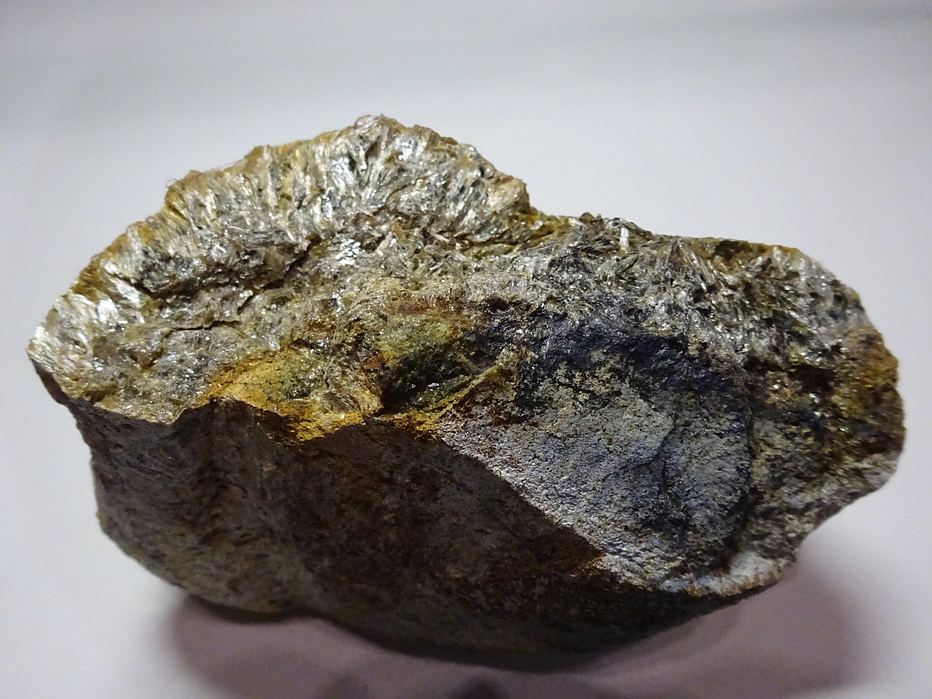
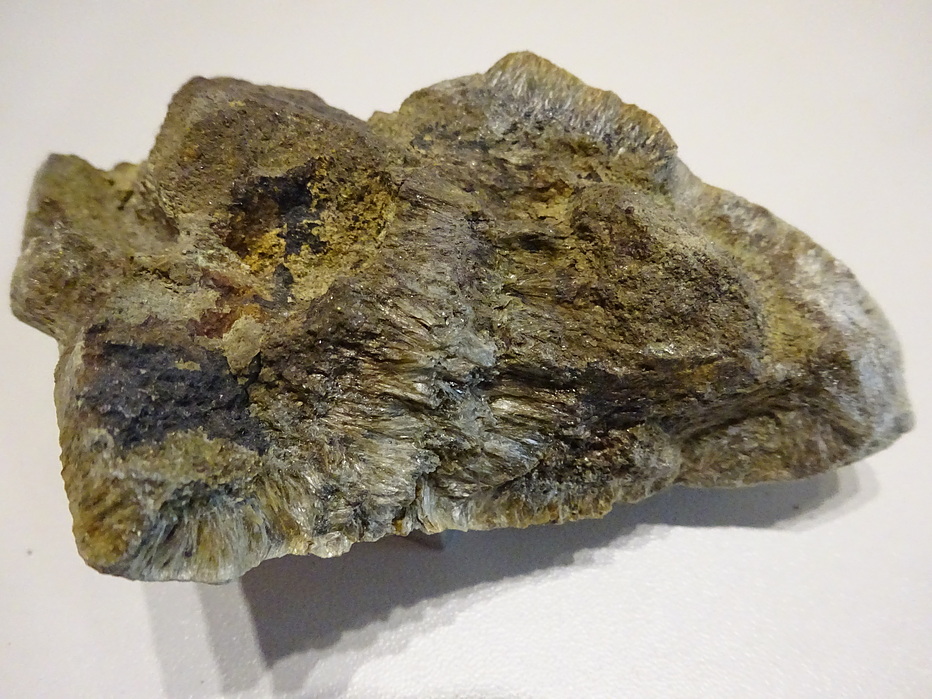
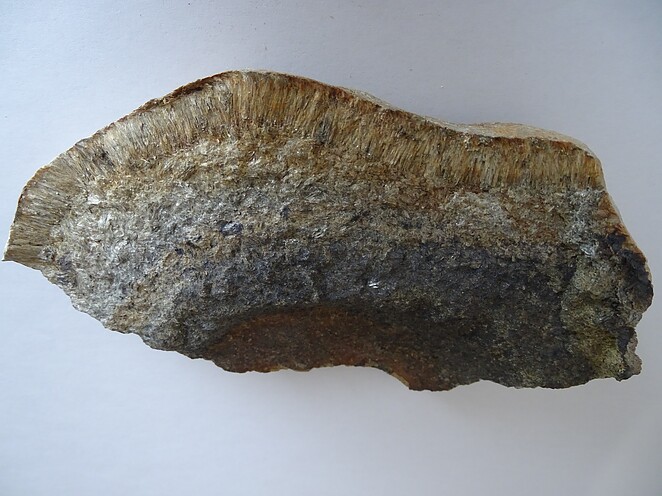
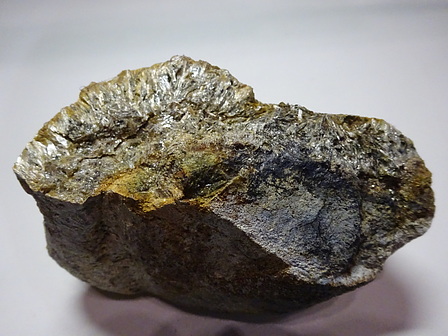
Antophyllite occurs as a fibrous halo around mafic and ultramafic (serpentinized peridotite) enclaves in partially melted metamorphic rocks (anatexites).
Norway
Risør, Agder, Norway
Moland Industrial Site, Akland, Risør, Agder, Norway
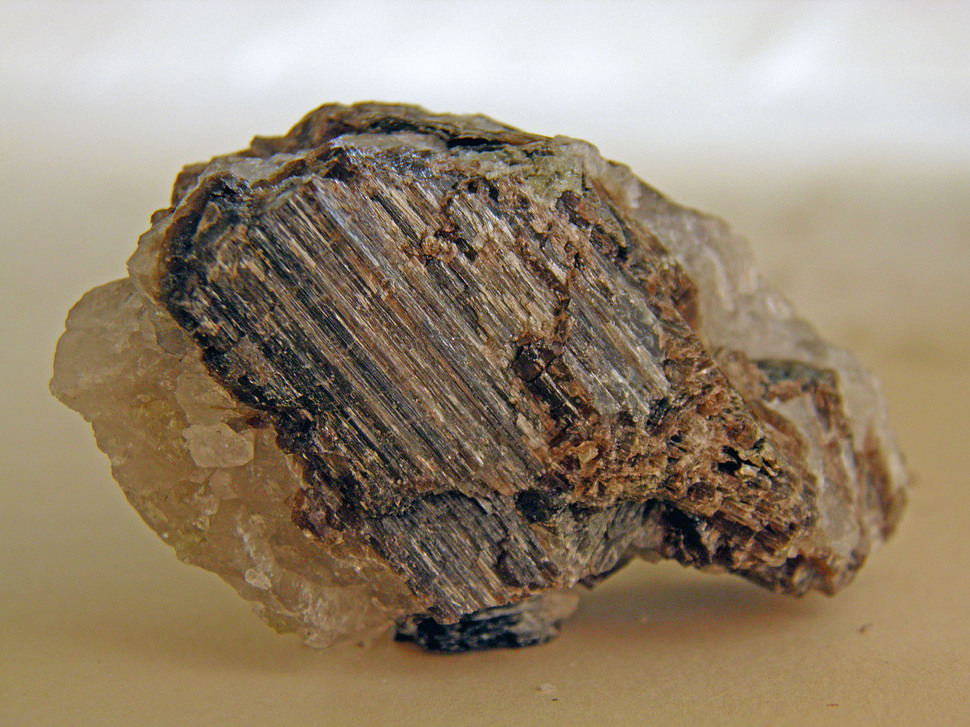
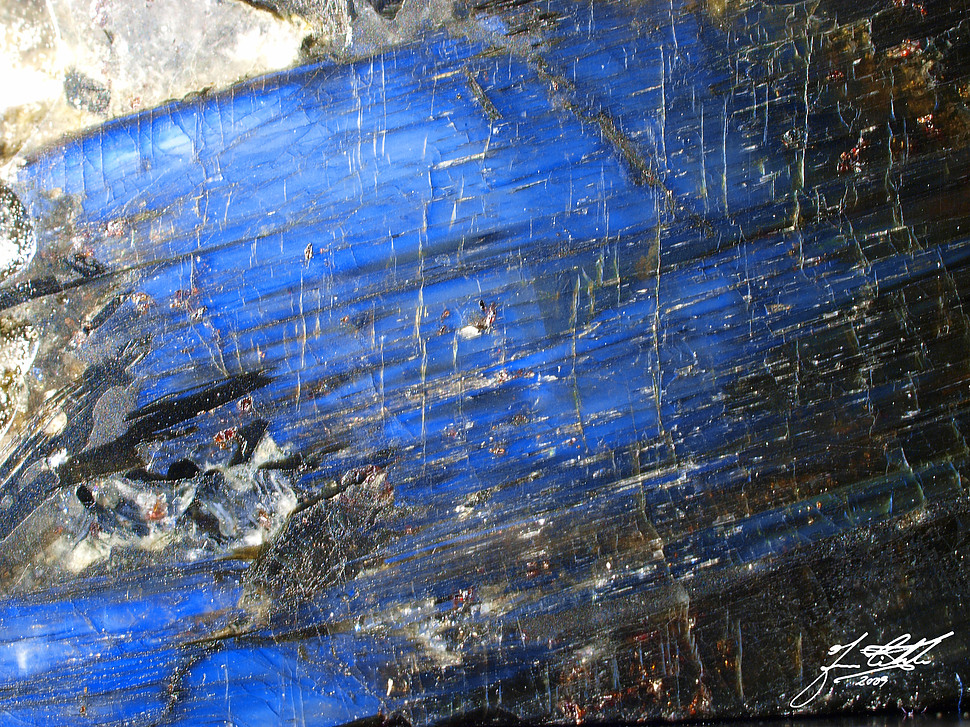
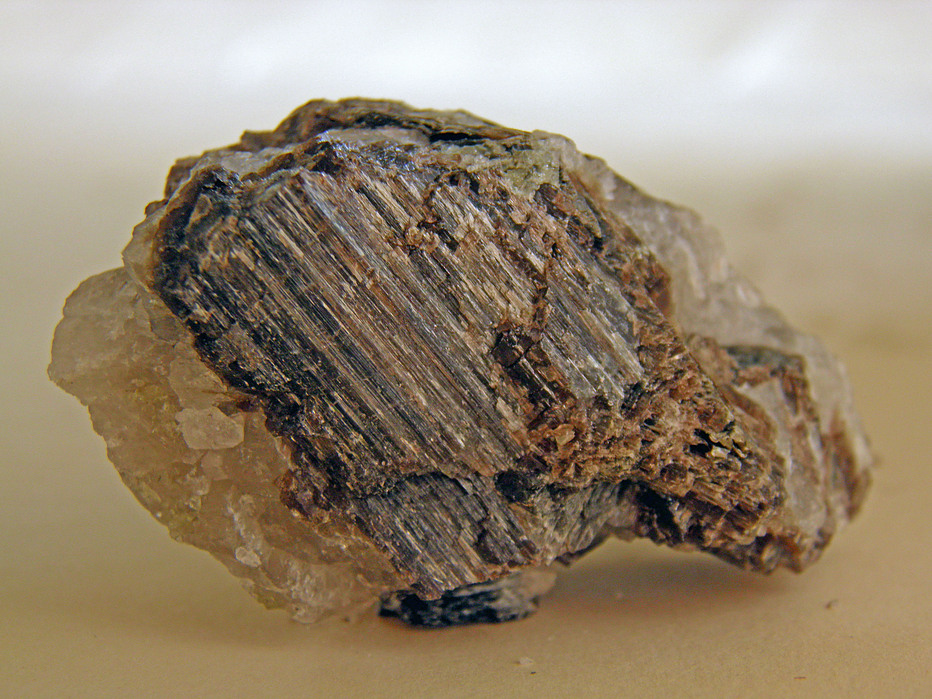
Risør is one of many localities in the Bamble formation where anthophyllite-gedrite rocks can be found. The Bamble formation is a rock sequence formed during the Sveco-Norwegian orogeny (1,1-1,5 Ga). Anthophyllite and gedrite is found in aluminous amphibolites and metasedimentary gneisses together with cordierite, Mg-rich mica +/- plagioclase and other amphibole group minerals. The composition of the ortho-amphiboles is always near the Mg endmember, but the Al content may vary. Beeson (1978) publishes 17 analyses of orthoamphiboles from different rocks in this area and found an Al content in the T position varying from 0,43 to 1,52 apfu. The borderline between anthophyllite and gedrite lies at Al=1 apfu in the T-position.
Anthophyllite/gedrite specimen occurs as individual crystals and crystalline masses up to minimum 10 cm. They were found in a plagioclase rich gneiss with cordierite and phlogopite.
The exsolved iridescent Gedrite-Anthophyllite crystals from Risør occurs solely with pristine cordierite, fine-grained rutile, a Mg-Ti rich biotite and less commonly albitic plagioclase. Sizes may reach 10 cm. Well defined crystals showing crystal faces are very rare, more commonly these orthoamphiboles tend to form irregular aggregates. A terminated single crystal from this occurrence (hand specimen) is on display in the mineral gallery of the Mineralogical-Geological museum in Oslo.
Altermark talc mine, Altermark area, Rana, Nordland, Norway
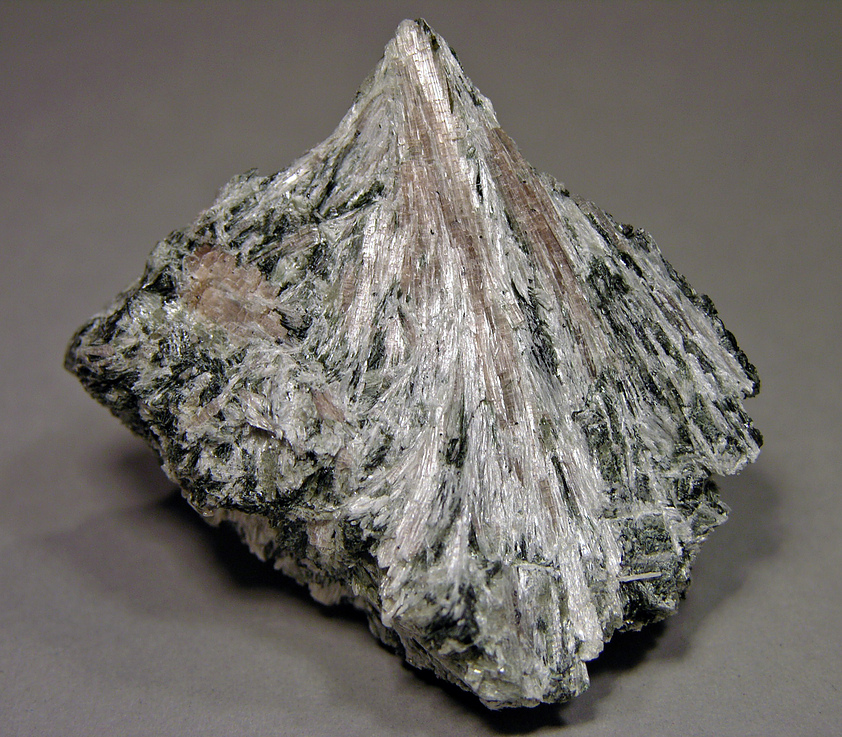
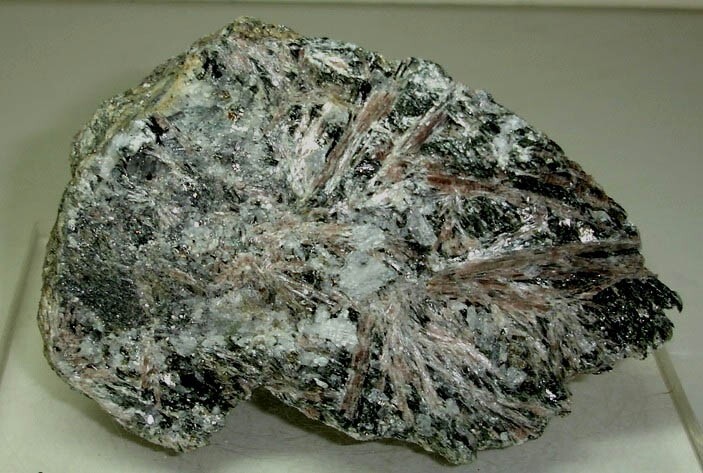
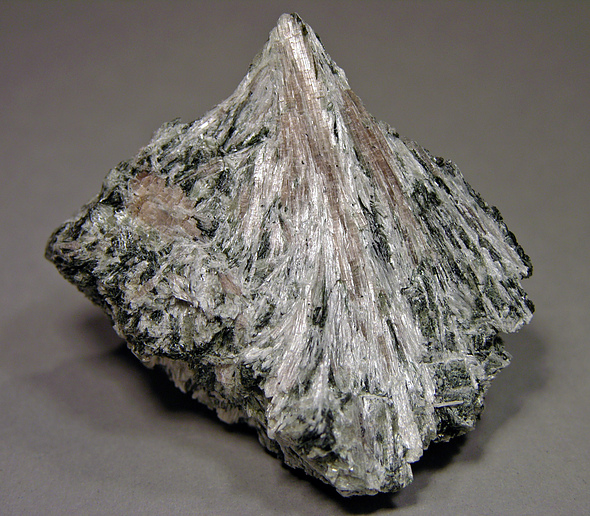
The Altermark talc mine has been a of talc since around 1934. The mine has been mined from four different levels, and the accumulated production is estimated to 1 mill. tons. The remaining reserves are considerable.
This is a metamorphosed ultramafic intrusion. During the metamorphosis to high greenschist/low amphibolite facies in the Caledonian orogeny, the original dunites/pyroxenites and rodingites(?) are now zoned with a serpentinite core surrounded by a serpentinite/carbonate/talc layer followed by a carbonate/talc layer. A thin talc schist zone can be found between the carbonate/talc layer and the surrounding "black-wall" rocks.
Amphiboles, in particular green chromian actinolite can be found in well-formed crystals up to 10cm, but also light colored amphiboles can be found in fibrous mats up to 10-15cm, as overgrowth on actinolite crystals and white "stars" like the one pictured in sizes up to 4-5cm. Karlsen(2000) and Birtel(2002) identifies both anthophyllite, cummingtonite and tremolite as occurring amphiboles. Birtel seems to consider anthophyllite rarer than what Karlsen do, but without really taking interest in these amphiboles.
Due to the occurrence of multiple light-colored amphibole species, a specimen should not be named unless accompanied by analytical data.
USA
Satan's Kingdom talc deposits, New Hartford, Litchfield County, Connecticut, USA
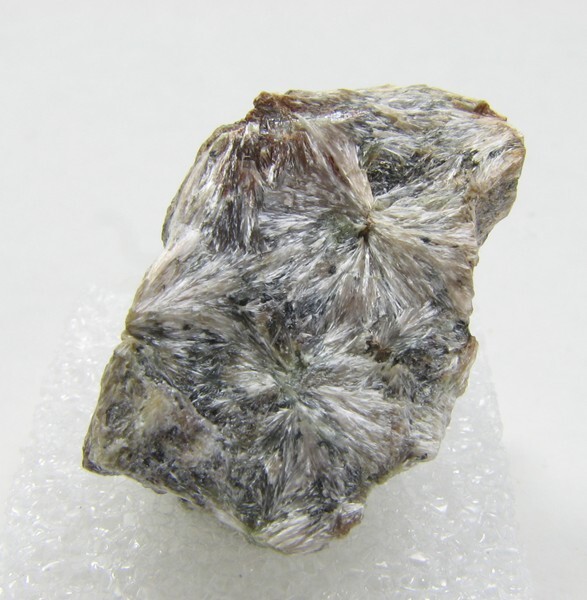
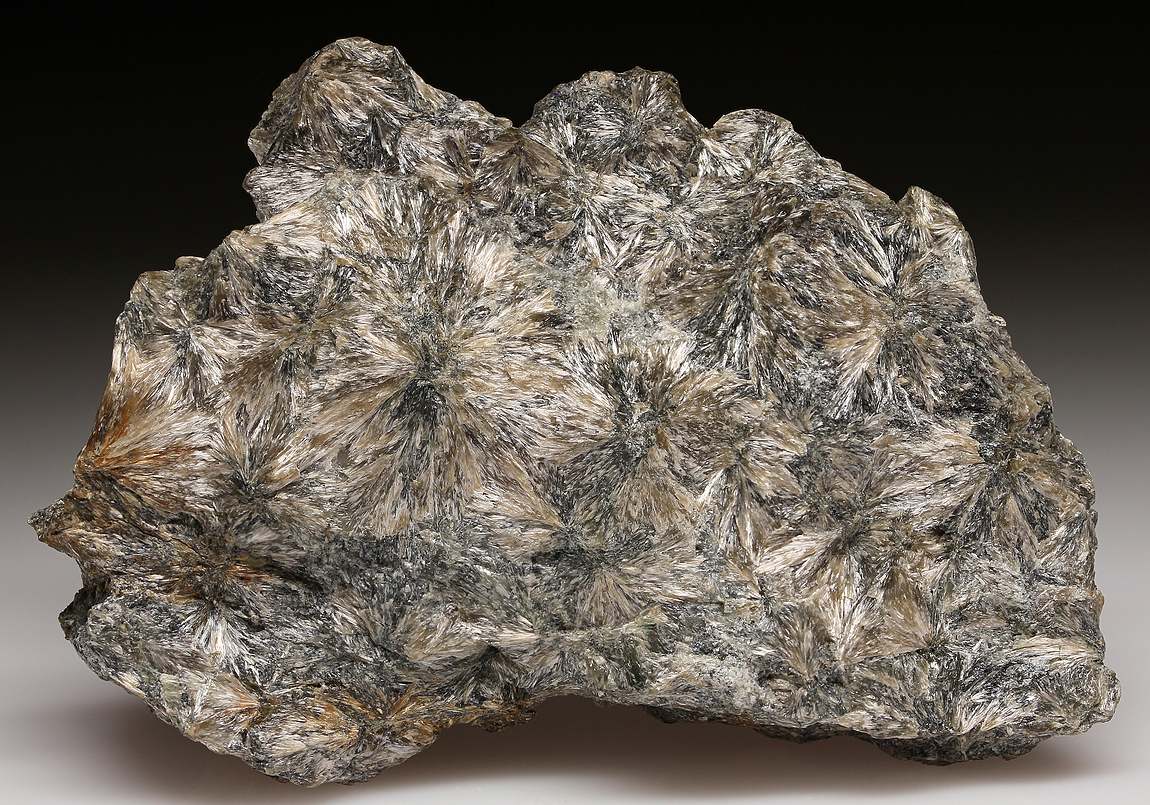
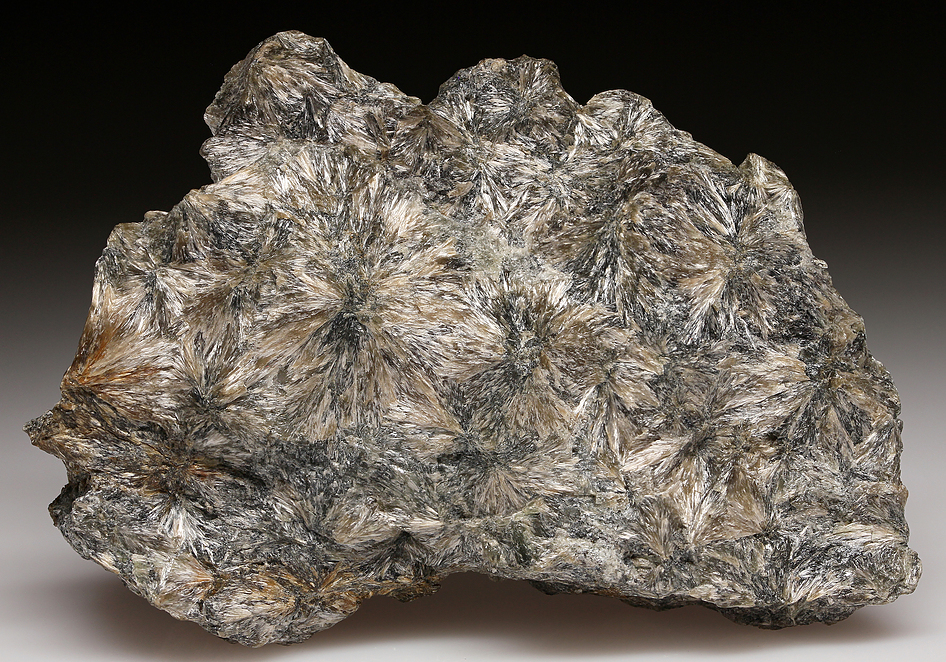
Anthophyllite occurs as fibers up to a few cm intergrown with radiating spheres of fibrous talc. This and other ultramafic serpentine lenses in the area show sparingly the olivine structure in thin section and may have been peridotites or norites. Anthophyllite was confirmed in 2016 using EDS and selected area electron diffraction (SAED) zone patterns.
Chester, Middlesex County, Connecticut, USA
State Route 9 Interchange 13 - Beaver Meadow Road, Haddam, Middlesex County, Connecticut, USA
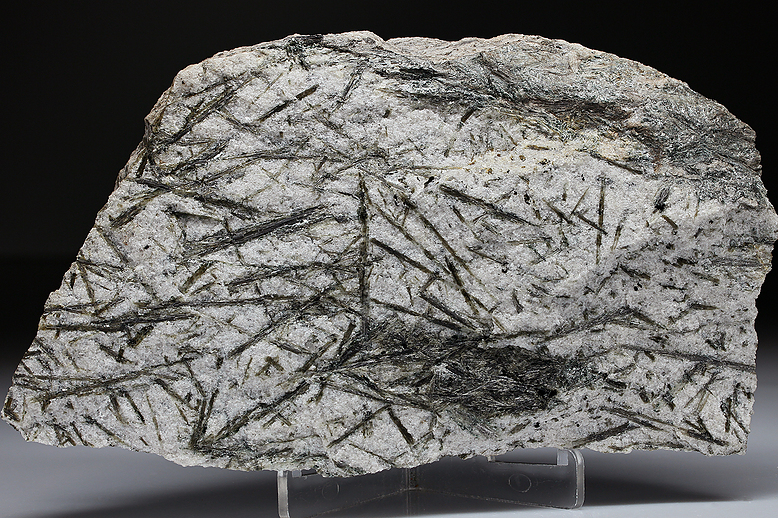
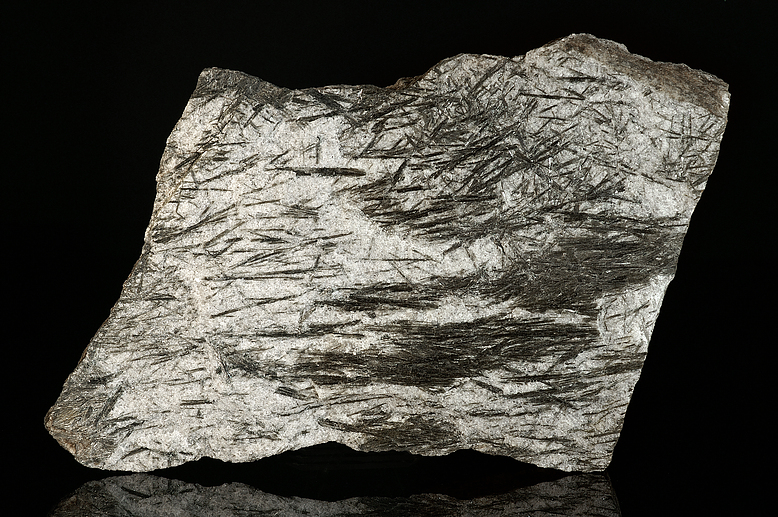
Orthoamphibole is a dominant mineral in some rock types constituting the Middletown formation, which is exposed in several outcrops (Lundgren 1979) throughout the extention of this formation. The orthoamphibole rocks are easily recognized in the field because these minerals are generally present in aggregates of rather large prismatic crystals, much larger than crystals of calciferous amphibole (hornblende, tremolite) present in the same rocks.
Orthoamphiboles occur in orthoamphibole rocks, garnet rocks and orthoamphibole-garnet rocks that form distinct layers and lenses within amphibolites. They are very coarse grained; the maximum crystal dimension commonly is between 5 cm and 10 cm. The coarsest garnet rocks ("garnetball rocks" ) are aggregates of red garnets the size of tennis balls. Some of these rocks are dike-like and are clearly structurally discordant, cutting sharply across fold structures and layering.
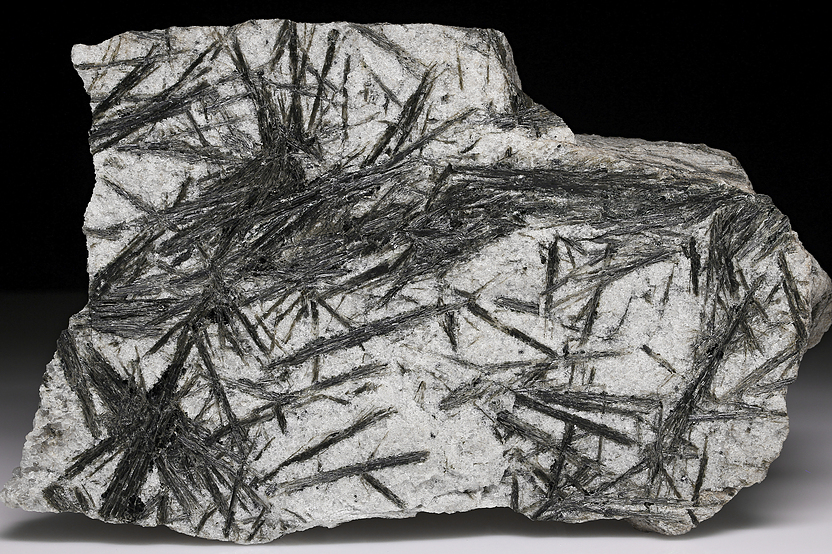
Lundgren (1979) and others use the name anthophyllite for the olive greenish to bronzy, acicular crystals. The anthophyllite typically occurs as thin layers in a granular quartz/albite gneiss matrix (easily split into slabs as shown in the photos) and is associated with magnetite, cordierite and black tourmaline. Anthophyllite is relativly widespread, and much more common than than the very dark, essentially opaque gedrite. Recent (2020)analysis (TEM/EDS) confirm this identification.
Pelham asbestos mine, Pelham, Hampshire County, Massachusetts, USA
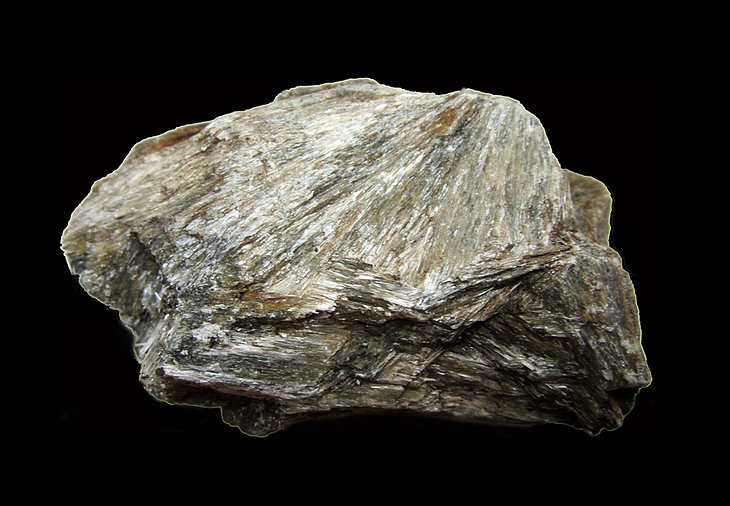
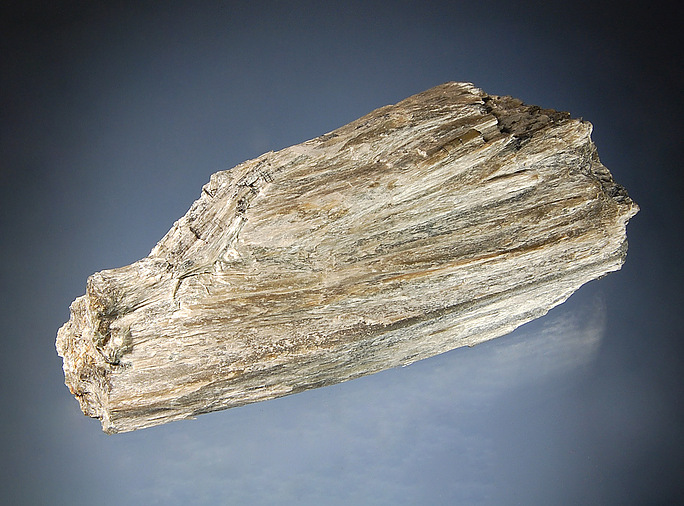
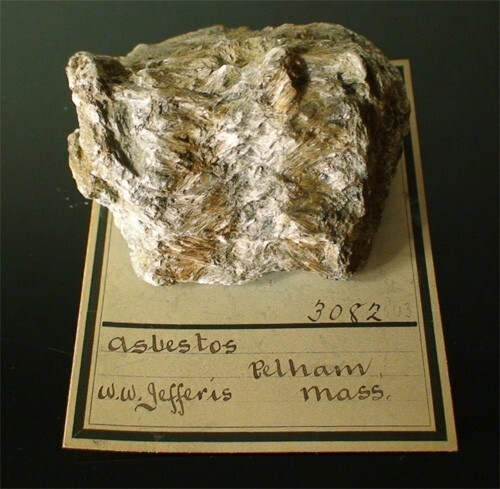

The Pelham asbestos mine was mined for anthophyllite asbestos in the second half of the 19th century. The anthophyllite was found as veins and pods penetrating a metamorphosed ultramafic olivine/pyroxene rock. The asbestos production has been estimated to "several hundred tons". Anthophyllite was found as fibrous asbestos with individual fibers up to 1m long and could still be found in the abandoned quarry up until the 1980-ties.
The Pelham asbestos mine is one of many similar ultramafic bodies in the area, metamorphosed to amphibolite facies in the Acadian orogeny (325-400ma). Tracey et al. (1984) describes anthophyllite also from other localities in the vicinity (in relative terms) of Pelham.
During the metamorphosis, an interesting mineral assemblage has formed in the border zone between the ultramafic anthophyllite bearing rock and the surrounding quartz-rich (metasedimentary) gneiss, and the mineralogy and the Pelham quarry is vividly described by Emerson (1898)
Mineral Hill, Elwyn, Middletown Township, Delaware County, Pennsylvania, USA
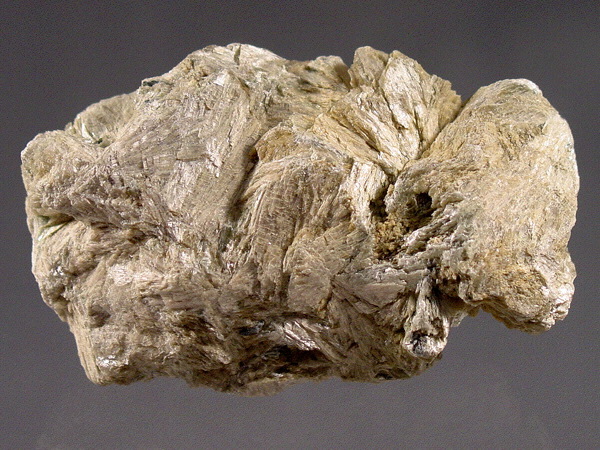

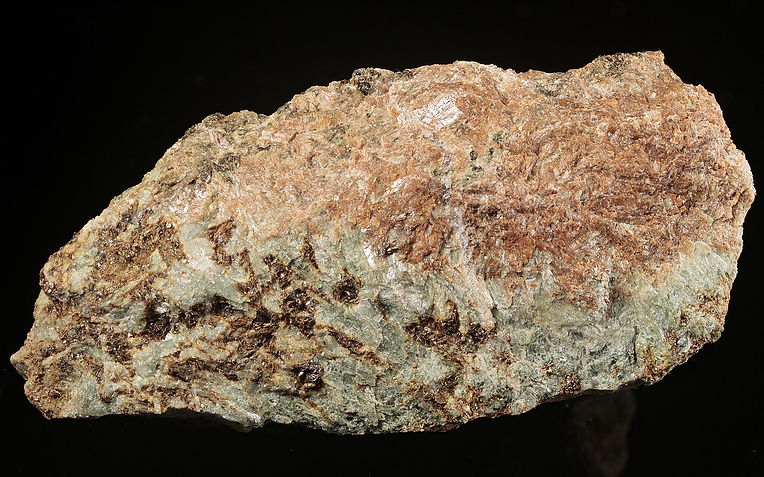
Anthophyllite (together with tremolite) can be found in many of these serpentine rocks as asbestiform fibers in thin veins in shear zones in the serpentinite host rock. The anthophyllite fibers can be up to 45-50cm long, and asbestos was a byproduct during 19th and early 20th century operations of these quarries.
Crumps Quarry is one of the many anthophyllite localities in serpentinites the North-Eastern USA. The serpentinites are believed to be metamorphosed enstatite-rich pyroxenites and peridotites originating from the oceanic crust between the ancient Iapetus ocean. These rocks were metamorphosed in the Acadian orogeny.
Related and referenced articles
Mindat article | |||||||||||
|
Links
www.hermanov.info/texts/koukola-kolem-hermanova.pdf
https://aps.ngu.no/pls/oradb/minres_deposit_fakta_NY_KS.Main?p_objid=23466&p_spraak=E
Revisons
Revision History | ||||||||||||||||
|
Latest photo reviewed: 1020240
References
Emerson, Benjamin. K. (1898) Geology of old Hampshire County, Massachusetts, comprising Franklin, Hampshire, and Hampden counties. Monograph 29. US Geological Survey doi:10.3133/m29
Shannon, Earl V. (1919) Famous mineral localities: The Pelham asbestos mine, Massachusetts. American Mineralogist, 4 (4). 37-39
Pearre, N. C.; Van Heyl, A. (1960) Chromite and other mineral deposits in serpentine rocks of the Piedmont Upland, Maryland, Pennsylvania, and Delaware. Bulletin 1082k. US Geological Survey doi:10.3133/b1082k
Beeson, R. (1978) The geochemistry of orthoamphiboles and coexisting cordierites and phlogopites from South Norway. Contributions to Mineralogy and Petrology, 66 (1) 5-14 doi:10.1007/bf00376080
Veblen, David R (1980) Anthophyllite asbestos: microstructures, intergrown sheet silicates, and mechanisms of fiber formation. American Mineralogist, 65 (11-12) 1075-1086
Tracy, R. J., Robinson, P., Wolff, R. A. (1984) Metamorphosed ultramafic rocks in the Bronson Hill Anticlinorium, central Massachusetts. American Journal of Science, 284 (4) 530-558 doi:10.2475/ajs.284.4-5.530
Article has been viewed at least 864 times.


Pohled, Havlíčkův Brod District, Vysočina Region, Czech Republic