D&D dice explained

Dungeons & Dragons (D&D) is a game where dice shape your fate. Whether you're casting spells or swinging swords, each action in the game depends on rolling the right die.
In this beginner-friendly guide, we'll explain what each D&D die does, how dice rolls work, and what dice you actually need to get started.
How Do D&D Dice Rolls Work?
Dice rolls in D&D determine success or failure in everything from combat to conversation. You roll a die and add modifiers based on your character’s abilities. Higher rolls are generally better. The most iconic roll is the d20 - used for attacks, saving throws, and ability checks.
Common Dice Roll Terms:
- Ability check: Determines if you succeed at tasks. For example, a Sleight of Hand (Dexterity) ability check might be called for if you are trying to lockpick a door.
- Saving throw: Used to resist effects like poison. For example, you might need to roll a Constitution saving throw to see whether you are poisoned.
- Attack roll: If you wanted to make a weapon attack, you would roll a d20, add any relevant modifiers, and check that against the target's Armour Class (AC).
Types of D&D dice and Their Uses
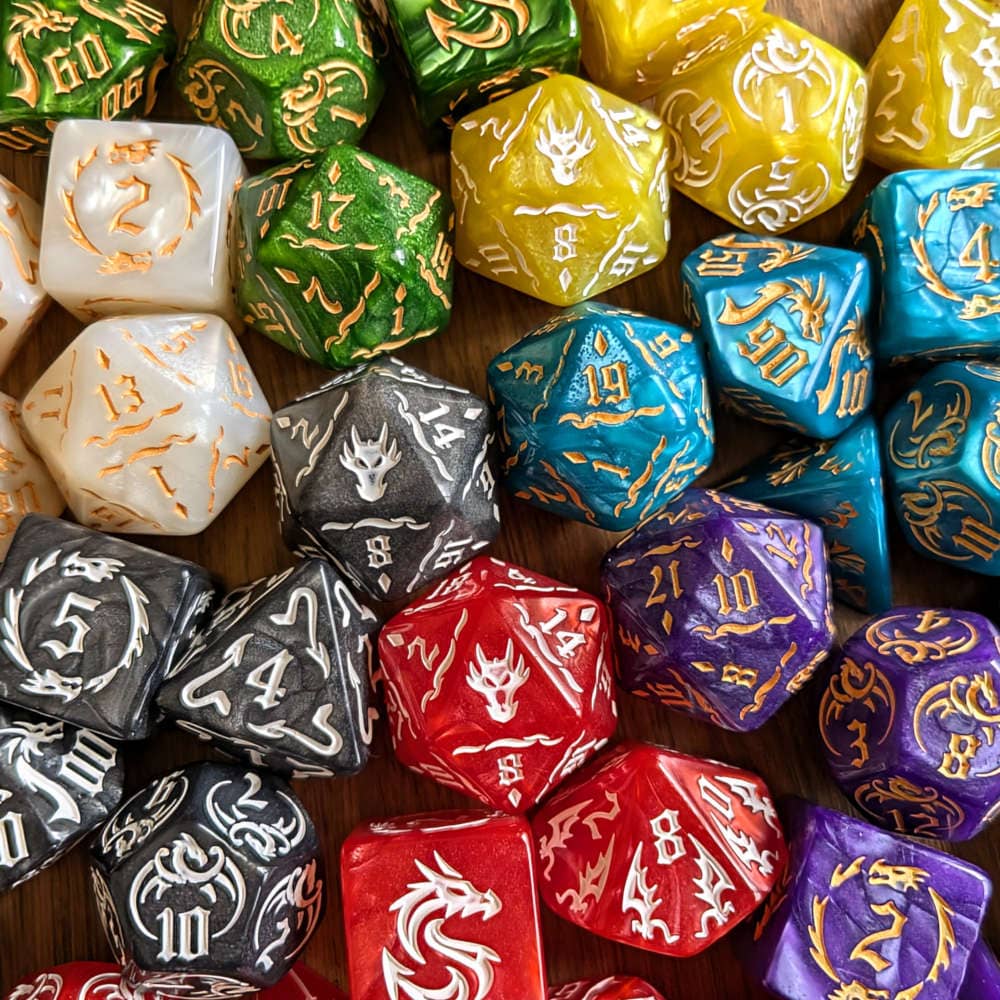
There are seven polyhedral dice in a standard D&D set. Each has a different shape and purpose. Here’s what you need to know:
D20: Twenty-sided die
Used for: Attacks, saving throws, ability checks

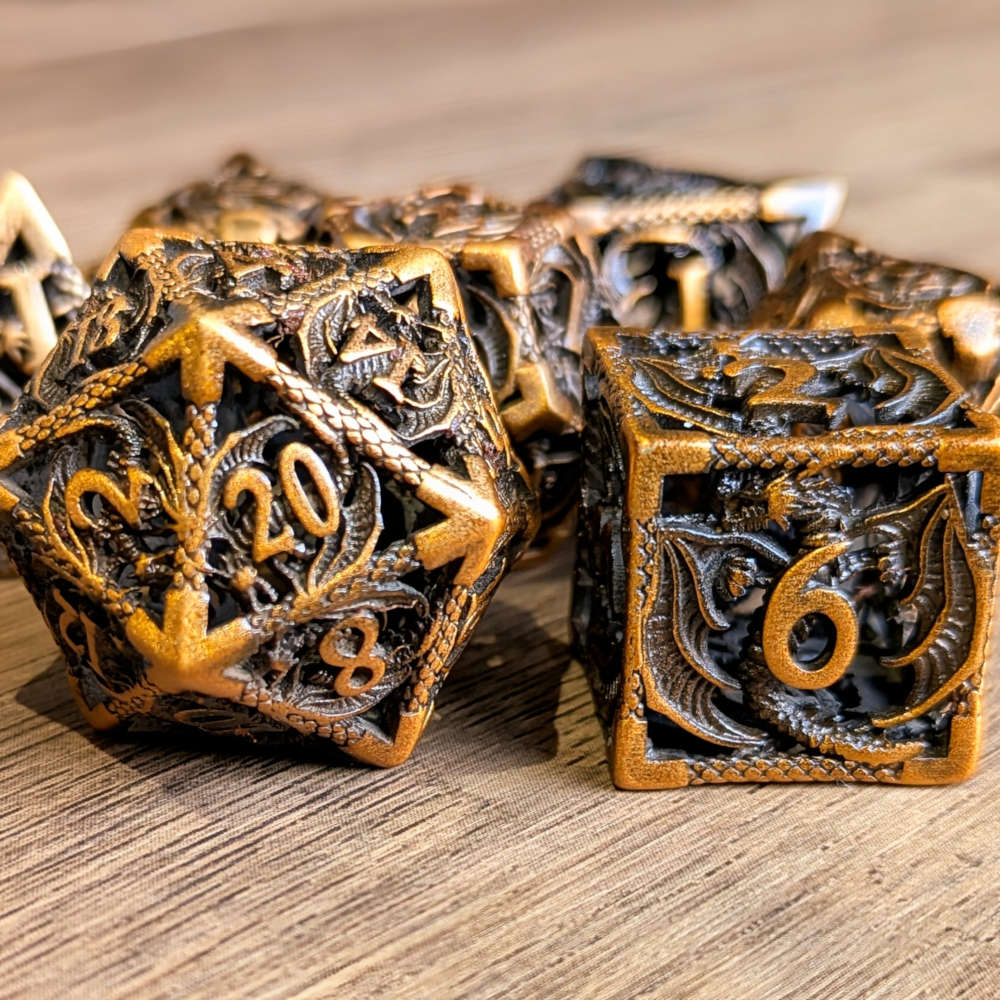
The D20, or the icosahedron, is a twenty-side die. Why does DND use a d20, you might ask? Well, it is used for a wide range of dice rolls. It is most notably used for attack rolls, ability checks, and saving throws.
As the most used die in D&D, it's the die that players hold their breath for, hoping to see that natural 20 come up when it counts most. Whether that’s in combat when you’re rolling to make a critical hit, or at the start of combat when rolling initiative.
D6: Six-sided die
Used for: Stat rolls, small weapon damage, sneak attack

The D6 is a cube-shaped die, also called a hexahedron, with six numbered sides.
Its uses in D&D include rolling for character stats during character creation and determining the damage dealt by some small weapons.
It's also used to calculate sneak attack and some spell damage. D6 dice come in a variety of styles and designs - some use pips or dots, and some numbers. Shop our range of d6 dice and find the right set for you.
D10: Ten-sided die
Used for: Some spell damage, class hit dice (e.g. Fighter)

The d10 is a pentagonal trapezohedron. In other words, it’s a die with ten numbered sides going from 1 to 10.
A d10 is used to roll for hit points when levelling up a Fighter, Paladin, or Ranger. There are also some spells that use the d10 for damage.
There are two d10 dice included in a DnD dice set. One is numbered 1 to 10, and the other is numbered 00 to 90, in increments of 10.
D%: Percentile die
Used for: Random tables (loot, encounters)

The percentile die, sometimes called a d100, is actually a ten-sided die. Instead of showing 1-10 like the d10 does, the percentile die shows 00-90. This is because it is used in combination with the d10 to make a d100 roll.
Rolling a d100 isn't too common in D&D, and it'll mostly be used by the Dungeon Master (DM) to roll on random loot and encounter tables.
When doing this, some people use the 2 d10 dice included. Others use a dedicated d100 die, which is numbered 1 to 100!
D8: Eight-sided die
Used for: Damage rolls and hit dice for mid-weight classes

The d8, or octahedron, is an eight-sided die with triangular faces. A d8 die reads 1 to 8.
It is frequently used to determine damage dealt by larger weapons.
It is also used to roll hit die for many classes including Bard, Rogue, and Monk.
It is also used in some healing spells in DnD.
D12: Twelve-sided die
Used for: Heavy weapon damage (e.g. Greataxe)

The D12 is a dodechaderon-shaped die with twelve numbered sides, reading from 1 to 12.
It is one of the less commonly used dice in D&D, mainly for rolling damage with heavy weapons.
There are also some less-common spells that use the d12 die for calculating damage. It is a high variance die - you have the chance of rolling a mighty 11 or 12, but equally, you could end up rolling a 1!
D4: Four-sided die
Used for: Small weapons (daggers) and minor spells

A d4 die, or a tetrahedron die, is used for damage dealt by many spells, and by some small weapons like the dagger.
It is the smallest die among the seven dice used in D&D, with four faces offering an outcome between 1 and 4.
There are a variety of different designs for d4 dice, so make sure you understand how to read a d4 correctly.
In short, some are read from the top, while some are read from the bottom.
FAQs: DnD Dice Explained Further
How many sides does a DnD dice have?
Each die in a DnD set has a different number of sides: 4, 6, 8, 10, 12, 20, and 100.
Why are there two D10s in a DnD set?
One is numbered 1-10, the other 00-90. Rolled together, they generate numbers from 1 to 100. Find out more in our guide to rolling a d100.
What does each DnD dice do?
Each die is tied to specific mechanics. For example, in D&D combat, a d6 deals dagger damage, while a d20 is used for attack rolls.
What does the "D" in d20 mean?
It stands for "die". So d20 = a 20-sided die.
What are DnD dice called?
DnD dice are often called "polyhedral dice", and a dice set includes a tetrahedron (d4), a cube (d6), a octahedron (d8), a pentagonal trapezohedron (d10), a dodecahedron (D12), and an icosahedron (d20).
How do DnD dice work?
You roll the die relevant to the action, then add modifiers. For example, you might be asked to make a Charisma check. You would roll a d20 and add your Charisma modifier to get your result. Results affect your success in the game.
What dice do I need to start playing DnD?
Dungeons and Dragons and most TTRPGs need a full set of dice, which includes: a d4, d6, d8, d10, d%, d12, and d20.
Which DnD dice is most used?
The most used die in D&D is the d20. It's used for ability checks, saving throws, and attack rolls, making it an essential tool for resolving various actions and determining outcomes in the game.
Can I play with just one dice set?
Yes! But Dungeon Masters or frequent players often get multiples for speed and style. Read more about this in our guide: How Many Dice Do I Need for D&D?
How do I choose between metal and resin dice?
The choice between resin and metal dice largely depends on budget and preference. Compare resin vs metal dice in our guide.
Ready to Roll?
Now that you know your d4s from your d20s, you're ready to explore! Check out our:
Make every roll magical with our full range of DnD Dice Sets. Whether you're a new adventurer or a seasoned DM, we've got the perfect set for your journey.