Sphalerite
A valid IMA mineral species
This page kindly sponsored by Mark Kucera
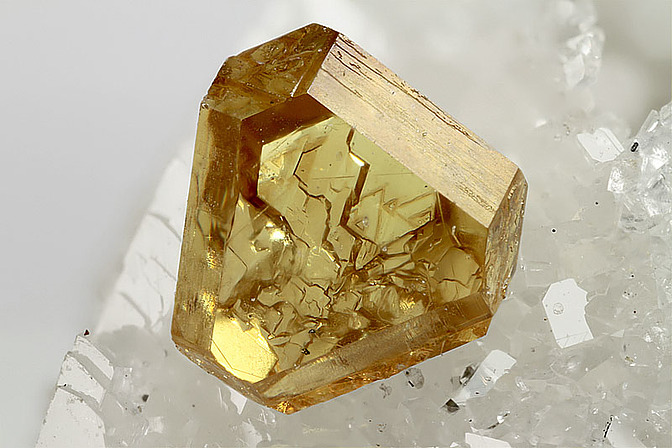
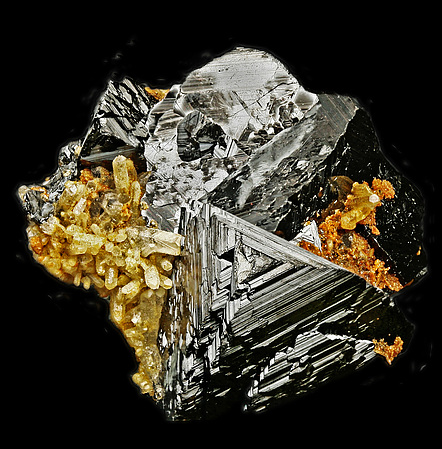
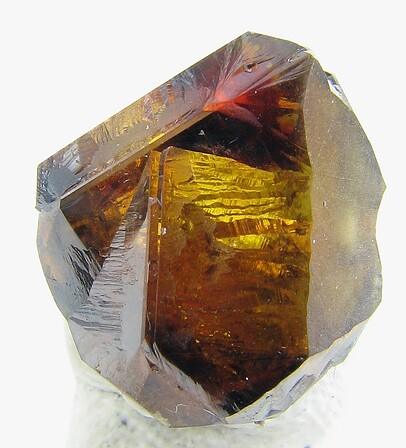
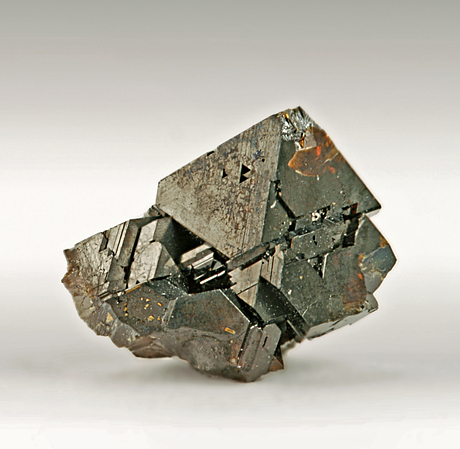
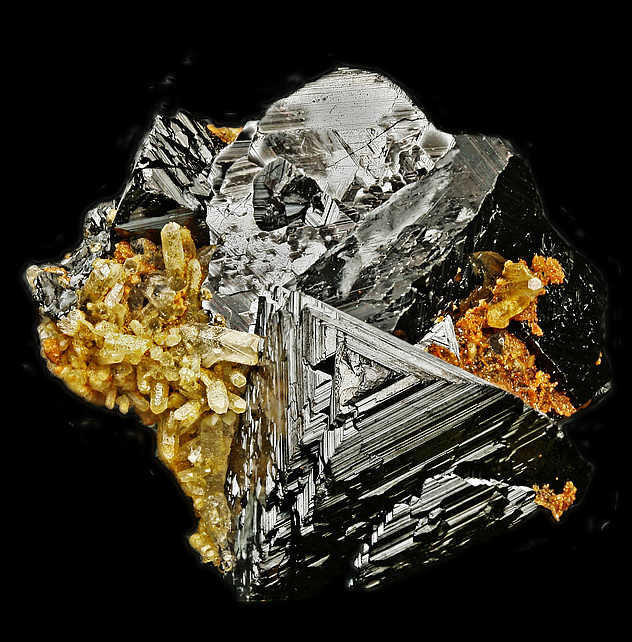
About Sphalerite
Formula:
ZnS
Colour:
Yellow, light to dark brown, black, red-brown, colourless, light blue, rarely green
Lustre:
Adamantine, Resinous
Hardness:
3½ - 4
Specific Gravity:
3.9 - 4.1
Crystal System:
Isometric
Member of:
Name:
Originally called blende in 1546 by Georgius Agricola (Georg Bauer). Known by a variety of chemical-based names subsequent to Agricola and before Glocker, including "zincum". Named Sphalerite in 1847 by Ernst Friedrich Glocker from the Greek σφαλεροζ "sphaleros" = treacherous, in allusion to the ease with which dark varieties were mistaken for galena, but yielded no lead.
Polymorph of:
Sphalerite Group.
Sphalerite, also known as blende or zinc blende, is the major ore of zinc. When pure (with little or no iron) it forms clear to white crystals (known as cleiophane). Yellow to orange sphalerite is often called 'golden sphalerite'.
Red shades of sphalerite have been called 'ruby blende' or 'ruby jack' in the past.
As iron content increases, sphalerite forms dark, opaque submetallic crystals (known as marmatite or, in the past, 'black jack').
Very rarely, green crystals owe their colour to trace amounts of cobalt (Henn & Hofmann, 1985; Rager et al., 1996).
Sphalerite may also contain considerable manganese, grading into alabandite. Samples containing up to 0.36 apfu (atoms per formula unit) manganese (21.4 wt.% MnO) have been described by Hurai & Huraiová (2011). It can also be mercury-rich and form a series with metacinnabar.
Sphalerite is an important source of rare metals like gallium (Ga) and indium (In), and the semi-metal germanium (Ge). Samples from the Restauradora vein of the Capillitas deposit, Argentina, bears a record, at 24.89 wt% In (and 13.49 wt% Cu) it is, astonishingly, still a sphalerite (Márquez-Zavalía et al. 2024).
See article on the schalenblende variety, by Harjo Neutkens: https://www.mindat.org/a/best_schalenblende
According to Haussühl and Müller (1963), there are numerous polytypes; the ones identified by them are 3R (=3C); 2H, 4H, 6H; and 9R, 12R, 15R and 21R. Note that this can be taken to infer that wurtzite (all the H polytypes) is merely a series of polytypes of sphalerite!
Compare UM1993-16-S:CdInZn and UM1993-15-S:CdInZn.
 Visit gemdat.org for gemological information about Sphalerite.
Sphalerite, also known as blende or zinc blende, is the major ore of zinc. When pure (with little or no iron) it forms clear to white crystals (known as cleiophane). Yellow to orange sphalerite is often called 'golden sphalerite'.
Red shades of sphalerite have been called 'ruby blende' or 'ruby jack' in the past.
As iron content increases, sphalerite forms dark, opaque submetallic crystals (known as marmatite or, in the past, 'black jack').
Very rarely, green crystals owe their colour to trace amounts of cobalt (Henn & Hofmann, 1985; Rager et al., 1996).
Sphalerite may also contain considerable manganese, grading into alabandite. Samples containing up to 0.36 apfu (atoms per formula unit) manganese (21.4 wt.% MnO) have been described by Hurai & Huraiová (2011). It can also be mercury-rich and form a series with metacinnabar.
Sphalerite is an important source of rare metals like gallium (Ga) and indium (In), and the semi-metal germanium (Ge). Samples from the Restauradora vein of the Capillitas deposit, Argentina, bears a record, at 24.89 wt% In (and 13.49 wt% Cu) it is, astonishingly, still a sphalerite (Márquez-Zavalía et al. 2024).
See article on the schalenblende variety, by Harjo Neutkens: https://www.mindat.org/a/best_schalenblende
According to Haussühl and Müller (1963), there are numerous polytypes; the ones identified by them are 3R (=3C); 2H, 4H, 6H; and 9R, 12R, 15R and 21R. Note that this can be taken to infer that wurtzite (all the H polytypes) is merely a series of polytypes of sphalerite!
Compare UM1993-16-S:CdInZn and UM1993-15-S:CdInZn.
Visit gemdat.org for gemological information about Sphalerite.Unique Identifiers
Mindat ID:
3727
Long-form identifier:
mindat:1:1:3727:9
Similar Names
IMA Classification of Sphalerite
Approved, 'Grandfathered' (first described prior to 1959)
Classification of Sphalerite
2.CB.05a
2 : SULFIDES and SULFOSALTS (sulfides, selenides, tellurides; arsenides, antimonides, bismuthides; sulfarsenites, sulfantimonites, sulfbismuthites, etc.)
C : Metal Sulfides, M: S = 1: 1 (and similar)
B : With Zn, Fe, Cu, Ag, etc.
2 : SULFIDES and SULFOSALTS (sulfides, selenides, tellurides; arsenides, antimonides, bismuthides; sulfarsenites, sulfantimonites, sulfbismuthites, etc.)
C : Metal Sulfides, M: S = 1: 1 (and similar)
B : With Zn, Fe, Cu, Ag, etc.
2.8.2.1
2 : SULFIDES
8 : AmXp, with m:p = 1:1
2 : SULFIDES
8 : AmXp, with m:p = 1:1
3.4.4
3 : Sulphides, Selenides, Tellurides, Arsenides and Bismuthides (except the arsenides, antimonides and bismuthides of Cu, Ag and Au, which are included in Section 1)
4 : Sulphides etc. of Group II metals other than Hg (Mg, Ca, Zn, Cd)
3 : Sulphides, Selenides, Tellurides, Arsenides and Bismuthides (except the arsenides, antimonides and bismuthides of Cu, Ag and Au, which are included in Section 1)
4 : Sulphides etc. of Group II metals other than Hg (Mg, Ca, Zn, Cd)
Mineral Symbols
As of 2021 there are now IMA–CNMNC approved mineral symbols (abbreviations) for each mineral species, useful for tables and diagrams.
Please only use the official IMA–CNMNC symbol. Older variants are listed for historical use only.
Please only use the official IMA–CNMNC symbol. Older variants are listed for historical use only.
| Symbol | Source | Reference |
|---|---|---|
| Sp | IMA–CNMNC | Warr, L.N. (2021). IMA–CNMNC approved mineral symbols. Mineralogical Magazine, 85(3), 291-320. doi:10.1180/mgm.2021.43 |
| Sp | Kretz (1983) | Kretz, R. (1983) Symbols of rock-forming minerals. American Mineralogist, 68, 277–279. |
| Sp | Siivolam & Schmid (2007) | Siivolam, J. and Schmid, R. (2007) Recommendations by the IUGS Subcommission on the Systematics of Metamorphic Rocks: List of mineral abbreviations. Web-version 01.02.07. IUGS Commission on the Systematics in Petrology. download |
| Sp | Whitney & Evans (2010) | Whitney, D.L. and Evans, B.W. (2010) Abbreviations for names of rock-forming minerals. American Mineralogist, 95, 185–187 doi:10.2138/am.2010.3371 |
| Sp | The Canadian Mineralogist (2019) | The Canadian Mineralogist (2019) The Canadian Mineralogist list of symbols for rock- and ore-forming minerals (December 30, 2019). download |
Physical Properties of Sphalerite
Adamantine, Resinous
Transparency:
Transparent, Translucent
Colour:
Yellow, light to dark brown, black, red-brown, colourless, light blue, rarely green
Comment:
Coloration of sphalerites from the Binntal, CH - varying from yellow to black for nearly identical iron contents - seems to be strongly influenced by the manganese content (Graeser, 1969).
Streak:
Pale yellow to brown.
Hardness:
3½ - 4 on Mohs scale
Hardness:
VHN100=208 - 224 kg/mm2 - Vickers
Tenacity:
Brittle
Cleavage:
Perfect
Perfect {011}
Perfect {011}
Fracture:
Conchoidal
Density:
3.9 - 4.1 g/cm3 (Measured) 4.096 g/cm3 (Calculated)
Optical Data of Sphalerite
Type:
Isotropic
RI values:
nα = 2.369
Birefringence:
May show strain induced birefringence
Surface Relief:
Moderate
Reflectivity:
| Wavelength | R1 (%) |
|---|---|
| 400nm | 19.6% |
| 420nm | 19.0% |
| 440nm | 18.3% |
| 460nm | 17.9% |
| 480nm | 17.5% |
| 500nm | 17.2% |
| 520nm | 16.9% |
| 540nm | 16.7% |
| 560nm | 16.5% |
| 580nm | 16.4% |
| 600nm | 16.3% |
| 620nm | 16.2% |
| 640nm | 16.1% |
| 660nm | 16.0% |
| 680nm | 15.9% |
| 700nm | 15.8% |
Graph shows reflectance levels at different wavelengths (in nm). Peak reflectance is 19.6%.
Colour in reflected light:
Medium gray
Internal Reflections:
White, yellow, red, brown
Pleochroism:
Non-pleochroic
Chemistry of Sphalerite
Mindat Formula:
ZnS
Elements listed:
Common Impurities:
Fe,Mn,Cd,Hg,In,Tl,Ga,Ge,Sb,Sn,Pb,Ag,Co
Age distribution
Recorded ages:
Phanerozoic : 519 Ma to 48.9 Ma - based on 24 recorded ages.
Chemical Analysis
Oxide wt%:
| 1 | |
|---|---|
| S | 29.51 % |
| Zn | 31.03 % |
| In | 24.89 % |
| Cu | 13.49 % |
| Ga | 0.96 % |
| Cd | 0.54 % |
| Fe | 0.05 % |
| Total: | 100.47 % |
Sample references:
| ID | Locality | Reference | Notes |
|---|---|---|---|
| 1 | Restauradora vein, Capillitas mining district, Andalgalá Department, Catamarca Province, Argentina | average of 10 analytical spots |
Crystallography of Sphalerite
Crystal System:
Isometric
Class (H-M):
4 3m - Hextetrahedral
Space Group:
F4 3m
Cell Parameters:
a = 5.406 Å
Unit Cell V:
157.99 ų (Calculated from Unit Cell)
Z:
4
Twinning:
{111}
Crystallographic forms of Sphalerite
Crystal Atlas:
Image Loading
Click on an icon to view

Sphalerite no.1 - Goldschmidt (1913-1926)
Sphalerite no.3 - Goldschmidt (1913-1926)
Sphalerite no.9 - Goldschmidt (1913-1926)
Sphalerite no.13 - Goldschmidt (1913-1926)
Sphalerite no.33 - Goldschmidt (1913-1926)
Sphalerite no.46 - Goldschmidt (1913-1926)
Sphalerite no.53 - Goldschmidt (1913-1926)
Sphalerite no.162 - Goldschmidt (1913-1926)
3d models and HTML5 code kindly provided by
www.smorf.nl.
Toggle
Edge Lines | Miller Indices | Axes
Transparency
Opaque | Translucent | Transparent
View
Along a-axis | Along b-axis | Along c-axis | Start rotation | Stop rotation
Toggle
Edge Lines | Miller Indices | Axes
Transparency
Opaque | Translucent | Transparent
View
Along a-axis | Along b-axis | Along c-axis | Start rotation | Stop rotation
Crystal Structure
Load
Unit Cell | Unit Cell Packed
2x2x2 | 3x3x3 | 4x4x4
Unit Cell | Unit Cell Packed
2x2x2 | 3x3x3 | 4x4x4
Show
Big Balls | Small Balls | Just Balls | Spacefill
Polyhedra Off | Si Polyhedra | All Polyhedra
Remove metal-metal sticks
Big Balls | Small Balls | Just Balls | Spacefill
Polyhedra Off | Si Polyhedra | All Polyhedra
Remove metal-metal sticks
Display Options
Black Background | White Background
Perspective On | Perspective Off
2D | Stereo | Red-Blue | Red-Cyan
Black Background | White Background
Perspective On | Perspective Off
2D | Stereo | Red-Blue | Red-Cyan
View
CIF File Best | x | y | z | a | b | c
CIF File Best | x | y | z | a | b | c
Rotation
Stop | Start
Stop | Start
Labels
Console Off | On | Grey | Yellow
Console Off | On | Grey | Yellow
Data courtesy of the American Mineralogist Crystal Structure Database. Click on an AMCSD ID to view structure
| ID | Species | Reference | Link | Year | Locality | Pressure (GPa) | Temp (K) |
|---|---|---|---|---|---|---|---|
| 0000110 | Sphalerite | Skinner B J (1961) Unit-cell edges of natural and synthetic sphalerites American Mineralogist 46 1399-1411 |  | 1961 | synthetic | 0 | 293 |
| 0018098 | Sphalerite | de Jong W (1927) Marmatit und christophit _cod_database_code 1011232 Zeitschrift fur Kristallographie 66 515-515 | 1927 | 0 | 293 | ||
| 0018099 | Sphalerite | de Jong W (1927) Marmatit und christophit _cod_database_code 1011233 Zeitschrift fur Kristallographie 66 515-515 | 1927 | 0 | 293 | ||
| 0018328 | Sphalerite | Nitta E, Kimata M, Hoshino M, Echigo T, Hamasaki S, Nishida N, Shimizu M, Akasak T (2008) Crystal chemistry of ZnS minerals formed as high-temperature volcanic sublimates: matraite identical with sphalerite Journal of Mineralogical and Petrological Sciences 103 145-151 | 2008 | Iwodake volcano, Satsuma-Iwojima, Kyushu, SW Japan | 0 | 293 |
CIF Raw Data - click here to close
X-Ray Powder Diffraction
Loading XRD data...
Data courtesy of RRUFF project at University of Arizona, used with permission.
Powder Diffraction Data:
| d-spacing | Intensity |
|---|---|
| 3.123 Å | (100) |
| 2.705 Å | (10) |
| 1.912 Å | (51) |
| 1.633 Å | (30) |
| 1.561 Å | (2) |
| 1.351 Å | (6) |
| 1.240 Å | (9) |
| 1.209 Å | (2) |
| 1.1034 Å | (9) |
| 1.0403 Å | (5) |
| 0.9557 Å | (3) |
| 0.9138 Å | (5) |
| 0.8548 Å | (3) |
| 0.8244 Å | (2) |
Comments:
ICDD 5-566 (synthetic). Similar data to that of cerianite-(Ce).
Geological Environment
Paragenetic Mode(s):
Synonyms of Sphalerite
Other Language Names for Sphalerite
Bosnian:Sfalerit
Catalan:Esfalerita
Czech:Sfalerit
Dutch:Zinkblende
Farsi/Persian:بلندروی
Finnish:Sinkkivälke
French:Sphalérite
German:Sphalerit
Blende
Brunckit
Brunkit
Marasmolit
Zinkblende
Rubinblende (in part)
Blende
Brunckit
Brunkit
Marasmolit
Zinkblende
Rubinblende (in part)
Hebrew:ספלריט
Hungarian:Szfalerit
Italian:Sfalerite
Japanese:閃亜鉛鉱
Latvian:Sfalerīts
Lithuanian:Sfaleritas
Low Saxon/Low German:Sphalerit
Norwegian:Sinkblende
Norwegian (Nynorsk):Sinkblende
Polish:Sfaleryt
Portuguese:Blenda
Romanian:Blendă
Russian:Сфалерит
Simplified Chinese:闪锌矿
Slovak:Sfalerit
Spanish:Blenda
Esfalerita
Esfalerita
Swedish:Zinkblände
Traditional Chinese:閃鋅礦
Ukrainian:Сфалерит
Varieties of Sphalerite
| Cadmium-bearing Sphalerite | A Cd-bearing variety of sphalerite. Rather common. |
| Cleiophane | Cleiophane is colorless to white or green sphalerite due to low contents of Fe2+ and Mn2+. Yellow gemmy sphalerite is called "golden sphalerite." First reported from Franklin, Franklin Mining District, Sussex Co., New Jersey, USA. |
| Gallium-bearing Sphalerite | Enrichment in Ga (and other rare elements like, especially, Cd) is quite typical for many sphalerites, and sphalerite may act as an important source of Ga. |
| Gem Blende | A ruby-red translucent variety of "blende" (= sphalerite). The translucency increases with decreasing iron content. |
| Honigblende | German name for honey-coloured sphalerite. |
| Indium-bearing Sphalerite | An In-bearing variety of sphalerite. It is usually also Cu-rich (coupled substitution of Cu+ + In3+ <-> 2Zn2+). In contents close to 22 wt.% are reported by Márquez-Zavalía et al. (2020). |
| Marmatite | A macroscopically opaque and black, iron-rich variety of sphalerite, with up to 25 wt% Fe, or 40 mol% FeS, usually also Mn-rich, formed at relatively high temperatures. |
| Mercury-bearing Sphalerite | A mercury-bearing variety of sphalerite. See also Polhemusite. |
| Mátraite | A densely twinned columnar variety of sphalerite. Discredited as 2006-C. Nitta et al. (2008) showed that the sphalerite is twinned on {111}. Originally reported from Gyöngyösoroszi, Mátra Mts., Heves Co., Hungary. |
| Pyrophoric sphalerite | A variety of sphalerite that gives off sparks or glows when abraded. Some pieces are so sensitive that the effect is obtained by scratching them with a fingernail (definitions furnished by Frank L. Hess, Mining Engineer, U.S. Bureau of Mines, Collee Park,... |
| Ruby Jack | Red variety of sphalerite. |
Relationship of Sphalerite to other Species
Member of:
Other Members of Sphalerite Group:
| Browneite | MnS | Iso. 4 3m : F4 3m |
| Coloradoite | HgTe | Iso. 4 3m : F4 3m |
| Hawleyite | CdS | Iso. 4 3m : F4 3m |
| Ishiharaite | (Cu,Ga,Fe,In,Zn)S | Iso. 4 3m : F4 3m |
| Metacinnabar | HgS | Iso. 4 3m : F4 3m |
| Rudashevskyite | (Fe,Zn)S | Iso. 4 3m : F4 3m |
| Stilleite | ZnSe | Iso. 4 3m : F4 3m |
| Tiemannite | HgSe | Iso. 4 3m : F4 3m |
Common Associates
Associated Minerals Based on Photo Data:
| 8,919 photos of Sphalerite associated with Quartz | SiO2 |
| 6,352 photos of Sphalerite associated with Galena | PbS |
| 5,140 photos of Sphalerite associated with Calcite | CaCO3 |
| 5,049 photos of Sphalerite associated with Pyrite | FeS2 |
| 4,073 photos of Sphalerite associated with Chalcopyrite | CuFeS2 |
| 3,555 photos of Sphalerite associated with Fluorite | CaF2 |
| 2,548 photos of Sphalerite associated with Dolomite | CaMg(CO3)2 |
| 1,930 photos of Sphalerite associated with Siderite | FeCO3 |
| 1,247 photos of Sphalerite associated with Baryte | BaSO4 |
| 874 photos of Sphalerite associated with Marcasite | FeS2 |
Related Minerals - Strunz-mindat Grouping
| 2.CB. | Richardsite | Zn2CuGaS4 |
| 2.CB. | Okruginite | Cu2SnSe3 |
| 2.CB. | Hanswilkeite | KFeS2 |
| 2.CB. | Auroselenide | AuSe |
| 2.CB. | Ruizhongite | (Ag2◻)Pb3Ge2S8 |
| 2.CB. | Agmantinite | Ag2MnSnS4 |
| 2.CB. | Tolstykhite | Au3S4Te6 |
| 2.CB. | Gachingite | Au(Te1-xSex) |
| 2.CB.05a | Hawleyite | CdS |
| 2.CB.05 | UM1998-15-S:CuFeZn | Cu2Fe3Zn5S10 |
| 2.CB.05a | Coloradoite | HgTe |
| 2.CB.05a | Metacinnabar | HgS |
| 2.CB.05a | Tiemannite | HgSe |
| 2.CB.05b | Sakuraiite | (Cu,Zn,Fe)3(In,Sn)S4 |
| 2.CB.05c | Polhemusite | (Zn,Hg)S |
| 2.CB.05a | Rudashevskyite | (Fe,Zn)S |
| 2.CB.05a | Stilleite | ZnSe |
| 2.CB.05a | Ishiharaite | (Cu,Ga,Fe,In,Zn)S |
| 2.CB.07a | Unnamed (Cu-Mn-Sn Sulphide) | Cu2MnSnS4 |
| 2.CB.07a | Shenzhuangite | NiFeS2 |
| 2.CB.10b | Talnakhite | Cu9(Fe,Ni)8S16 |
| 2.CB.10b | Haycockite | Cu4Fe5S8 |
| 2.CB.10a | Lenaite | AgFeS2 |
| 2.CB.10a | Gallite | CuGaS2 |
| 2.CB.10a | Roquesite | CuInS2 |
| 2.CB.10a | Eskebornite | CuFeSe2 |
| 2.CB.10a | UM1984-30-S:CuFeSn | Cu2Fe2Sn3S7 |
| 2.CB.10c | Omariniite | Cu8Fe2ZnGe2S12 |
| 2.CB.10a | Chalcopyrite | CuFeS2 |
| 2.CB.10a | Unnamed (Cu-Zn-In Sulphide) | CuZn2InS4 |
| 2.CB.10b | Mooihoekite | Cu9Fe9S16 |
| 2.CB.10a | Laforêtite | AgInS2 |
| 2.CB.10b | Putoranite | Cu1.1Fe1.2S2 |
| 2.CB.15a | Velikite | Cu2HgSnS4 |
| 2.CB.15c | UM2006-11-S:CuFeGeZn | Cu8(Fe,Zn)3Ge2S12 (?) |
| 2.CB.15a | Hocartite | Ag2(Fe2+,Zn)SnS4 |
| 2.CB.15a | Kësterite | Cu2ZnSnS4 |
| 2.CB.15a | Pirquitasite | Ag2ZnSnS4 |
| 2.CB.15a | Stannite | Cu2FeSnS4 |
| 2.CB.15c | Stannoidite | Cu+6Cu2+2(Fe2+,Zn)3Sn2S12 |
| 2.CB.15b | Mohite | Cu2SnS3 |
| 2.CB.15a | Černýite | Cu2CdSnS4 |
| 2.CB.15a | Idaite | Cu5FeS6 |
| 2.CB.15a | Ferrokësterite | Cu2FeSnS4 |
| 2.CB.15a | Kuramite | Cu3SnS4 |
| 2.CB.17a v | Arsenic-bearing Renierite | Cu11GeAsFe4S16 |
| 2.CB.20 | Mawsonite | Cu6Fe2SnS8 |
| 2.CB.20 | Chatkalite | Cu6FeSn2S8 |
| 2.CB.30 | Frieseite | Ag2Fe5S8 (?) |
| 2.CB.30 | Nekrasovite | Cu26V2(Sn,As,Sb)6S32 |
| 2.CB.30 | Argyropyrite | near Ag2Fe7S11 |
| 2.CB.30 | Maikainite | Cu20(Fe,Cu)6Mo2Ge6S32 |
| 2.CB.30 | Colusite | Cu13VAs3S16 |
| 2.CB.30 | Germanite | Cu13Fe2Ge2S16 |
| 2.CB.30 | Germanocolusite | Cu26V2(Ge,As)6S32 |
| 2.CB.30 | Stibiocolusite | Cu13V(Sb,Sn,As)3S16 |
| 2.CB.30 | Ovamboite | Cu20(Fe,Cu,Zn)6W2Ge6S32 |
| 2.CB.35a | Morozeviczite | (Pb,Fe)3Ge1-xS4 |
| 2.CB.35a | Renierite | (Cu1+,Zn)11Fe4(Ge4+,As5+)2S16 |
| 2.CB.35a | Hemusite | Cu6SnMoS8 |
| 2.CB.35b | Catamarcaite | Cu6GeWS8 |
| 2.CB.35a | Vinciennite | Cu+7Cu2+3Fe2+2Fe3+2Sn(As,Sb)S16 |
| 2.CB.35a | Kiddcreekite | Cu6SnWS8 |
| 2.CB.35a | Polkovicite | (Fe,Pb)3(Ge,Fe)1-xS4 |
| 2.CB.40 | Lautite | CuAsS |
| 2.CB.42 | Lingbaoite | AgTe3 |
| 2.CB.45 | Cadmoselite | CdSe |
| 2.CB.45 | Rambergite | MnS |
| 2.CB.45 | Buseckite | (Fe,Zn,Mn)S |
| 2.CB.45 | Maletoyvayamite | Au3Se4Te6 |
| 2.CB.45 | Greenockite | CdS |
| 2.CB.45 | Wurtzite | (Zn,Fe)S |
| 2.CB.47 | Murchisite | Cr5S6 |
| 2.CB.50 | Zincselenide | ZnSe |
| 2.CB.50 | Wassonite | TiS |
| 2.CB.52 | Dzhezkazganite | ReMoCu2PbS6 ? |
| 2.CB.55b | Isocubanite | CuFe2S3 |
| 2.CB.55a | Cubanite | CuFe2S3 |
| 2.CB.60 | Raguinite | TlFeS2 |
| 2.CB.60 | Picotpaulite | TlFe2S3 |
| 2.CB.65 | Argentopyrite | AgFe2S3 |
| 2.CB.65 | Sternbergite | AgFe2S3 |
| 2.CB.70 | Sulvanite | Cu3VS4 |
| 2.CB.75 | Vulcanite | CuTe |
| 2.CB.80 | Empressite | AgTe |
| 2.CB.85 | Muthmannite | AuAgTe2 |
Fluorescence of Sphalerite
Light colored sphalerite may fluoresce in blue or orange in LW. Fluoresces less strongly, sometimes not at all, in SW or MW.
Other Information
Health Risks:
May be rich in some toxic elements, eg Cd, Hg.
Sphalerite in petrology
An essential component of rock names highlighted in red, an accessory component in rock names highlighted in green.
Internet Links for Sphalerite
mindat.org URL:
https://www.mindat.org/min-3727.html
Please feel free to link to this page.
Please feel free to link to this page.
Search Engines:
External Links:
References for Sphalerite
Reference List:
Glocker, Ernst Friedrich (1847) Generum et specierum mineralium, secundum ordines naturales digestorum synopsis, omnium, quotquot adhuc reperta sunt, mineralium nomina complectens [A synopsis of the genera and species of minerals, according to their natural orders, including the names of all the minerals that have yet been discovered.]. Eduardus Anton. 348 pp. pp.17-18
Palache, Charles (1932) Multiple twins of diamond and sphalerite. American Mineralogist, 17 (7) 360-361
Buerger, N. W. (1934) The unmixing of chalcopyrite from sphalerite. American Mineralogist, 19 (11) 525-530
Brown, John Stafford (1936) Supergene sphalerite, galena, and willemite at Balmat, New York. Economic Geology, 31 (4) 331-354 doi:10.2113/gsecongeo.31.4.331
Evrard, Pierre (1945) Minor elements in sphalerites from Belgium. Economic Geology, 40 (8) 568-574 doi:10.2113/gsecongeo.40.8.568
Kopp, Otto C., Kerr, Paul F. (1958) Differential thermal analysis of sphalerite. American Mineralogist, 43 (7-8) 732-748
Rooymans, C.J.M. (1963) A phase transformation in the wurtzite and zinc blende lattice under pressure. Journal of Inorganic and Nuclear Chemistry, 25 (3) 253-255 doi:10.1016/0022-1902(63)80050-0
Williams, K. L. (1965) Determination of the iron content of sphalerite. Economic Geology, 60 (8) 1740-1747 doi:10.2113/gsecongeo.60.8.1740
Barton, Paul B., Toulmin, Priestley (1966) Phase relations involving sphalerite in the Fe-Zn-S system. Economic Geology, 61 (5) 815-849 doi:10.2113/gsecongeo.61.5.815
Graeser, Stefan (1969) Minor elements in sphalerite and galena from Binnatal. Contributions to Mineralogy and Petrology, 24 (2) 156-163 doi:10.1007/bf00376888(Coloration of sphalerites from the Binntal, CH - varying from yellow to black for nearly identical iron contents - seems to be strongly influenced by the manganese content.)
Clark, Alan H. (1970) Arsenian sphalerite from Mina Alcaran, Pampa Larga, Copiapó, Chile. American Mineralogist, 55 (9-10) 1794-1796
Scott, S. D., Barnes, H. L. (1971) Sphalerite geothermometry and geobarometry. Economic Geology, 66 (4) 653-669 doi:10.2113/gsecongeo.66.4.653
Scott, S. D., Kissin, S. A. (1973) Sphalerite Composition in the Zn-Fe-S System Below 300°C. Economic Geology, 68 (4). 475-479 doi:10.2113/gsecongeo.68.4.475
Fleet, Michael E. (1977) Structural transformations in natural ZnS. American Mineralogist, 62 (5-6) 540-546
Maurel, Colette (1978) Stabilité de la blende dans le système Zn-Cd-S. Bulletin de Minéralogie, 101 (4) 406-411 doi:10.3406/bulmi.1978.7209
Shimizu, M.; Shimazaki, H. (1981) Application of the sphalerite geobarometer to some skarn-type ore deposits. Mineralium Deposita, 16 (1). 45-50 doi:10.1007/bf00206453
Geilikman, M. B. (1982) Mechanisms of polytype stabilization during the wurtzite-sphalerite transition. Physics and Chemistry of Minerals, 8 (1) 2-7 doi:10.1007/bf00311155
Barton, Paul B., Bethke, Philip M. (1987) Chalcopyrite disease in sphalerite: Pathology and epidemiology. American Mineralogist, 72 (5-6) 451-467
Dickinson, C., Pattrick, R. A. D. (1987) A TEM investigation of optical variations in sphalerite. Mineralogical Magazine, 51 (359) 127 doi:10.1180/minmag.1987.051.359.13
Toulmin, Priestley, III; Barton, P. B., Jr.; Wiggins, L. B. (1991) Commentary on the sphalerite geobarometer. American Mineralogist, 76 (5-6). 1038-1051
Rager, Helmut, Amthauer, Georg, Bernroider, Manfred (1996) Colour, crystal chemistry, and mineral association of a green sphalerite from Steinperf, Dill syncline, FRG. European Journal of Mineralogy, 8 (5) 1191-1198 doi:10.1127/ejm/8/5/1191
Lusk, John, Calder, Brian O.E (2004) The composition of sphalerite and associated sulfides in reactions of the Cu–Fe–Zn–S, Fe–Zn–S and Cu–Fe–S systems at 1 bar and temperatures between 250 and 535 °C. Chemical Geology, 203 (3) 319-345 doi:10.1016/j.chemgeo.2003.10.011
Deore, S., Navrotsky, A. (2006) Oxide melt solution calorimetry of sulfides: Enthalpy of formation of sphalerite, galena, greenockite, and hawleyite. American Mineralogist, 91 (2) 400-403 doi:10.2138/am.2006.1921
Tan, Zheng, Su, Xuping, Li, Zhi, Liu, Ya, Wang, Jianhua (2007) Phase equilibria in the Zn–Fe–S system at 450°C. International Journal of Materials Research, 98 (1) 16-20 doi:10.3139/146.101435
Cook, Nigel J., Ciobanu, Cristiana L., Pring, Allan, Skinner, William, Shimizu, Masaaki, Danyushevsky, Leonid, Saini-Eidukat, Bernhardt, Melcher, Frank (2009) Trace and minor elements in sphalerite: A LA-ICPMS study. Geochimica et Cosmochimica Acta, 73 (16) 4761-4791 doi:10.1016/j.gca.2009.05.045
Osadchii, Evgeniy G., Gorbaty, Yuri E. (2010) Raman spectra and unit cell parameters of sphalerite solid solutions (FexZn1−xS) Geochimica et Cosmochimica Acta, 74 (2) 568-573 doi:10.1016/j.gca.2009.10.022
Hurai, Vratislav, Huraiová, Monika (2011) Origin of ferroan alabandite and manganoan sphalerite from the Tisovec skarn, Slovakia. Neues Jahrbuch für Mineralogie - Abhandlungen, 188 (2) 119-134 doi:10.1127/0077-7757/2011/0183
Cook, N. J., Ciobanu, C. L., Brugger, J., Etschmann, B., Howard, D. L., de Jonge, M. D., Ryan, C., Paterson, D. (2012) Determination of the oxidation state of Cu in substituted Cu-In-Fe-bearing sphalerite via μ-XANES spectroscopy. American Mineralogist, 97 (2). 476-479 doi:10.2138/am.2012.4042
Cook, Nigel, Etschmann, Barbara, Ciobanu, Cristiana, Geraki, Kalotina, Howard, Daryl, Williams, Timothy, Rae, Nick, Pring, Allan, Chen, Guorong, Johannessen, Bernt, Brugger, Joël (2015) Distribution and Substitution Mechanism of Ge in a Ge-(Fe)-Bearing Sphalerite. Minerals, 5 (2) 117-132 doi:10.3390/min5020117
Gurevich, V.M., Osadchii, V.O., Polyakov, V.B., Gavrichev, K.S., Osadchii, E.G. (2016) Heat capacity and thermodynamic functions of sphalerite: Implication to sulfide solid-state galvanic cell measurements. Thermochimica Acta, 641. 14-23 doi:10.1016/j.tca.2016.08.006
Goldmann, Simon, Junge, Malte, Wirth, Richard, Schreiber, Anja (2019) Distribution of trace elements in sphalerite and arsenopyrite on the nanometre-scale – discrete phases versus solid solution. European Journal of Mineralogy, 31 (2) 325-333 doi:10.1127/ejm/2019/0031-2807
Li, M., Barnes, H.L. (2019) Orbitally forced sphalerite growth in the Upper Mississippi Valley District. Geochemical Perspectives Letters, 12. 18-22 doi:10.7185/geochemlet.1929 "(...) banding in sphalerite follows the Milankovitch climate frequencies over 104 – 105 years"
Pring, Allan, Wade, Benjamin, McFadden, Aoife, Lenehan, Claire E., Cook, Nigel J. (2020) Coupled Substitutions of Minor and Trace Elements in Co-Existing Sphalerite and Wurtzite. Minerals, 10 (2) 147 doi:10.3390/min10020147
White, Sarah Jane O., Piatak, Nadine M., McAleer, Ryan J., Hayes, Sarah M., Seal, Robert R., Schaider, Laurel A., Shine, James P. (2022) Germanium redistribution during weathering of Zn mine wastes: Implications for environmental mobility and recovery of a critical mineral. Applied Geochemistry, 143. 105341 doi:10.1016/j.apgeochem.2022.105341(on valency of Ge in sphalerite)
Márquez‐Zavalía, María Florencia, Vymazalová, Anna, Galliski, Miguel Ángel, Laufek, František, Tuhý, Marek, Watanabe, Yasushi, Bernhardt, Heinz‐Jürgen (2024) Indium‐copper‐rich sphalerite from the Restauradora vein, Capillitas, Catamarca, Argentina. Resource Geology, 74 (1) doi:10.1111/rge.12325
Sun, Guotao, Zhou, Jia-xi, Cugerone, Alexandre, Zhou, Mei-fu, Zhou, Lingli (2024) Germanium-rich nanoparticles in Cu-poor sphalerite: A new mechanism for Ge enrichment. Geological Society of America Bulletin, 136 (7) 2891-2905 doi:10.1130/b37014.1
Barbier, Tristan, Lebedev, Oleg I., Maignan, Antoine (2024) Metal Substitutions (M = Al, Ga, In; Sn, Ge; and Mn, Fe, Co) in ZnS: Sphalerite versus Wurtzite Formation. Inorganic Chemistry, 63 (16) 7189-7198 doi:10.1021/acs.inorgchem.3c04374
Xiao, Fan; He, Zongcong; Zheng, Yi; Xiong, Suofei; Cheng, Qiuming (2025) A DFT study on mechanisms of indium absorption in sphalerite (100), (110), and (111) surfaces: Implications for critical metal mineralization. Ore Geology Reviews, 106572 doi:10.1016/j.oregeorev.2025.106572
Luo, Kai; Cugerone, Alexandre; Fougerouse, Denis; Zhou, Jia-Xi; Xian, Haiyang; Yang, Yiping; Saxey, David W.; Motto-Ros, Vincent; Sun, Xiao; Rickard, William D.A.; et al. (2025) Rapid crystal growth promotes the precipitation of nanoscale fluid inclusions rich in halogens and metals in colloform sphalerite. Geochimica et Cosmochimica Acta, 398. 119-138 doi:10.1016/j.gca.2025.04.003
Yan, Lei; Fan, Yu; Huang, Jun; Zuo, Tong; Wang, Fangyue; Zhou, Taofa (2025) Formation of nano-CdS solid solution: A mechanism for Cd enrichment in sphalerite. American Mineralogist, 110 (8). doi:10.2138/am-2024-9524
Niu, Pan-Pan; Jiang, Shao-Yong; Muñoz, Manuel; Bonnet, Clément; Mathon, Olivier; Boiron, Marie-Christine; Wei, Hai-Zhen; Xiong, Suo-Fei (2025) Germanium oxidation state and substitution mechanism in Ge-rich sphalerite from MVT deposits: Constraints from X-ray absorption fine structure (XAFS) and geometric optimization. American Mineralogist, 110 (9). 1399-1414 doi:10.2138/am-2024-9485
Significant localities for Sphalerite
Showing 44 significant localities out of 27,011 recorded on mindat.org.
 symbol to view information about a locality.
The
symbol to view information about a locality.
The Locality List
 - This locality has map coordinates listed.
- This locality has estimated coordinates.
ⓘ - Click for references and further information on this occurrence.
? - Indicates mineral may be doubtful at this locality.
- This locality has map coordinates listed.
- This locality has estimated coordinates.
ⓘ - Click for references and further information on this occurrence.
? - Indicates mineral may be doubtful at this locality.
 - Good crystals or important locality for species.
 - World class for species or very significant.
(TL) - Type Locality for a valid mineral species.
(FRL) - First Recorded Locality for everything else (eg varieties).
- World class for species or very significant.
(TL) - Type Locality for a valid mineral species.
(FRL) - First Recorded Locality for everything else (eg varieties).
All localities listed without proper references should be considered as questionable.
Austria | |
| Niedermayr et al. (1995) |
Canada | |
| Mielke (n.d.) +1 other reference |
France | |
| Belot (1978) |
| Mines +1 other reference |
| J F Carpenter specimen |
Germany | |
| Kirill Vlasov |
| Lapis 2005 (30) |
Ireland | |
| Flannery (n.d.) +2 other references |
| Flannery (n.d.) +1 other reference |
| Flannery (n.d.) +2 other references | |
| Moreton (1999) | |
Italy | |
| Cioffi M. (Alpi Apuane) +1 other reference |
| Biagioni et al. (2008) |
| Benvenuti et al. (2000) |
| Dini (1995) | |
| Orlandi et al. (2004) |
Kazakhstan | |
| RWMW specimen +2 other references |
Kosovo | |
| Féraud J. (1979) +3 other references |
Norway | |
| Neumann (1944) |
| Torkelsen (1993) |
Peru | |
| - (1997) +2 other references |
| Imai et al. (1985) +2 other references |
| - (1997) +1 other reference |
| - (1997) |
| Burkart-Baumann +2 other references |
Poland | |
| Andrzejewski K. (1993) |
Romania | |
| Mârza +10 other references |
Russia | |
| Dobovol'skaya et al. (1990) +3 other references |
South Africa | |
| Wilson (2001) |
Spain | |
| Calvo et al. (1993) +1 other reference |
| Gómez Fernández et al. (2006) |
| [var: Marmatite] Calvo (2003) |
Switzerland | |
| Graeser et al. (1987) |
UK | |
| Dunham K C |
| David Baldwin |
USA | |
| Januzzi (1994) +1 other reference |
| Fluorite: The Collector's Choice. Extra ... +7 other references |
| J. Zolan +2 other references |
| J. Wingard |
| Sherwood et al. (1998) |
| [var: Cleiophane] |
| Kyle (1976) +2 other references |
| Rocks & Min. +2 other references |
Lengenbach Quarry, Fäld, Binn, Goms, Valais, Switzerland