Bukovskýite
A valid IMA mineral species
This page is currently not sponsored. Click here to sponsor this page.
About Bukovskýite

Antonín Bukovský
Formula:
Fe3+2(AsO4)(SO4)(OH) · 9H2O
Colour:
Pale yellowish-green to grayish-green
Hardness:
5
Specific Gravity:
2.334
Crystal System:
Triclinic
Name:
Named in 1967 by František Novák, Pavel Pavondra, and Jiří Vtělenský in honor of Antonín Bukovský (1865–1950), Professor at the secondary school of Kutná Hora, Czech Republic, who first analyzed the mineral.
Chemically related to zýkaite.
Often associated with kaňkite.
Compare also Sanjuanite-Destinezite Group.
Bukovskýite is metastable with respect to scorodite, and represents an intermediate step in the conversion of the unstable gels to the stable assemblage of scorodite and iron sulfates (Majzlan et al., 2012).
Often associated with kaňkite.
Compare also Sanjuanite-Destinezite Group.
Bukovskýite is metastable with respect to scorodite, and represents an intermediate step in the conversion of the unstable gels to the stable assemblage of scorodite and iron sulfates (Majzlan et al., 2012).
Name Encoding
ASCII-7:
Bukovskyite
Unique Identifiers
Mindat ID:
798
Long-form identifier:
mindat:1:1:798:4
IMA Classification of Bukovskýite
Approved
IMA Formula:
Fe3+2(AsO4)(SO4)(OH) · 7H2O
First published:
1967
Classification of Bukovskýite
8.DB.40
8 : PHOSPHATES, ARSENATES, VANADATES
D : Phosphates, etc. with additional anions, with H2O
B : With only medium-sized cations, (OH, etc.):RO4< 1:1
8 : PHOSPHATES, ARSENATES, VANADATES
D : Phosphates, etc. with additional anions, with H2O
B : With only medium-sized cations, (OH, etc.):RO4< 1:1
43.5.1.2
43 : COMPOUND PHOSPHATES, ETC.
5 : Hydrated Compound Phosphates, etc·, Containing Hydroxyl or Halogen
43 : COMPOUND PHOSPHATES, ETC.
5 : Hydrated Compound Phosphates, etc·, Containing Hydroxyl or Halogen
22.3.27
22 : Phosphates, Arsenates or Vanadates with other Anions
3 : Phosphates, arsenates or vanadates with sulphates
22 : Phosphates, Arsenates or Vanadates with other Anions
3 : Phosphates, arsenates or vanadates with sulphates
Mineral Symbols
As of 2021 there are now IMA–CNMNC approved mineral symbols (abbreviations) for each mineral species, useful for tables and diagrams.
| Symbol | Source | Reference |
|---|---|---|
| Buk | IMA–CNMNC | Warr, L.N. (2021). IMA–CNMNC approved mineral symbols. Mineralogical Magazine, 85(3), 291-320. doi:10.1180/mgm.2021.43 |
Physical Properties of Bukovskýite
Colour:
Pale yellowish-green to grayish-green
Streak:
Yellowish-white
Hardness:
5 on Mohs scale
Density:
2.334 g/cm3 (Measured)
Optical Data of Bukovskýite
Type:
Biaxial (+)
Dispersion:
very weak
Chemistry of Bukovskýite
Mindat Formula:
Fe3+2(AsO4)(SO4)(OH) · 9H2O
Element Weights:
Crystallography of Bukovskýite
Crystal System:
Triclinic
Class (H-M):
1 - Pinacoidal
Space Group:
P1
Cell Parameters:
a = 7.549(1) Å, b = 10.305(1) Å, c = 10.914(2) Å
α = 115.136(3)°, β = 99.798(3)°, γ = 92.864(3)°
α = 115.136(3)°, β = 99.798(3)°, γ = 92.864(3)°
Ratio:
a:b:c = 0.733 : 1 : 1.059
Unit Cell V:
750.27 ų (Calculated from Unit Cell)
Z:
4
Morphology:
Needle-like, elongated along [011], showing {0kl} forms and terminated by {100} and {302}.
Comment:
Originally given cell: 10.722, 14.079, 10.284 A, 93.50, 115.96, 90.27°.
X-Ray Powder Diffraction
Powder Diffraction Data:
| d-spacing | Intensity |
|---|---|
| 9.625 Å | (43) |
| 9.197 Å | (100) |
| 8.884 Å | (60) |
| 5.338 Å | (20) |
| 3.920 Å | (35) |
| 3.077 Å | (36) |
| 2.458 Å | (23) |
Geological Environment
Paragenetic Mode(s):
| Paragenetic Mode | Earliest Age (Ga) |
|---|---|
| High-? alteration and/or metamorphism | |
| 33 : Minerals deposited by hydrothermal metal-rich fluids (see also [#12]) | |
| Stage 10b: Anthropogenic minerals | <10 Ka |
| 55 : Anthropogenic mine minerals |
Type Occurrence of Bukovskýite
General Appearance of Type Material:
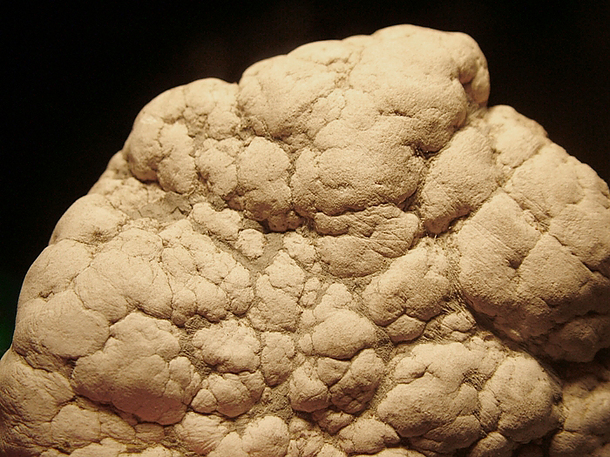
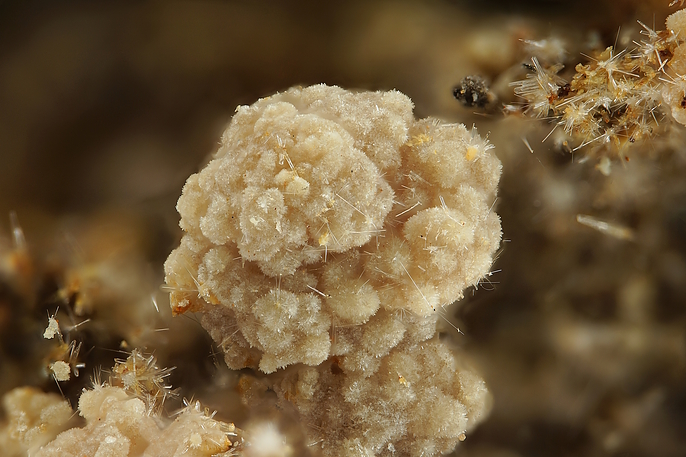
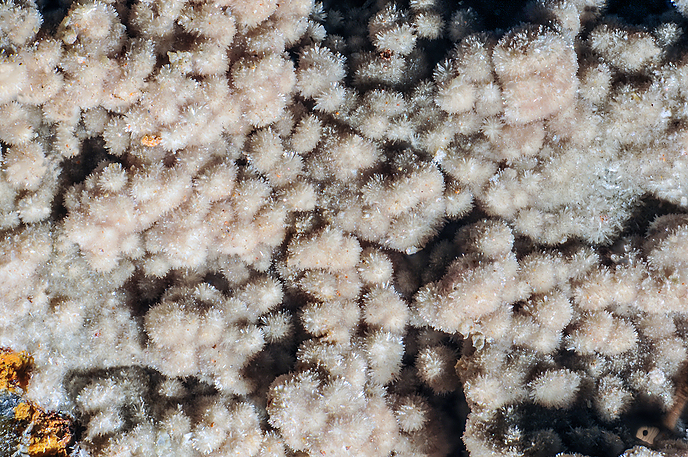
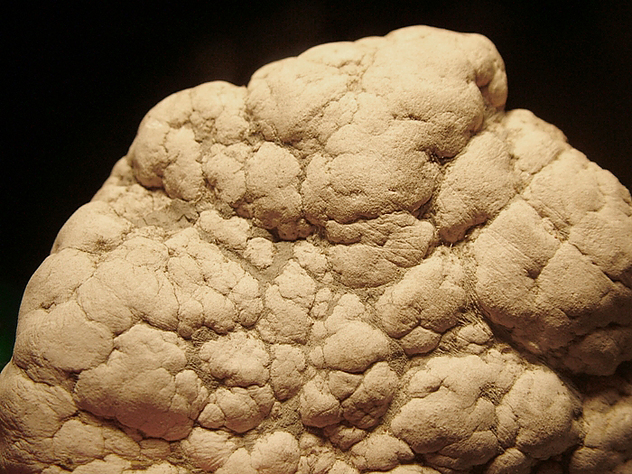
Soft, powdery microcrystalline aggregates of metacolloidal nature, to 30 cm. Under the microscope, colourless or yellowish needles with average dimension 0.5 x 0.007 mm.
Place of Conservation of Type Material:
Charles University, Prague, Czech Republic, 14240
National Museum, Prague, Czech Republic, 53411.
National Museum, Prague, Czech Republic, 53411.
Geological Setting of Type Material:
A recent weathering product of arsenopyrite in dumps.
Synonyms of Bukovskýite
Other Language Names for Bukovskýite
Dutch:Bukovskýiet
Common Associates
Associated Minerals Based on Photo Data:
Related Minerals - Strunz-mindat Grouping
| 8.DB. | Arangasite | Al2F(PO4)(SO4) · 9H2O |
| 8.DB. | Höslite | Fe3+3(VO4)2(SO4)(OH)(H2O)4 · 3H2O |
| 8.DB. | Camaronesite | [Fe3+(H2O)2(PO3OH)]2(SO4) · 1-2H2O |
| 8.DB.05 | Destinezite | Fe3+2(PO4)(SO4)(OH) · 6H2O |
| 8.DB.05 | Pitticite | (Fe, AsO4, H2O) (?) |
| 8.DB.05 | Diadochite | Fe3+2(PO4)(SO4)(OH) · 6H2O |
| 8.DB.07 | Wilhelmgümbelite | ZnFe2+Fe3+3(PO4)3(OH)4(H2O)5 · 2H2O |
| 8.DB.07 | Schmidite | [Zn2(Fe3+,Mn2+)2Fe3+(PO4)3(OH)3(H2O)6] · 2H2O |
| 8.DB.07 | Wildenauerite | Zn(Fe3+,Mn2+)2MnFe3+(PO4)3(OH)3(H2O)6 · 2H2O |
| 8.DB.10 | Vashegyite | Al11(PO4)9(OH)6 · 38H2O |
| 8.DB.15 | Schoonerite | ZnMn2+Fe2+2Fe3+(PO4)3(OH)2 · 9H2O |
| 8.DB.20 | Sinkankasite | Mn2+Al(PO3OH)2(OH) · 6H2O |
| 8.DB.25 | Mitryaevaite | Al6(PO4)((P,S)O3(OH,O))2F2(OH)2 · 14.5H2O |
| 8.DB.30 | Sanjuanite | Al2(PO4)(SO4)(OH) · 9H2O |
| 8.DB.35 | Sarmientite | Fe3+2(AsO4)(SO4)(OH) · 5H2O |
| 8.DB.40 | Manganflurlite | ZnMn2+3Fe3+(PO4)3(OH)2(H2O)7 · 2H2O |
| 8.DB.40 | Flurlite | Zn3Mn2+Fe3+(PO4)3(OH)2 · 9H2O |
| 8.DB.42 | Bohuslavite | Fe3+4(PO4)3(SO4)(OH) · nH2O |
| 8.DB.45 | Zýkaite | Fe3+4(AsO4)3(SO4)(OH) · 15H2O |
| 8.DB.47 | Lapeyreite | Cu3O[AsO3(OH)]2 · 0.75H2O |
| 8.DB.50 | Rossiantonite | Al3(PO4)(SO4)2(OH)2(H2O)14 |
| 8.DB.50 | Giniite | Fe2+Fe3+4(PO4)3(OH)5 · 2H2O |
| 8.DB.52 | Arctowskite | Al9(PO4)8(OH)3 · 27H2O |
| 8.DB.55 | Sasaite | (Al,Fe3+)14(PO4)11(SO4)(OH)7 · 83H2O |
| 8.DB.60 | Mcauslanite | Fe3Al2(PO4)3(PO3OH)F · 18H2O |
| 8.DB.65 | Goldquarryite | CuCd2Al3(PO4)4F2(H2O,F)2 · 10H2O |
| 8.DB.70 | Birchite | Cd2Cu2(PO4)2(SO4) · 5H2O |
| 8.DB.75 | Braithwaiteite | NaCu5(Ti4+Sb5+)(AsO4)4(HAsO4)2O2 · 8H2O |
Other Information
Notes:
Readily decomposes in HCl.
Health Risks:
No information on health risks for this material has been entered into the database. You should always treat mineral specimens with care.
Internet Links for Bukovskýite
mindat.org URL:
https://www.mindat.org/min-798.html
Please feel free to link to this page.
Please feel free to link to this page.
Search Engines:
External Links:
References for Bukovskýite
Reference List:
Loun, Jan, Čejka, Jiří, Sejkora, Jiří, Plášil, Jakub, Novák, Milan, Frost, Ray L., Palmer, Sara J., Keeffe, Eloise C. (2011) A Raman spectroscopic study of bukovskýite Fe2(AsO4)(SO4)(OH)·7H2O, a mineral phase with a significant role in arsenic migration. Journal of Raman Spectroscopy, 42 (7) 1596-1600 doi:10.1002/jrs.2900
Majzlan, Juraj, Lazic, Biljana, Armbruster, Thomas, Johnson, Michel B., White, Mary Anne, Fisher, Robert A., Plášil, Jakub, Loun, Jan, Škoda, Radek, Novák, Milan (2012) Crystal structure, thermodynamic properties, and paragenesis of bukovskýite, Fe2(AsO4)(SO4)(OH)·9H2O. Journal of Mineralogical and Petrological Sciences, 107 (3) 133-148 doi:10.2465/jmps.110930
Localities for Bukovskýite
 symbol to view information about a locality.
The
symbol to view information about a locality.
The Locality List
 - This locality has map coordinates listed.
- This locality has estimated coordinates.
ⓘ - Click for references and further information on this occurrence.
? - Indicates mineral may be doubtful at this locality.
- This locality has map coordinates listed.
- This locality has estimated coordinates.
ⓘ - Click for references and further information on this occurrence.
? - Indicates mineral may be doubtful at this locality.
 - Good crystals or important locality for species.
 - World class for species or very significant.
(TL) - Type Locality for a valid mineral species.
(FRL) - First Recorded Locality for everything else (eg varieties).
- World class for species or very significant.
(TL) - Type Locality for a valid mineral species.
(FRL) - First Recorded Locality for everything else (eg varieties).
All localities listed without proper references should be considered as questionable.
Austria | |
| C.Auer (2021) |
| Blass et al. (1998) +2 other references |
| Pichler (2009) | |
| Strasser (1989) |
| Strasser (1989) |
| Paar et al. (1993) +1 other reference |
| C.Auer (2020) |
| C.Auer (2021) | |
| Collection of NHM |
Canada | |
| Paktunc et al. (2013) |
Czech Republic (TL) | |
| Acta Univ. Carolinae (1967) +1 other reference |
| Aleš Tomek specimen | |
Germany | |
| Witzke et al. (1993) +1 other reference |
Ghana | |
| Craw et al. (2014) |
Greece | |
| Fritz Schreiber collection (analysed by Branko Rieck) |
| Wendel (2000) +1 other reference | |
| Triantafyllidis et al. (2006) |
Italy | |
| Siuk-AMI /University of Turin - Italy |
New Zealand | |
| Haffert et al. (2010) |
Russia | |
| Kudrin et al. (2021) |
UK | |
| Rollinson et al. (2017) |
USA | |
| Bowell et al. (2005) |
Kaňk, Kutná Hora, Kutná Hora District, Central Bohemian Region, Czech Republic