|
|
School District Demographic Economic Characteristics
-- ACS 2015 Household Composition, Education, Language, Related Attributes
Decision-Making Information

|
ProximityOne
information resources & solutions
(888) DMI-SOLN
(888) 364-7656
Visual analysis with ProximityOne tools
click graphic for info; hover to pause
|
Data Analytics Blog
Mapping Statistical Data
Support & Technical Assistance
help using these resources
|
Percent college graduates is one measure useful to characterize educational attainment and social characteristics for a school district.
How do school districts of interest compare to peers or in a region?
There are other measures that need to be considered for a more comprehensive look at social characteristics.
This section is focused on tools, resources and methods that you can use to access, integrate and analyze school district social characteristics.
These data uniquely provide insights into many of the most important social characteristics.
This section updates in 2018.
One of Four Sections.
Approximately 600 subject matter items from the American Community Survey ACS 2015
database are included in these four pages/tables:
• General Demographics
• Social Characteristics -- this page/section -- view table
• Economic Characteristics
• Housing Characteristics
School Districts with Highest Percent College Graduates
Use the interactive table below in this section to examine social housing characteristics of school districts.
Below is a list of the 10 school districts having the highest percent college graduates developed using the interactive tables.
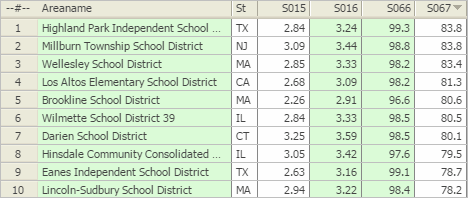
- ranked on item S067 -- percent population ages 25 years and over who are college graduates.
Patterns of Educational Attainment by School District
- percent college graduate (item S067 in table)
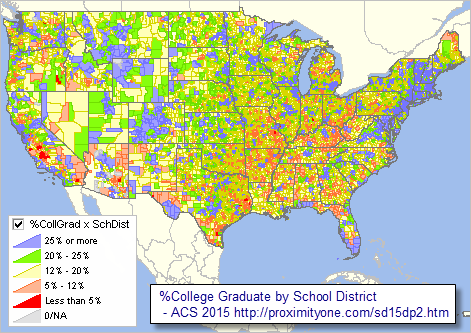
- view developed with CVGIS software
using related GIS project and datasets.
Related Sections
See related tables for Census Tracts |
ZIP Codes |
State, Metro & County.
Using the Interactive Table
Use the interactive table below to view, query, rank, compare
social characteristics of the population for these areas.
The scroll box shown below lists each of the subject matter items available for each area via the ranking table.
In the subject matter items scrollbox, subject matter items are organized into to mini-tables with related items.
The number at the left of the subject matter item is also used as the short name for the subject matter item
in the column header in the ranking table.
Affiliate Geography. This page introduces use of the Affiliate Geography. The rightmost column (Geo2) may contain a school district code
for an affiliated school district. In this table, the affiliated code is only active for
Phoenix Union High School District, AZ and affiliated, intersecting in this case,
13 elementary school districts. Click ShowAll button and then the Affiliate button below the table. The table refreshes showing only these districts.
Now this set of districts may be sorted and viewed as a group. Affiliated geography coding is useful to examine related elementary/secondary districts (that overlap
the same geography).
Social Characteristics Items
.. a few item names and numbers changed from previous year data/table.
HOUSEHOLDS BY TYPE
S001 Total households
S002 Family households (families)
S003 With own children of the householder under 18 years
S004 Married-couple family
S005 With own children of the householder under 18 years
S006 Male householder, no wife present, family
S007 With own children of the householder under 18 years
S008 Female householder, no husband present, family
S009 With own children of the householder under 18 years
S010 Nonfamily households
S011 Householder living alone
S012 65 years and over
S013 Households with one or more people under 18 years
S014 Households with one or more people 65 years and over
S015 Average household size
S016 Average family size
RELATIONSHIP
S017 Population in households
S018 Householder
S019 Spouse
S020 Child
S021 Other relatives
S022 Nonrelatives
S023 Unmarried partner
MARITAL STATUS
S024 Males 15 years and over
S025 Never married
S026 Now married, except separated
S027 Separated
S028 Widowed
S029 Divorced
S030 Females 15 years and over
S031 Never married
S032 Now married, except separated
S033 Separated
S034 Widowed
S035 Divorced
FERTILITY
S036 Number of women 15 to 50 years old who had a birth in the past 12 months
S037 Unmarried women (widowed, divorced, and never married)
S038 Per 1,000 unmarried women
S039 Per 1,000 women 15 to 50 years old
S040 Per 1,000 women 15 to 19 years old
S041 Per 1,000 women 20 to 34 years old
S042 Per 1,000 women 35 to 50 years old
GRANDPARENTS
S043 Number of grandparents living with own grandchildren under 18 years
S044 Grandparents responsible for grandchildren
Years responsible for grandchildren
S045 Less than 1 year
S046 1 or 2 years
S047 3 or 4 years
S048 5 or more years
S049 Number of grandparents responsible for own grandchildren under 18 years
S050 Who are female
S051 Who are married
SCHOOL ENROLLMENT
S052 Population 3 years and over enrolled in school
S053 Nursery school, preschool
S054 Kindergarten
S055 Elementary school (grades 1-8)
S056 High school (grades 9-12)
S057 College or graduate school
EDUCATIONAL ATTAINMENT
S058 Population 25 years and over
S059 Less than 9th grade
S060 9th to 12th grade, no diploma
S061 High school graduate (includes equivalency)
S062 Some college, no degree
S063 Associate's degree
S064 Bachelor's degree
S065 Graduate or professional degree
S066 Percent high school graduate or higher
S067 Percent bachelor's degree or higher
VETERAN STATUS
S068 Civilian population 18 years and over
S069 Civilian veterans
DISABILITY STATUS OF THE CIVILIAN NONINSTITUTIONALIZED POPULATION
S070 Total Civilian Noninstitutionalized Population
S071 With a disability
S072 Under 18 years
S073 With a disability
S074 18 to 64 years
S075 With a disability
S076 65 years and over
S077 With a disability
RESIDENCE 1 YEAR AGO
S078 Population 1 year and over
S079 Same house
S080 Different house in the U.S.
S081 Same county
S082 Different county
S083 Same state
S084 Different state
S085 Abroad
PLACE OF BIRTH
S086 Total population
S087 Native
S088 Born in United States
S089 State of residence
S090 Different state
S091 Born in Puerto Rico, U.S. Island areas, or born abroad to American parent(s)
S092 Foreign born
U.S. CITIZENSHIP STATUS
S093 Foreign-born population
S094 Naturalized U.S. citizen
S095 Not a U.S. citizen
YEAR OF ENTRY
S096 Population born outside the United States
S097 Native
S098 Entered 2010 or later
S099 Entered before 2010
S100 Foreign born
S101 Entered 2010 or later
S102 Entered before 2010
WORLD REGION OF BIRTH OF FOREIGN BORN
S103 Foreign-born population, excluding population born at sea
S104 Europe
S105 Asia
S106 Africa
S107 Oceania
S108 Latin America
S109 Northern America
LANGUAGE SPOKEN AT HOME
S110 Population 5 years and over
S111 English only
S112 Language other than English
S113 Speak English less than "very well"
S114 Spanish
S115 Speak English less than "very well"
S116 Other Indo-European languages
S117 Speak English less than "very well"
S118 Asian and Pacific Islander languages
S119 Speak English less than "very well"
S120 Other languages
S121 Speak English less than "very well"
ANCESTRY
S122 Total population
S123 American
S124 Arab
S125 Czech
S126 Danish
S127 Dutch
S128 English
S129 French (except Basque)
S130 French Canadian
S131 German
S132 Greek
S133 Hungarian
S134 Irish
S135 Italian
S136 Lithuanian
S137 Norwegian
S138 Polish
S139 Portuguese
S140 Russian
S141 Scotch-Irish
S142 Scottish
S143 Slovak
S144 Subsaharan African
S145 Swedish
S146 Swiss
S147 Ukrainian
S148 Welsh
S149 West Indian (excluding Hispanic origin groups)
COMPUTERS AND INTERNET USE
S150 Total households
S151 With a computer
S152 With a broadband Internet subscription
School District Social Characteristics -- interactive table
ACS 2015 5-year estimates
Click ShowAll button between Find/Queries. Use mouseover on column header to view column description.
See usage notes below table. See related tables -- http://proximityone.com/rankingtables.htm.
Usage Notes
• If table not showing any rows; click ShowAll button below table.
• Use vertical and horizontal scroll bars to navigate up/down or left/right.
• Adjust column widths using column divider between header cells.
• CBSA> button -- use to select districts in a specified metro/CBSA
.. get metro 5-character code here
.. paste the 5-character metro code in the edit box to right of CBSA> button.
.. overwriting the value 19100.
.. click the CBSA> button ... table refreshes with all districts in specified metro.
• Find Name> button -- use to select district based on exact spelling of partial name in column 1.
.. Key in exact up/low case spelling of partial name of district in the edit box to right of Find Name> button.
.. overwriting the value Dallas.
.. click the Find Name> button ... table refreshes with all districts with matched spelling in column 1.
• Selected columns -- "AvgHHSize.AvgFamSize.%HSGrad.%CollGrad" below the table to show only these columns;
.. click "All columns" button to restore view to all columns.
• All items are estimates for 2015.
• Click ShowAll button between specific area queries.
• Cells with negative value could not be estimated (for this geography and this time frame).
Selecting Districts within a Metro/CBSA
Proceed with these steps to view districts within a selected metro/CBSA:
• Click ShowAll button below table.
• Click AvgHHSize.. button below table.
• Click the CBSA> button (using the default Dallas metro CBSA code 19100).
• Click the S067 column header; click again to sort in other direction.
Examine a metro of interest -- get metro 5-character code here ..
• Click ShowAll button below table.
• Click AvgHHSize.. button below table.
• Paste the 5-character metro code in the edit box to right of CBSA> button.
.. overwriting the value 19100.
• Click the CBSA> button.
• Click the S067 column header; click again to sort in other direction.
Use
find codes/names
to determine census tract, city/place, school district etc. geocode/area name based on address.
Importance of Demographic-Economic Data
The importance of understanding the demographic-economic make-up and trends can hardly be overstated.
Community and educational challenges and opportunities are shaped by demographic-economic dynamics.
Only by knowing "where we are" can we develop the most effective plans for improvement.
The American Community Survey provides "richer" demographic-economic characteristics for national scope
wide-ranging geographic areas.
While Census 2010 provides data similar to those items in the General Demographics section, only ACS
sourced data provide details on topics such as income and poverty,
labor force and employment, housing value and costs, educational participation and attainment, language spoken
at home, among many related items. The approximate 600 items accessible via the dataset
are supplemented by a wide range of additional subject matter.
These data are updated annually in December of each year for each/all political/statistical areas,
including school districts, census tracts, ZIP code areas and block groups.
ProximityOne User Group
Join the ProximityOne User Group
to keep up-to-date with new developments relating to metros and component geography decision-making information resources.
Receive updates and access to tools and resources available only to members.
Use this form to join the User Group.
Support Using these Resources
Learn more about accessing and using demographic-economic data and related analytical tools.
Join us in a Data Analytics Lab session.
There is no fee for these one-hour Web sessions.
Each informal session is focused on a specific topic.
The open structure also provides for Q&A and discussion of application issues of interest to participants.
Additional Information
ProximityOne develops geodemographic-economic data and analytical tools and helps organizations knit together and use diverse data in a decision-making and analytical framework. We develop custom demographic/economic estimates and projections, develop geographic and geocoded address files, and assist with impact and geospatial analyses.
Wide-ranging organizations use our tools (software, data, methodologies) to analyze their own data integrated with other data.
Follow ProximityOne on Twitter at www.twitter.com/proximityone.
Contact us (888-364-7656) with questions about data covered in this section or to discuss
custom estimates, projections or analyses for your areas of interest.

