


Portal:Computer programming

The Computer Programming Portal

Computer programming or coding is the composition of sequences of instructions, called programs, that computers can follow to perform tasks. It involves designing and implementing algorithms, step-by-step specifications of procedures, by writing code in one or more programming languages. Programmers typically use high-level programming languages that are more easily intelligible to humans than machine code, which is directly executed by the central processing unit. Proficient programming usually requires expertise in several different subjects, including knowledge of the application domain, details of programming languages and generic code libraries, specialized algorithms, and formal logic.
Auxiliary tasks accompanying and related to programming include analyzing requirements, testing, debugging (investigating and fixing problems), implementation of build systems, and management of derived artifacts, such as programs' machine code. While these are sometimes considered programming, often the term software development is used for this larger overall process – with the terms programming, implementation, and coding reserved for the writing and editing of code per se. Sometimes software development is known as software engineering, especially when it employs formal methods or follows an engineering design process. (Full article...)
Selected articles -
-
 SNOBOL (StriNg Oriented and symBOlic Language) is a series of programming languages developed between 1962 and 1967 at AT&T Bell Laboratories by David J. Farber, Ralph Griswold and Ivan P. Polonsky, culminating in SNOBOL4. It was one of a number of text-string-oriented languages developed during the 1950s and 1960s; others included COMIT and TRAC. Despite the similar name, it is entirely unlike COBOL.
SNOBOL4 stands apart from most programming languages of its era by having patterns as a first-class data type, a data type whose values can be manipulated in all ways permitted to any other data type in the programming language, and by providing operators for pattern concatenation and alternation. SNOBOL4 patterns are a type of object and admit various manipulations, much like later object-oriented languages such as JavaScript whose patterns are known as regular expressions. In addition SNOBOL4 strings generated during execution can be treated as programs and either interpreted or compiled and executed (as in the eval function of other languages).
SNOBOL4 was quite widely taught in larger U.S. universities in the late 1960s and early 1970s and was widely used in the 1970s and 1980s as a text manipulation language in the humanities. (Full article...) -

Erlang (/ˈɜːrlæŋ/ UR-lang) is a general-purpose, concurrent, functional high-level programming language, and a garbage-collected runtime system. The term Erlang is used interchangeably with Erlang/OTP, or Open Telecom Platform (OTP), which consists of the Erlang runtime system, several ready-to-use components (OTP) mainly written in Erlang, and a set of design principles for Erlang programs.
The Erlang runtime system is designed for systems with these traits:- Distributed
- Fault-tolerant
- Soft real-time
- Highly available, non-stop applications
- Hot swapping, where code can be changed without stopping a system.
-

Julia is a dynamic general-purpose programming language. As a high-level language, distinctive aspects of Julia's design include a type system with parametric polymorphism, the use of multiple dispatch as a core programming paradigm, just-in-time compilation and a parallel garbage collection implementation. Notably, Julia does not support classes with encapsulated methods but instead relies on the types of all of a function's arguments to determine which method will be called.
By default, Julia is run similarly to scripting languages, using its runtime, and allows for interactions, but Julia programs can also be compiled to small binary standalone executables (or to small libraries for e.g. Python), with e.g. the JuliaC.jl compiler.
Julia programs can reuse libraries from other languages, and vice versa. Julia has interoperability with C, C++, Fortran, Rust, Python, and R. Additionally, some Julia packages have bindings to be used from Python and R as libraries. (Full article...) -
Linus Benedict Torvalds (born 28 December 1969) is a Finnish and American software engineer who is the creator and lead developer of the Linux kernel since 1991. He also created the distributed version control system Git.
Torvalds was one of the recipients of the 2012 Millennium Technology Prize "in recognition of his creation of a new open source operating system for computers leading to the widely used Linux kernel". He is also the recipient of the 2014 IEEE Computer Society Computer Pioneer Award and the 2018 IEEE Masaru Ibuka Consumer Electronics Award. (Full article...) -

R is a programming language for statistical computing and data visualization. It has been widely adopted in the fields of data mining, bioinformatics, data analysis, and data science.
The core R language is extended by a large number of software packages, which contain reusable code, documentation, and sample data. Some of the most popular R packages are in the tidyverse collection, which enhances functionality for visualizing, transforming, and modelling data, as well as improves the ease of programming (according to the authors and users).
R is free and open-source software distributed under the GNU General Public License. The language is implemented primarily in C, Fortran, and R itself. Precompiled executables are available for the major operating systems (including Linux, MacOS, and Microsoft Windows). (Full article...) -
Programming languages are used for controlling the behavior of a machine (often a computer). Like natural languages, programming languages follow rules for syntax and semantics.
There are thousands of programming languages and new ones are created every year. Few languages ever become sufficiently popular that they are used by more than a few people, but professional programmers may use dozens of languages in a career.
Most programming languages are not standardized by an international (or national) standard, even widely used ones, such as Perl or Standard ML (despite the name). Notable standardized programming languages include ALGOL, C, C++, JavaScript (under the name ECMAScript), Smalltalk, Prolog, Common Lisp, Scheme (IEEE standard), ISLISP, Ada, Fortran, COBOL, SQL, and XQuery. (Full article...) -

Carphone Warehouse is a mobile phone retailer based in London, United Kingdom. In August 2014 the company became a subsidiary of Currys plc (previously named "Dixons Carphone"), which was formed by the merger of its former parent Carphone Warehouse Group with Dixons Retail. Prior to this merger, Carphone Warehouse Group was listed on the London Stock Exchange, and was a constituent of the FTSE 250 Index. Following the closure of all stand-alone UK stores in April 2020, all remaining Carphone Warehouse UK outlets were within branches of Currys PC World. In April 2021, the Carphone Warehouse business in Ireland (including all stand-alone and co-located branches and the website) was closed with immediate effect. Currys continued to use the Carphone Warehouse brand in the United Kingdom, online and, until 2021, inside Currys stores. (Full article...) -

Ada is a structured, statically typed, imperative, and object-oriented high-level programming language, inspired by Pascal and other languages. It has built-in language support for design by contract (DbC), extremely strong typing, explicit concurrency, tasks, synchronous message passing, protected objects, and non-determinism. Ada improves code safety and maintainability by using the compiler to find errors in favor of runtime errors. Ada is an international technical standard, jointly defined by the International Organization for Standardization (ISO), and the International Electrotechnical Commission (IEC). As of May 2023[update], the standard, ISO/IEC 8652:2023, is called Ada 2022 informally.
Ada was originally designed by a team led by French computer scientist Jean Ichbiah of Honeywell under contract to the United States Department of Defense (DoD) from 1977 to 1983 to supersede over 450 programming languages then used by the DoD. Ada was named after Ada Lovelace (1815–1852), who has been credited as the first computer programmer. (Full article...) -

Python is a high-level, general-purpose programming language. Its design philosophy emphasizes code readability with the use of significant indentation. Python is dynamically type-checked and garbage-collected. It supports multiple programming paradigms, including structured (particularly procedural), object-oriented and functional programming.
Guido van Rossum began working on Python in the late 1980s as a successor to the ABC programming language. Python 3.0, released in 2008, was a major revision and not completely backward-compatible with earlier versions. Beginning with Python 3.5, capabilities and keywords for typing were added to the language, allowing optional static typing. As of 2026[update], the Python Software Foundation supports Python 3.10, 3.11, 3.12, 3.13, and 3.14, following the project's annual release cycle and five-year support policy. Python 3.15 is currently in the alpha development phase, and the stable release is expected to come out in October 2026." Earlier versions in the 3.x series have reached end-of-life and no longer receive security updates.
Python has gained widespread use in the machine learning community. It is widely taught as an introductory programming language. Since 2003, Python has consistently ranked in the top ten of the most popular programming languages in the TIOBE Programming Community Index, which ranks based on searches in 24 platforms. (Full article...) -

Block diagram of a basic computer with uniprocessor CPU. Black lines indicate the flow of control signals, whereas red lines indicate the flow of processor instructions and data. Arrows indicate the direction of flow.
In computer science and computer engineering, a computer architecture is the structure of a computer system made from component parts. It can sometimes be a high-level description that ignores details of the implementation. At a more detailed level, the description may include the instruction set architecture design, microarchitecture design, logic design, and implementation. (Full article...) -
Paul Gardner Allen (January 21, 1953 – October 15, 2018) was an American businessman, computer programmer, and investor. He co-founded Microsoft Corporation with his childhood friend Bill Gates in 1975, which was followed by the microcomputer revolution of the 1970s and 1980s. Allen was also known for discovering the wrecks of various famous warships, like the IJN Musashi and USS Indianapolis, and was ranked as one of the richest people in American history by Forbes, with an estimated net worth of $20.3 billion at the time of his death in October 2018.
Allen quit from day-to-day work at Microsoft in early 1983 after a Hodgkin lymphoma diagnosis, remaining on its board as vice-chairman. He and his sister, Jody Allen, founded Vulcan Inc. in 1986, a privately held company that managed his business and philanthropic efforts. At the time of his death, he had a multi-billion dollar investment portfolio, including technology and media companies, scientific research, real estate holdings, private space flight ventures and stakes in other sectors. He owned the Seattle Seahawks of the National Football League and the Portland Trail Blazers of the National Basketball Association, and was part-owner of the Seattle Sounders FC of Major League Soccer. Under Allen's helm, the Seahawks won Super Bowl XLVIII and made it to two other Super Bowls (XL and XLIX). In 2000 he resigned from his position on Microsoft's board and assumed the post of senior strategy advisor to the company's management team.
Allen founded the Allen Institutes for Brain Science, Artificial Intelligence, and Cell Science, as well as companies like Stratolaunch Systems and Apex Learning. He gave more than $2 billion to causes such as education, wildlife and environmental conservation, the arts, healthcare and community services. In 2004, he funded the first crewed private spaceplane with SpaceShipOne. He received numerous awards and honors and was listed among the Time 100 Most Influential People in the World in 2007 and 2008. (Full article...) -

A Blender screenshot displaying Suzanne, a 3D test model
Computer graphics deals with generating images and art with the aid of computers. Computer graphics is a core technology in digital photography, film, video games, digital art, cell phone and computer displays, and many specialized applications. A great deal of specialized hardware and software has been developed, with the displays of most devices being driven by computer graphics hardware. It is a vast and recently developed area of computer science. The phrase was coined in 1960 by computer graphics researchers Verne Hudson and William Fetter of Boeing. It is often abbreviated as CG, or typically in the context of film as computer generated imagery (CGI). The non-artistic aspects of computer graphics are the subject of computer science research.
Computer graphics is responsible for displaying art and image data effectively and meaningfully to the consumer. It is also used for processing image data received from the physical world, such as photo and video content. Computer graphics development has had a significant impact on many types of media and has revolutionized animation, movies, advertising, and video games in general. (Full article...) -

A computer lab contains a wide range of information technology elements, including hardware, software and storage systems.
Information technology (IT) is the study or use of computers, telecommunication systems and other devices to create, process, store, retrieve and transmit information. While the term is commonly used to refer to computers and computer networks, it also encompasses other information distribution technologies such as television and telephones. Information technology is an application of computer science and computer engineering.
An information technology system (IT system) is generally an information system, a communications system, or, more specifically speaking, a computer system — including all hardware, software, and peripheral equipment — operated by a limited group of IT users, and an IT project usually refers to the commissioning and implementation of an IT system. IT systems play a vital role in facilitating efficient data management, enhancing communication networks, and supporting organizational processes across various industries. Successful IT projects require meticulous planning and ongoing maintenance to ensure optimal functionality and alignment with organizational objectives.
Although humans have been storing, retrieving, manipulating, analysing and communicating information since the earliest writing systems were developed, the term information technology in its modern sense first appeared in a 1958 article published in the Harvard Business Review; authors Harold J. Leavitt and Thomas L. Whisler commented that "the new technology does not yet have a single established name. We shall call it information technology (IT)." Their definition consists of three categories: techniques for processing, the application of statistical and mathematical methods to decision-making, and the simulation of higher-order thinking through computer programs. (Full article...) -

Tcl (pronounced "tickle" or "TCL"; originally Tool Command Language) is a high-level, general-purpose, interpreted, dynamic programming language. It was designed with the goal of being very simple but powerful. Tcl casts everything into the mold of a command, even programming constructs like variable assignment and procedure definition. Tcl supports multiple programming paradigms, including object-oriented, imperative, functional, and procedural styles.
It is commonly embedded into C applications for rapid prototyping, scripted applications, GUIs, and testing. Tcl interpreters are available for many operating systems, allowing Tcl code to run on a wide variety of systems. Because Tcl is a very compact language, it is used on embedded systems platforms, both in its full form and in several other small-footprint versions.
The popular combination of Tcl with the Tk extension is referred to as Tcl/Tk (pronounced "tickle teak"[citation needed] or "tickle TK") and enables building a graphical user interface (GUI) natively in Tcl. Tcl/Tk is included in the standard Python installation in the form of Tkinter. (Full article...) -
Structured Query Language (SQL) (pronounced /ˌɛsˌkjuˈɛl/ S-Q-L; or alternatively as /ˈsiːkwəl/ ⓘ "sequel") is a domain-specific language used to manage data, especially in a relational database management system (RDBMS). It is particularly useful in handling structured data, i.e., data incorporating relations among entities and variables.
Introduced in the 1970s, SQL offered two main advantages over older read–write APIs such as ISAM or VSAM. Firstly, it introduced the concept of accessing many records with one single command. Secondly, it eliminates the need to specify how to reach a record, i.e., with or without an index.
Originally based upon relational algebra and tuple relational calculus, SQL consists of many types of statements, which may be informally classed as sublanguages, commonly: data query language (DQL), data definition language (DDL), data control language (DCL), and data manipulation language (DML). (Full article...)


_(cropped).jpeg)


.jpg)


Selected images
-
 A head crash on a modern hard disk drive
 -

-
 A view of the GNU nano Text editor version 6.0
 -
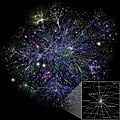 Partial map of the Internet based on the January 15, 2005 data found on opte.org. Each line is drawn between two nodes, representing two IP addresses. The length of the lines are indicative of the delay between those two nodes. This graph represents less than 30% of the Class C networks reachable by the data collection program in early 2005.
 -
 Ada Lovelace was an English mathematician and writer, chiefly known for her work on Charles Babbage's proposed mechanical general-purpose computer, the Analytical Engine. She was the first to recognize that the machine had applications beyond pure calculation, and to have published the first algorithm intended to be carried out by such a machine. As a result, she is often regarded as the first computer programmer.
 -
 Bill Gosper's Glider Gun in action
 -
 GNOME Shell, GNOME Clocks, Evince, gThumb and GNOME Files at version 3.30, in a dark theme
 -
 Margaret Hamilton standing next to the navigation software that she and her MIT team produced for the Apollo Project.
 -
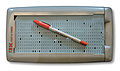 An IBM Port-A-Punch punched card
 -
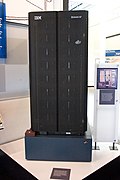 Deep Blue was a chess-playing expert system run on a unique purpose-built IBM supercomputer. It was the first computer to win a game, and the first to win a match, against a reigning world champion under regular time controls. Photo taken at the Computer History Museum.
 -
 Output from a (linearised) shallow water equation model of water in a bathtub. The water experiences 5 splashes which generate surface gravity waves that propagate away from the splash locations and reflect off of the bathtub walls.
 -
 Stephen Wolfram is a British-American computer scientist, physicist, and businessman. He is known for his work in computer science, mathematics, and in theoretical physics.
 -
 Grace Hopper at the UNIVAC keyboard, c. 1960. Grace Brewster Murray: American mathematician and rear admiral in the U.S. Navy who was a pioneer in developing computer technology, helping to devise UNIVAC I. the first commercial electronic computer, and naval applications for COBOL (common-business-oriented language).
 -
 This image (when viewed in full size, 1000 pixels wide) contains 1 million pixels, each of a different color.
 -
 A lone house. An image made using Blender 3D.
 -
-
 Partial view of the Mandelbrot set. Step 1 of a zoom sequence: Gap between the "head" and the "body" also called the "seahorse valley".
 -
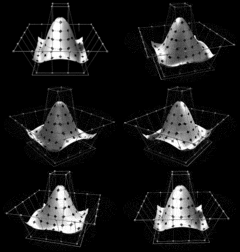 Animation of a Non-uniform rational B-spline surface. Modeled and rendered in Cobalt.


_in_Dark_theme.png)


Did you know? -

- ... that a "hacker" with blog posts written by ChatGPT was at the center of an online scavenger hunt promoting Avenged Sevenfold's album Life Is but a Dream...?
- ... that the study of selection algorithms has been traced to an 1883 work of Lewis Carroll on how to award second place in single-elimination tournaments?
- ... that both Thackeray and Longfellow bought paintings by Fanny Steers?
- ... that the programming language Acorn System BASIC was so non-standard that one commenter suggested that using it on the BBC Micro would be a disaster?
- ... that it took a particle accelerator and machine-learning algorithms to extract the charred text of PHerc. Paris. 4 without unrolling it?
- ... that the Gale–Shapley algorithm was used to assign medical students to residencies long before its publication by Gale and Shapley?
Subcategories

WikiProjects

- There are many users interested in computer programming, join them.
Computer programming news
No recent news
Topics


Related portals


Associated Wikimedia
The following Wikimedia Foundation sister projects provide more on this subject:
-
 Commons
Free media repository -
 Wikibooks
Free textbooks and manuals -
 Wikidata
Free knowledge base -
 Wikinews
Free-content news -
 Wikiquote
Collection of quotations -
 Wikisource
Free-content library -
 Wikiversity
Free learning tools -
 Wiktionary
Dictionary and thesaurus


